Artículo
The transition from memory retrieval to extinction
Cammarota, Martin Pablo ; Barros, Daniela M.; Vianna, Mónica R.M.; Bevilaqua, Lia R.M.; Coitinho, Adriana; Szapiro, Germán; Izquierdo, Luciana A.; Medina, Jorge Horacio
; Izquierdo, Iván
; Barros, Daniela M.; Vianna, Mónica R.M.; Bevilaqua, Lia R.M.; Coitinho, Adriana; Szapiro, Germán; Izquierdo, Luciana A.; Medina, Jorge Horacio
; Izquierdo, Iván
; Barros, Daniela M.; Vianna, Mónica R.M.; Bevilaqua, Lia R.M.; Coitinho, Adriana; Szapiro, Germán; Izquierdo, Luciana A.; Medina, Jorge Horacio
; Izquierdo, Iván
Fecha de publicación:
12/2004
Editorial:
Academia Brasileira de Ciencias
Revista:
Anais da Academia Brasileira de Ciencias
ISSN:
0001-3765
e-ISSN:
1678-2690
Idioma:
Inglés
Tipo de recurso:
Artículo publicado
Clasificación temática:
Resumen
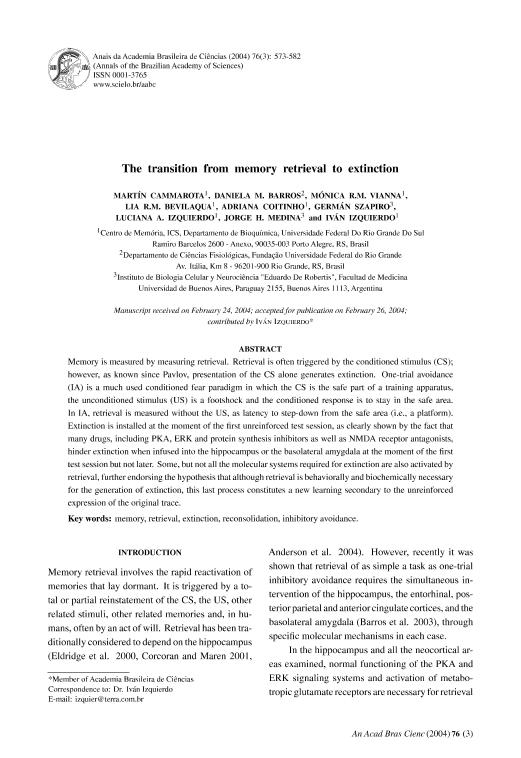
Memory is measured by measuring retrieval. Retrieval is often triggered by the conditioned stimulus (CS); however, as known since Pavlov, presentation of the CS alone generates extinction. One-trial avoidance (IA) is a much used conditioned fear paradigm in which the CS is the safe part of a training apparatus, the unconditioned stimulus (US) is a footshock and the conditioned response is to stay in the safe area. In IA, retrieval is measured without the US, as latency to step-down from the safe area (i.e., a platform). Extinction is installed at the moment of the first unreinforced test session, as clearly shown by the fact that many drugs, including PKA, ERK and protein synthesis inhibitors as well as NMDA receptor antagonists, hinder extinction when infused into the hippocampus or the basolateral amygdala at the moment of the first test session but not later. Some, but not all the molecular systems required for extinction are also activated by retrieval, further endorsing the hypothesis that although retrieval is behaviorally and biochemically necessary for the generation Of extinction, this last process constitutes a new learning secondary to the unreinforced expression of the original trace.
Palabras clave:
EXTINCTION
,
INHIBITORY AVOIDANCE
,
MEMORY
,
RECONSOLIDATION
,
RETRIEVAL
Archivos asociados

Tamaño:
108.6Kb
Formato:
PDF
Licencia
 Excepto donde se diga explícitamente, este item se publica bajo la siguiente descripción:
Creative Commons Attribution-NonCommercial 2.5 Unported (CC BY-NC 2.5)
Excepto donde se diga explícitamente, este item se publica bajo la siguiente descripción:
Creative Commons Attribution-NonCommercial 2.5 Unported (CC BY-NC 2.5)
Identificadores
Colecciones
Articulos(IBCN)
Articulos de INST.DE BIOLO.CEL.Y NEURCS."PROF.E.DE ROBERTIS"
Articulos de INST.DE BIOLO.CEL.Y NEURCS."PROF.E.DE ROBERTIS"
Citación
Cammarota, Martin Pablo; Barros, Daniela M.; Vianna, Mónica R.M.; Bevilaqua, Lia R.M.; Coitinho, Adriana; et al.; The transition from memory retrieval to extinction; Academia Brasileira de Ciencias; Anais da Academia Brasileira de Ciencias; 76; 3; 12-2004; 573-582
Compartir


Altmétricas