Mostrar el registro sencillo del ítem
dc.contributor.author
Ahtiainen, Pettieri
dc.contributor.author
Sharp, Victoria
dc.contributor.author
Rulli, Susana Beatriz
dc.contributor.author
Rivero Müller, Adolfo
dc.contributor.author
Mamaeva, Veronika
dc.contributor.author
Röytta, Matias
dc.contributor.author
Huhtaniemi, Ilpo
dc.date.available
2017-04-03T15:01:05Z
dc.date.issued
2010-06-03
dc.identifier.citation
Ahtiainen, Pettieri; Sharp, Victoria; Rulli, Susana Beatriz; Rivero Müller, Adolfo; Mamaeva, Veronika; et al.; Enhanced LH action in transgenic female mice expressing hCGbeta-subunit induces pituitary prolactinomas; the role of high progesterone levels; Bioscientifica; Endocrine - Related Cancer; 17; 3; 3-6-2010; 611-621
dc.identifier.issn
1351-0088
dc.identifier.uri
http://hdl.handle.net/11336/14673
dc.description.abstract
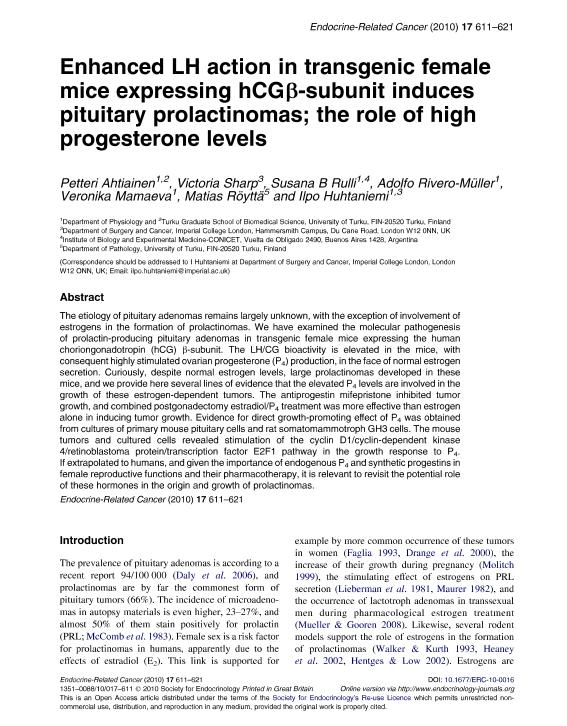
The etiology of pituitary adenomas remains largely unknown, with the exception of involvement of estrogens in the formation of prolactinomas. We have examined the molecular pathogenesis of prolactin-producing pituitary adenomas in transgenic female mice expressing the human choriongonadotropin (hCG) beta-subunit. The LH/CG bioactivity is elevated in the mice, with consequent highly stimulated ovarian progesterone (P(4)) production, in the face of normal estrogen secretion. Curiously, despite normal estrogen levels, large prolactinomas developed in these mice, and we provide here several lines of evidence that the elevated P(4) levels are involved in the growth of these estrogen-dependent tumors. The antiprogestin mifepristone inhibited tumor growth, and combined postgonadectomy estradiol/P(4) treatment was more effective than estrogen alone in inducing tumor growth. Evidence for direct growth-promoting effect of P(4) was obtained from cultures of primary mouse pituitary cells and rat somatomammotroph GH3 cells. The mouse tumors and cultured cells revealed stimulation of the cyclin D1/cyclin-dependent kinase 4/retinoblastoma protein/transcription factor E2F1 pathway in the growth response to P(4). If extrapolated to humans, and given the importance of endogenous P(4) and synthetic progestins in female reproductive functions and their pharmacotherapy, it is relevant to revisit the potential role of these hormones in the origin and growth of prolactinomas.
dc.format
application/pdf
dc.language.iso
eng
dc.publisher
Bioscientifica
dc.rights
info:eu-repo/semantics/openAccess
dc.rights.uri
https://creativecommons.org/licenses/by-nc-sa/2.5/ar/
dc.subject
Chorionic Gonadotropin
dc.subject
Prolactinoma
dc.subject
Transgenic Mice
dc.subject
Pituitary
dc.subject.classification
Fisiología
dc.subject.classification
Medicina Básica
dc.subject.classification
CIENCIAS MÉDICAS Y DE LA SALUD
dc.title
Enhanced LH action in transgenic female mice expressing hCGbeta-subunit induces pituitary prolactinomas; the role of high progesterone levels
dc.type
info:eu-repo/semantics/article
dc.type
info:ar-repo/semantics/artículo
dc.type
info:eu-repo/semantics/publishedVersion
dc.date.updated
2017-03-23T18:23:02Z
dc.identifier.eissn
1479-6821
dc.journal.volume
17
dc.journal.number
3
dc.journal.pagination
611-621
dc.journal.pais
Reino Unido
dc.journal.ciudad
Bristol
dc.description.fil
Fil: Ahtiainen, Pettieri. University of Turku; Finlandia
dc.description.fil
Fil: Sharp, Victoria. Imperial College London; Reino Unido
dc.description.fil
Fil: Rulli, Susana Beatriz. Consejo Nacional de Investigaciones Científicas y Técnicas. Instituto de Biología y Medicina Experimental (i); Argentina; Argentina. University of Turku; Finlandia
dc.description.fil
Fil: Rivero Müller, Adolfo. University of Turku; Finlandia
dc.description.fil
Fil: Mamaeva, Veronika. University of Turku; Finlandia
dc.description.fil
Fil: Röytta, Matias. University of Turku; Finlandia
dc.description.fil
Fil: Huhtaniemi, Ilpo. University of Turku; Finlandia. Imperial College London; Reino Unido
dc.journal.title
Endocrine - Related Cancer
dc.relation.alternativeid
info:eu-repo/semantics/altIdentifier/url/http://erc.endocrinology-journals.org/content/17/3/611.long
dc.relation.alternativeid
info:eu-repo/semantics/altIdentifier/url/https://www.ncbi.nlm.nih.gov/pmc/articles/PMC2881531/
dc.relation.alternativeid
info:eu-repo/semantics/altIdentifier/doi/http://dx.doi.org/ 10.1677/ERC-10-0016
Archivos asociados

Tamaño:
207.6Kb
Formato:
PDF