Artículo
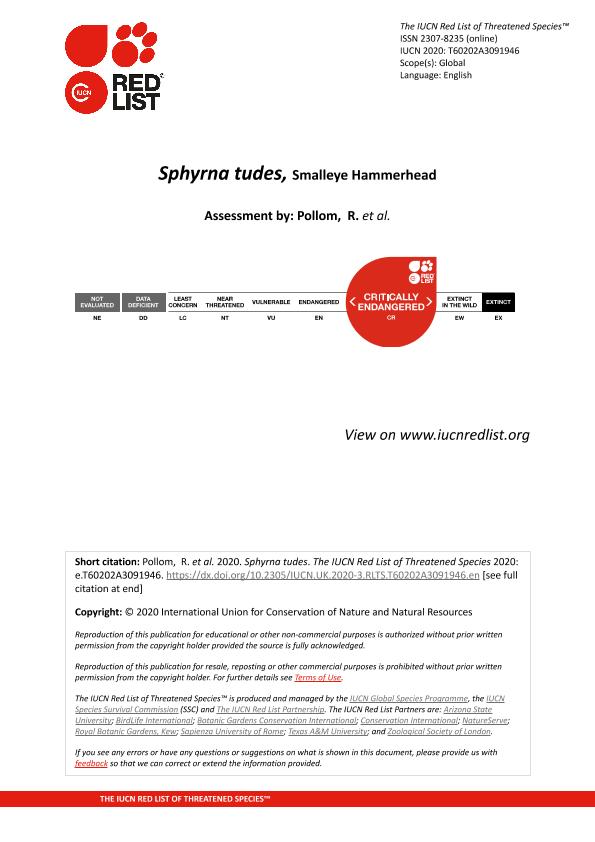
Sphyrna tudes, Smalleye Hammerhead
Pollom, R.; Barreto, R.; Charvet, P.; Chiaramonte, Gustavo Enrique ; Cuevas, J. M.; Faria, V.; Herman, K.; Lasso Alcala, O.; Marcante, F.; Mejía Falla, P.A.; Montealegre Quijano, S.; Motta, F.; Navia, A. F.; Nunes, J.; Paesch, L.; Rincon, G.
; Cuevas, J. M.; Faria, V.; Herman, K.; Lasso Alcala, O.; Marcante, F.; Mejía Falla, P.A.; Montealegre Quijano, S.; Motta, F.; Navia, A. F.; Nunes, J.; Paesch, L.; Rincon, G.
Fecha de publicación:
12/2020
Editorial:
International Union for Conservation of Nature
Revista:
The IUCN Red List of Threatened Species
ISSN:
2307-8235
e-ISSN:
2307-8235
Idioma:
Inglés
Tipo de recurso:
Artículo publicado
Clasificación temática:
Resumen
The Smalleye Hammerhead (Sphyrna tudes) is a medium-sized (to 150 cm total length) shark that occurs in the Western Central and Southwest Atlantic from Colombia to the Rio de La Plata, Argentina. It inhabits inshore waters over the continental shelf at depths of 5–80 m. It is captured in intense and largely unmanaged commercial and artisanal beach seines, gillnets, longlines, and trawls throughout its geographic range. This shark is targeted or retained as bycatch for its meat, which is consumed or sold locally. There are few data on population reduction but these intensive unmanaged fisheries are suspected to have caused reductions and possibly local extinctions throughout this species' range. For example, in Brazil, this hammerhead has not been recorded in 35 years from Ceará state and it is considered by local fishers to be depleted in Bahia state. This shark is supposed to be strictly protected in Brazil, but it is clear that it is still landed and traded in various states. Overall, due to intense and largely unmanaged fisheries across its range, lack of refuge at depth, suspected declines in many areas and local extinctions suspected from an absence of records (despite continued sampling and observation), and its relatively unproductive life history, it is suspected that the Smalleye Hammerhead has undergone a population reduction of >80% over the past three generations (37 years), and it is assessed as Critically Endangered A2bd.
Palabras clave:
Chondrichthyes
,
Carcharhiniformes
,
Sphyrnidae
,
Smalleye Hammerhead
Archivos asociados

Tamaño:
1.463Mb
Formato:
PDF
Licencia
 Excepto donde se diga explícitamente, este item se publica bajo la siguiente descripción:
Creative Commons Attribution-NonCommercial-ShareAlike 2.5 Unported (CC BY-NC-SA 2.5)
Excepto donde se diga explícitamente, este item se publica bajo la siguiente descripción:
Creative Commons Attribution-NonCommercial-ShareAlike 2.5 Unported (CC BY-NC-SA 2.5)
Identificadores
Colecciones
Articulos(MACNBR)
Articulos de MUSEO ARG.DE CS.NAT "BERNARDINO RIVADAVIA"
Articulos de MUSEO ARG.DE CS.NAT "BERNARDINO RIVADAVIA"
Citación
Pollom, R.; Barreto, R.; Charvet, P.; Chiaramonte, Gustavo Enrique; Cuevas, J. M.; et al.; Sphyrna tudes, Smalleye Hammerhead; International Union for Conservation of Nature; The IUCN Red List of Threatened Species; 12-2020; 1-14
Compartir

