Artículo
Myliobatis ridens, Shortnose Eagle Ray
Pollom, R.; Barreto, R.; Charvet, P.; Chiaramonte, Gustavo Enrique ; Cuevas, J. M.; Herman, K.; Montealegre Quijano, S.; Motta, F.; Paesch, L.; Rincon, G.
; Cuevas, J. M.; Herman, K.; Montealegre Quijano, S.; Motta, F.; Paesch, L.; Rincon, G.
Fecha de publicación:
12/2020
Editorial:
International Union for Conservation of Nature
Revista:
The IUCN Red List of Threatened Species
ISSN:
2307-8235
Idioma:
Inglés
Tipo de recurso:
Artículo publicado
Clasificación temática:
Resumen
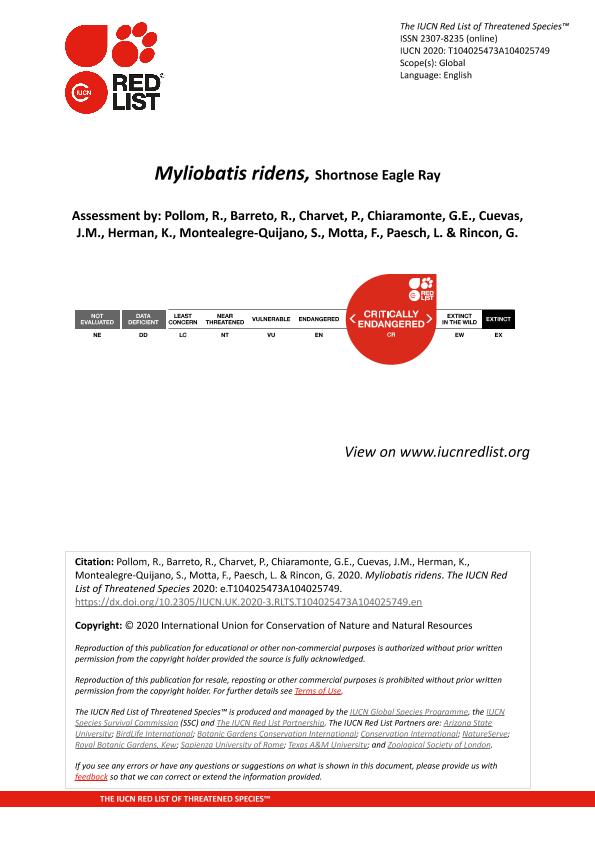
The Shortnose Eagle Ray (Myliobatis ridens) is a medium-sized (to 70 cm disc width) ray that occurs in the Southwest Atlantic from Santa Catarina, Brazil, to Buenos Aires Province, Argentina. It inhabits inshore bays and estuaries at depths of 5-47 m. It is captured in intense and largely unmanaged artisanal gillnet and beach seine fisheries throughout much of its geographic range. The meat from this species may be consumed or sold locally or discarded. In Rio Grande do Sul, beach seine and drifting gillnet fisheries are intense and capture this species in relatively high numbers. Eagle rays, in general, declined in that state by 91% in research trawls between 1974 and 2005. Gillnets are used in Argentina to target elasmobranchs, including eagle rays, and it is suspected that declines have occurred there due to overfishing. Overall, due to the level of intense and largely unmanaged fisheries that operate throughout its range, its lack of refuge at depth, its unproductive life history, and noted declines in eagle rays in general, it is suspected that the Shortnose Eagle Ray has undergone a population reduction of >80% over the past three generations (18 years), and it is assessed as Critically Endangered A2bd.
Palabras clave:
Chondrichthyes
,
Myliobatiformes
,
Myliobatidae
,
Shortnose Eagle Ray
Archivos asociados

Tamaño:
1.274Mb
Formato:
PDF
Licencia
 Excepto donde se diga explícitamente, este item se publica bajo la siguiente descripción:
Creative Commons Attribution-NonCommercial-ShareAlike 2.5 Unported (CC BY-NC-SA 2.5)
Excepto donde se diga explícitamente, este item se publica bajo la siguiente descripción:
Creative Commons Attribution-NonCommercial-ShareAlike 2.5 Unported (CC BY-NC-SA 2.5)
Identificadores
Colecciones
Articulos(MACNBR)
Articulos de MUSEO ARG.DE CS.NAT "BERNARDINO RIVADAVIA"
Articulos de MUSEO ARG.DE CS.NAT "BERNARDINO RIVADAVIA"
Citación
Pollom, R.; Barreto, R.; Charvet, P.; Chiaramonte, Gustavo Enrique; Cuevas, J. M.; et al.; Myliobatis ridens, Shortnose Eagle Ray; International Union for Conservation of Nature; The IUCN Red List of Threatened Species; 12-2020; 1-12
Compartir

