Mostrar el registro sencillo del ítem
dc.contributor.author
Santomero, Lucila
dc.contributor.author
Jara, Valentina
dc.contributor.author
Lorenzotti, Micaela Luz
dc.date.available
2021-10-26T15:55:05Z
dc.date.issued
2020-12
dc.identifier.citation
Santomero, Lucila; Jara, Valentina; Lorenzotti, Micaela Luz; Género, gramática e inclusión en el español de la Argentina: intervenciones para la clase de lengua; Universitat Politècnica de València; Lenguaje y Textos; 52; 12-2020; 101-111
dc.identifier.issn
1133-4770
dc.identifier.uri
http://hdl.handle.net/11336/145113
dc.description.abstract
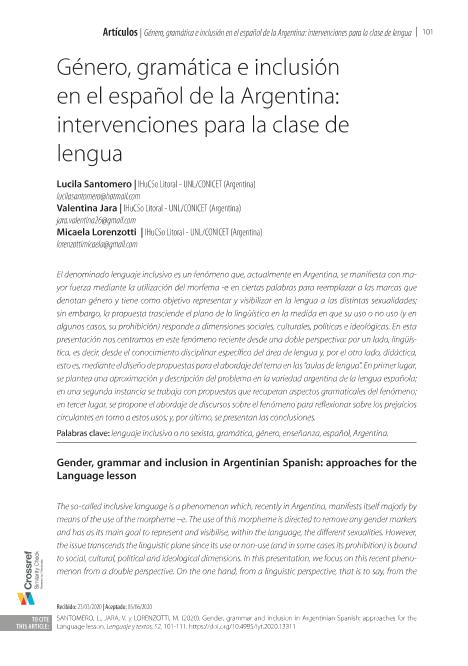
El denominado lenguaje inclusivo es un fenómeno que, actualmente en Argentina, se manifiesta con mayor fuerza mediante la utilización del morfema -e en ciertas palabras para reemplazar a las marcas que denotan género y tiene como objetivo representar y visibilizar en la lengua a las distintas sexualidades; sin embargo, la propuesta trasciende el plano de lo lingüístico en la medida en que su uso o no uso (y en algunos casos, su prohibición) responde a dimensiones sociales, culturales, políticas e ideológicas. En esta presentación nos centramos en este fenómeno reciente desde una doble perspectiva: por un lado, lingüística, es decir, desde el conocimiento disciplinar específico del área de lengua y, por el otro lado, didáctica, esto es, mediante el diseño de propuestas para el abordaje del tema en las "aulas de lengua". En primer lugar, se plantea una aproximación y descripción del problema en la variedad argentina de la lengua española; en una segunda instancia se trabaja con propuestas que recuperan aspectos gramaticales del fenómeno; en tercer lugar, se propone el abordaje de discursos sobre el fenómeno para reflexionar sobre los prejuicios circulantes en torno a estos usos; y, por último, se presentan las conclusiones.
dc.description.abstract
The so-called inclusive language is a phenomenon which, recently in Argentina, manifests itself majorly by means of the use of the morpheme –e. The use of this morpheme is directed to remove any gender markers and has as its main goal to represent and visibilise, within the language, the different sexualities. However, the issue transcends the linguistic plane since its use or non-use (and in some cases its prohibition) is bound to social, cultural, political and ideological dimensions. In this presentation, we focus on this recent phenomenon from a double perspective. On the one hand, from a linguistic perspective, that is to say, from the specific disciplinary knowledge of the language. On the other, from a didactic perspective, meaning, through the design of proposals to address the issue inside “language classrooms”. In the first place, an approach and a description of the issue in the Argentine variety of the Spanish language are put forward. Second, proposals dealing with the grammatical aspects of the phenomenon are addressed. Third, we propose an approach on the discourses surrounding the topic in order to reflect on the prejudices involving these practices. Last of all, conclusions are put forward.
dc.format
application/pdf
dc.language.iso
spa
dc.publisher
Universitat Politècnica de València
dc.rights
info:eu-repo/semantics/openAccess
dc.rights.uri
https://creativecommons.org/licenses/by-nc-nd/2.5/ar/
dc.subject
LENGUAJE INCLUSIVO O NO SEXISTA
dc.subject
GRAMÁTICA
dc.subject
ENSEÑANZA
dc.subject
ARGENTINA
dc.subject.classification
Lingüística
dc.subject.classification
Lengua y Literatura
dc.subject.classification
HUMANIDADES
dc.title
Género, gramática e inclusión en el español de la Argentina: intervenciones para la clase de lengua
dc.title
Gender, grammar and inclusion in Argentinian Spanish: approaches for the Language lesson
dc.type
info:eu-repo/semantics/article
dc.type
info:ar-repo/semantics/artículo
dc.type
info:eu-repo/semantics/publishedVersion
dc.date.updated
2021-09-07T14:04:35Z
dc.identifier.eissn
2530-0075
dc.journal.number
52
dc.journal.pagination
101-111
dc.journal.pais
España
dc.journal.ciudad
Valencia
dc.description.fil
Fil: Santomero, Lucila. Universidad Nacional del Litoral. Instituto de Humanidades y Ciencias Sociales del Litoral. Consejo Nacional de Investigaciones Científicas y Técnicas. Centro Científico Tecnológico Conicet - Santa Fe. Instituto de Humanidades y Ciencias Sociales del Litoral; Argentina
dc.description.fil
Fil: Jara, Valentina. Universidad Nacional del Litoral. Instituto de Humanidades y Ciencias Sociales del Litoral. Consejo Nacional de Investigaciones Científicas y Técnicas. Centro Científico Tecnológico Conicet - Santa Fe. Instituto de Humanidades y Ciencias Sociales del Litoral; Argentina
dc.description.fil
Fil: Lorenzotti, Micaela Luz. Universidad Nacional del Litoral. Instituto de Humanidades y Ciencias Sociales del Litoral. Consejo Nacional de Investigaciones Científicas y Técnicas. Centro Científico Tecnológico Conicet - Santa Fe. Instituto de Humanidades y Ciencias Sociales del Litoral; Argentina
dc.journal.title
Lenguaje y Textos
dc.relation.alternativeid
info:eu-repo/semantics/altIdentifier/url/https://polipapers.upv.es/index.php/lyt/article/view/13311
dc.relation.alternativeid
info:eu-repo/semantics/altIdentifier/doi/https://doi.org/10.4995/lyt.2020.13311
Archivos asociados

Tamaño:
205.8Kb
Formato:
PDF