Mostrar el registro sencillo del ítem
dc.contributor.author
Carlson, J.
dc.contributor.author
Charvet, P.
dc.contributor.author
Avalos Castillo, C.
dc.contributor.author
Blanco Parra, M. P.
dc.contributor.author
Briones Bell lloch, A.
dc.contributor.author
Cardeñosa, D.
dc.contributor.author
Chiaramonte, Gustavo Enrique
dc.contributor.author
Cuevas, J.M.
dc.contributor.author
Derrick, D.
dc.contributor.author
Espinoza, E.
dc.contributor.author
Mejía Falla, P. A.
dc.contributor.author
Morales Saldaña, J. M.
dc.contributor.author
Motta, F.
dc.contributor.author
Naranjo Elizondo, B.
dc.contributor.author
Pacoureau, N.
dc.contributor.author
Paesch, L.
dc.contributor.author
Pérez Jiménez, J. C.
dc.contributor.author
Rincon, G.
dc.contributor.author
Schneider, E. V. C.
dc.contributor.author
Simpson, N. J.
dc.contributor.author
Talwar, B. S.
dc.contributor.author
Pollom, R.
dc.date.available
2021-10-20T17:10:49Z
dc.date.issued
2020-12
dc.identifier.citation
Carlson, J.; Charvet, P.; Avalos Castillo, C.; Blanco Parra, M. P.; Briones Bell lloch, A.; et al.; Myliobatis goodei, southern eagle ray; International Union for Conservation of Nature; The IUCN Red List of Threatened Species; 12-2020; 1-14
dc.identifier.issn
2307-8235
dc.identifier.uri
http://hdl.handle.net/11336/144515
dc.description.abstract
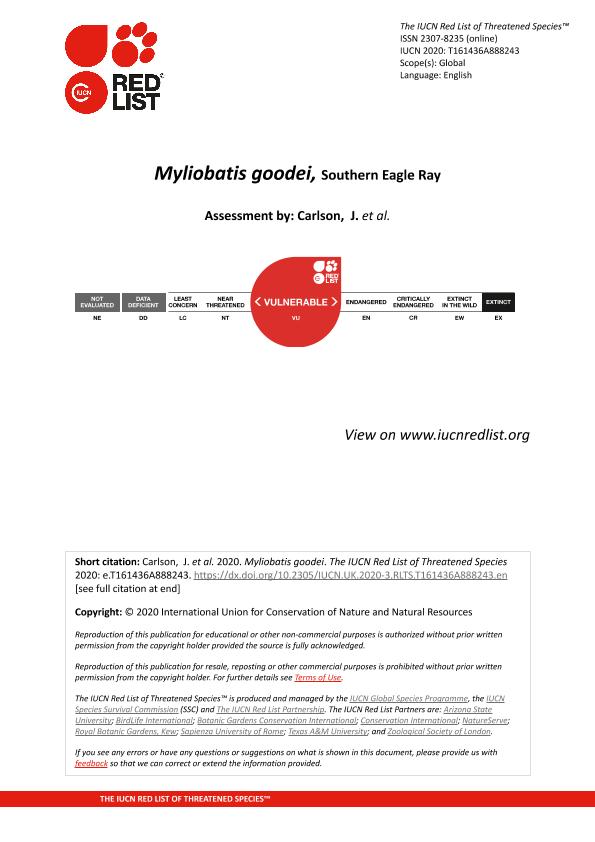
The Southern Eagle Ray (Myliobatis goodei) is a medium-sized (to at least 115 cm DW) coastal eagle ray that occurs in the Western Central and Southwest Atlantic Oceans from South Carolina and Florida, USA and Quintana Roo, Mexico to San Jorge Gulf, Santa Cruz, Argentina. It inhabits continental shelves from inshore to depths of 181 m. It is captured using artisanal longlines, gillnets, beach seines, and in industrial shrimp trawls. This species is inferred to be stable or increasing in the Western Central Atlantic, based on its similarity to the Bullnose Eagle Ray (Myliobatis freminvillei). In the Southwest Atlantic artisanal fisheries are intense, further there are largely unmanaged commercial trawl and longline fisheries in many areas. In Brazil, landings of eagle rays have been reduced by 60% over 2000?2012 in Santa Catarina State, and a reduction of 91% in Rio Grande do Sul since the 1980s. This inshore eagle ray has no refuge at depth and is exposed to intense and often unmanaged fishing pressure throughout the Atlantic South American portion of its range and there it is suspected that this species has undergone a population reduction of >80% over the past three generation lengths (44 years), but is stable in the Western Central Atlantic. Overall, based its range with the almost all threats found in the Southwest Atlantic, the suspected low productivity of the species, this species is suspected to have undergone a population reduction of 30 49% in three generation lengths (44 years) due to levels of exploitation, and it is assessed as Vulnerable A2d.
dc.format
application/pdf
dc.language.iso
eng
dc.publisher
International Union for Conservation of Nature
dc.rights
info:eu-repo/semantics/openAccess
dc.rights.uri
https://creativecommons.org/licenses/by-nc-sa/2.5/ar/
dc.subject
Chondrichthyes
dc.subject
Myliobatiformes
dc.subject
Myliobatidae
dc.subject
Southern Eagle Ray
dc.subject.classification
Conservación de la Biodiversidad
dc.subject.classification
Ciencias Biológicas
dc.subject.classification
CIENCIAS NATURALES Y EXACTAS
dc.title
Myliobatis goodei, southern eagle ray
dc.type
info:eu-repo/semantics/article
dc.type
info:ar-repo/semantics/artículo
dc.type
info:eu-repo/semantics/publishedVersion
dc.date.updated
2021-09-07T18:06:10Z
dc.journal.pagination
1-14
dc.journal.pais
Reino Unido
dc.description.fil
Fil: Carlson, J.. National Marine Fisheries Service; Estados Unidos
dc.description.fil
Fil: Charvet, P.. Universidade Federal do Paraná; Brasil
dc.description.fil
Fil: Avalos Castillo, C.. Fundación Mundo Azul; Guatemala
dc.description.fil
Fil: Blanco Parra, M. P.. Universidad de Quintana Roo; México
dc.description.fil
Fil: Briones Bell lloch, A.. Dirección de Regulaciones Pesqueras y Ciencias; Cuba
dc.description.fil
Fil: Cardeñosa, D.. Florida International University; Estados Unidos
dc.description.fil
Fil: Chiaramonte, Gustavo Enrique. Consejo Nacional de Investigaciones Científicas y Técnicas. Oficina de Coordinación Administrativa Parque Centenario. Museo Argentino de Ciencias Naturales "Bernardino Rivadavia". Estación Hidrobiológica de Puerto Quequén (sede Quequén); Argentina
dc.description.fil
Fil: Cuevas, J.M.. Wildlife Conservation Society; Estados Unidos
dc.description.fil
Fil: Derrick, D.. University Fraser Simon; Canadá
dc.description.fil
Fil: Espinoza, E.. Galapagos National Park Directorate; Ecuador
dc.description.fil
Fil: Mejía Falla, P. A.. Wildlife Conservation Society; Estados Unidos
dc.description.fil
Fil: Morales Saldaña, J. M.. Smithsonian Tropical Research Institute; Panamá
dc.description.fil
Fil: Motta, F.. Universidade Federal Do Sao Paulo; Brasil
dc.description.fil
Fil: Naranjo Elizondo, B.. Universidad de Costa Rica; Costa Rica
dc.description.fil
Fil: Pacoureau, N.. University Fraser Simon; Canadá
dc.description.fil
Fil: Paesch, L.. Direccion Nacional de Recursos Acuaticos ; Uruguay
dc.description.fil
Fil: Pérez Jiménez, J. C.. El Colegio de la Frontera del Sur; México
dc.description.fil
Fil: Rincon, G.. Universidade Federal Do Maranhao.; Brasil
dc.description.fil
Fil: Schneider, E. V. C.. Cape Eleuthera Institute; Bahamas
dc.description.fil
Fil: Simpson, N. J.. Salvageblue; San Vicente y las Granadinas
dc.description.fil
Fil: Talwar, B. S.. Florida International University; Estados Unidos
dc.description.fil
Fil: Pollom, R.. University Fraser Simon; Canadá
dc.journal.title
The IUCN Red List of Threatened Species
dc.relation.alternativeid
info:eu-repo/semantics/altIdentifier/url/https://www.iucnredlist.org/species/161436/888243
dc.relation.alternativeid
info:eu-repo/semantics/altIdentifier/doi/https://dx.doi.org/10.2305/IUCN.UK.2020-3.RLTS.T161436A888243.en
Archivos asociados

Tamaño:
1.420Mb
Formato:
PDF