Mostrar el registro sencillo del ítem
dc.contributor.author
Di Sisto, Romina Paula
dc.contributor.author
Rossignoli, Natalia Lorena
dc.date.available
2021-10-18T14:30:00Z
dc.date.issued
2020-07
dc.identifier.citation
Di Sisto, Romina Paula; Rossignoli, Natalia Lorena; Centaur and giant planet crossing populations: origin and distribution; Springer; Celestial Mechanics & Dynamical Astronomy; 132; 6-7; 7-2020; 1-39
dc.identifier.issn
0923-2958
dc.identifier.uri
http://hdl.handle.net/11336/144066
dc.description.abstract
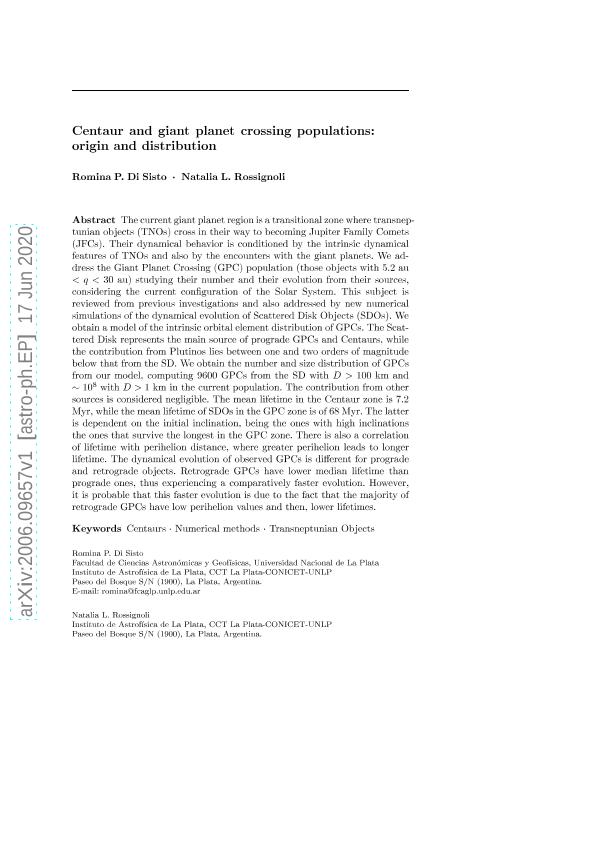
The current giant planet region is a transitional zone where transneptunian objects (TNOs) cross in their way to becoming Jupiter Family Comets. Their dynamical behavior is conditioned by the intrinsic dynamical features of TNOs and also by the encounters with the giant planets. We address the Giant Planet Crossing (GPC) population (those objects with 5.2 au 100km and ∼ 10 8 with D>1km in the current population. The contribution from other sources is considered negligible. The mean lifetime in the Centaur zone is 7.2 Myr, while the mean lifetime of SDOs in the GPC zone is of 68 Myr. The latter is dependent on the initial inclination, being the ones with high inclinations the ones that survive the longest in the GPC zone. There is also a correlation of lifetime with perihelion distance, where greater perihelion leads to longer lifetime. The dynamical evolution of observed GPCs is different for prograde and retrograde objects. Retrograde GPCs have lower median lifetime than prograde ones, thus experiencing a comparatively faster evolution. However, it is probable that this faster evolution is due to the fact that the majority of retrograde GPCs have low perihelion values and then, lower lifetimes.
dc.format
application/pdf
dc.language.iso
eng
dc.publisher
Springer
dc.rights
info:eu-repo/semantics/openAccess
dc.rights.uri
https://creativecommons.org/licenses/by-nc-sa/2.5/ar/
dc.subject
CENTAURS
dc.subject
NUMERICAL METHODS
dc.subject
TRANSNEPTUNIAN OBJECTS
dc.subject.classification
Astronomía
dc.subject.classification
Ciencias Físicas
dc.subject.classification
CIENCIAS NATURALES Y EXACTAS
dc.title
Centaur and giant planet crossing populations: origin and distribution
dc.type
info:eu-repo/semantics/article
dc.type
info:ar-repo/semantics/artículo
dc.type
info:eu-repo/semantics/publishedVersion
dc.date.updated
2021-08-17T15:54:06Z
dc.journal.volume
132
dc.journal.number
6-7
dc.journal.pagination
1-39
dc.journal.pais
Alemania
dc.description.fil
Fil: Di Sisto, Romina Paula. Consejo Nacional de Investigaciones Científicas y Técnicas. Centro Científico Tecnológico Conicet - La Plata. Instituto de Astrofísica La Plata. Universidad Nacional de La Plata. Facultad de Ciencias Astronómicas y Geofísicas. Instituto de Astrofísica La Plata; Argentina
dc.description.fil
Fil: Rossignoli, Natalia Lorena. Universidad Nacional de La Plata; Argentina. Consejo Nacional de Investigaciones Científicas y Técnicas. Centro Científico Tecnológico Conicet - La Plata. Instituto de Astrofísica La Plata. Universidad Nacional de La Plata. Facultad de Ciencias Astronómicas y Geofísicas. Instituto de Astrofísica La Plata; Argentina
dc.journal.title
Celestial Mechanics & Dynamical Astronomy
dc.relation.alternativeid
info:eu-repo/semantics/altIdentifier/arxiv/https://arxiv.org/abs/2006.09657v1
dc.relation.alternativeid
info:eu-repo/semantics/altIdentifier/doi/http://dx.doi.org/10.1007/s10569-020-09971-7
Archivos asociados

Tamaño:
988.7Kb
Formato:
PDF