Artículo
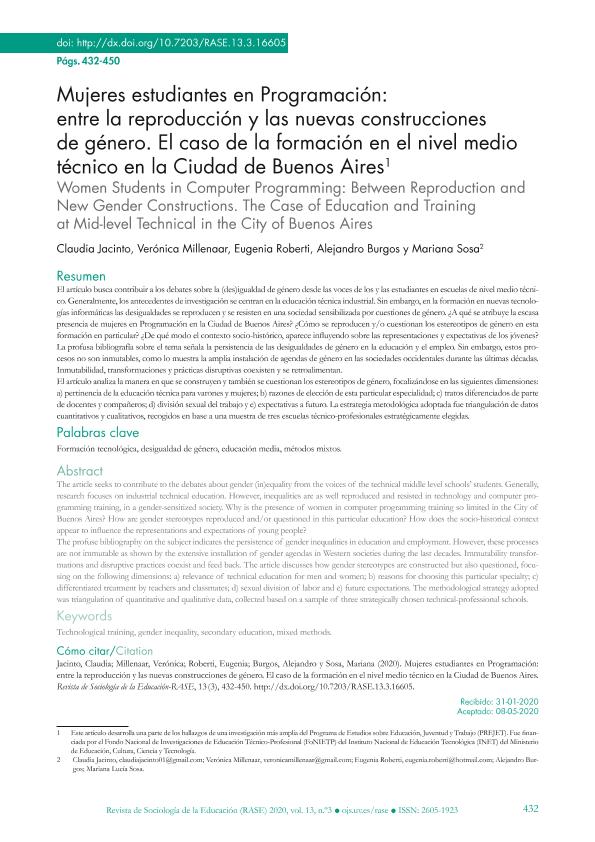
El artículo busca contribuir a los debates sobre la (des)igualdad de género desde las voces de los y las estudiantes en escuelas de nivel medio técnico. Generalmente, los antecedentes de investigación se centran en la educación técnica industrial. Sin embargo, en la formación en nuevas tecnologías informáticas las desigualdades se reproducen y se resisten en una sociedad sensibilizada por cuestiones de género. ¿A qué se atribuye la escasa presencia de mujeres en Programación en la Ciudad de Buenos Aires? ¿Cómo se reproducen y/o cuestionan los estereotipos de género en esta formación en particular? ¿De qué modo el contexto socio-histórico, aparece influyendo sobre las representaciones y expectativas de los jóvenes?La profusa bibliografía sobre el tema señala la persistencia de las desigualdades de género en la educación y el empleo. Sin embargo, estos procesos no son inmutables, como lo muestra la amplia instalación de agendas de género en las sociedades occidentales durante las últimas décadas. Inmutabilidad, transformaciones y prácticas disruptivas coexisten y se retroalimentan. El artículo analiza la manera en que se construyen y también se cuestionan los estereotipos de género, focalizándose en las siguientes dimensiones: a) pertinencia de la educación técnica para varones y mujeres; b) razones de elección de esta particular especialidad; c) tratos diferenciados de parte de docentes y compañeros; d) división sexual del trabajo y e) expectativas a futuro. La estrategia metodológica adoptada fue triangulación de datos cuantitativos y cualitativos, recogidos en base a una muestra de tres escuelas técnico-profesionales estratégicamente elegidas. The article seeks to contribute to the debates about gender (in)equality from the voices of the technical middle level schools’ students. Generally, research focuses on industrial technical education. However, inequalities are as well reproduced and resisted in technology and computer programming training, in a gender-sensitized society. Why is the presence of women in computer programming training so limited in the City of Buenos Aires? How are gender stereotypes reproduced and/or questioned in this particular education? How does the socio-historical context appear to influence the representations and expectations of young people? The profuse bibliography on the subject indicates the persistence of gender inequalities in education and employment. However, these processes are not immutable as shown by the extensive installation of gender agendas in Western societies during the last decades. Immutability transformations and disruptive practices coexist and feed back. The article discusses how gender stereotypes are constructed but also questioned, focusing on the following dimensions: a) relevance of technical education for men and women; b) reasons for choosing this particular specialty; c) differentiated treatment by teachers and classmates; d) sexual division of labor and e) future expectations. The methodological strategy adopted was triangulation of quantitative and qualitative data, collected based on a sample of three strategically chosen technical-professional schools.
Mujeres en Programación: entre la reproducción y las nuevas construcciones de género: El caso de la formación en el nivel medio en la Ciudad de Buenos Aires
Título:
Women Students in Computer Programming: Between Reproduction and New Gender Constructions: The Case of Education and Training at Mid-level Technical in the City of Buenos Aires
Jacinto, Claudia Gabriela ; Millenaar, Verónica
; Roberti, María Eugenia
; Burgos, Edgardo Alejandro
; Sosa, Mariana Lucia
; Millenaar, Verónica
; Roberti, María Eugenia
; Burgos, Edgardo Alejandro
; Sosa, Mariana Lucia
; Millenaar, Verónica
; Roberti, María Eugenia
; Burgos, Edgardo Alejandro
; Sosa, Mariana Lucia
Fecha de publicación:
05/2020
Editorial:
Asociación de Sociología de la Educación / Universidad Complutense de Madrid
Revista:
Rase
ISSN:
2605-1923
Idioma:
Español
Tipo de recurso:
Artículo publicado
Clasificación temática:
Resumen
Archivos asociados

Tamaño:
322.0Kb
Formato:
PDF
Licencia
 Excepto donde se diga explícitamente, este item se publica bajo la siguiente descripción:
Creative Commons Attribution-NonCommercial-ShareAlike 2.5 Unported (CC BY-NC-SA 2.5)
Excepto donde se diga explícitamente, este item se publica bajo la siguiente descripción:
Creative Commons Attribution-NonCommercial-ShareAlike 2.5 Unported (CC BY-NC-SA 2.5)
Identificadores
Colecciones
Articulos(CIS)
Articulos de CTRO.DE INVESTIGACIONES SOCIALES
Articulos de CTRO.DE INVESTIGACIONES SOCIALES
Citación
Jacinto, Claudia Gabriela; Millenaar, Verónica; Roberti, María Eugenia; Burgos, Edgardo Alejandro; Sosa, Mariana Lucia; Mujeres en Programación: entre la reproducción y las nuevas construcciones de género: El caso de la formación en el nivel medio en la Ciudad de Buenos Aires; Asociación de Sociología de la Educación / Universidad Complutense de Madrid; Rase; 13; 3; 5-2020; 432-450
Compartir


Altmétricas