Artículo
The direction of genital asymmetry is expressed stochastically in internally fertilizing anablepid fishes: Random sidedness of genital asymmetry

Fecha de publicación:
07/2020
Editorial:
The Royal Society
Revista:
Proceedings of the Royal Society of London. Series B: Biological Sciences
ISSN:
0962-8452
Idioma:
Inglés
Tipo de recurso:
Artículo publicado
Clasificación temática:
Resumen
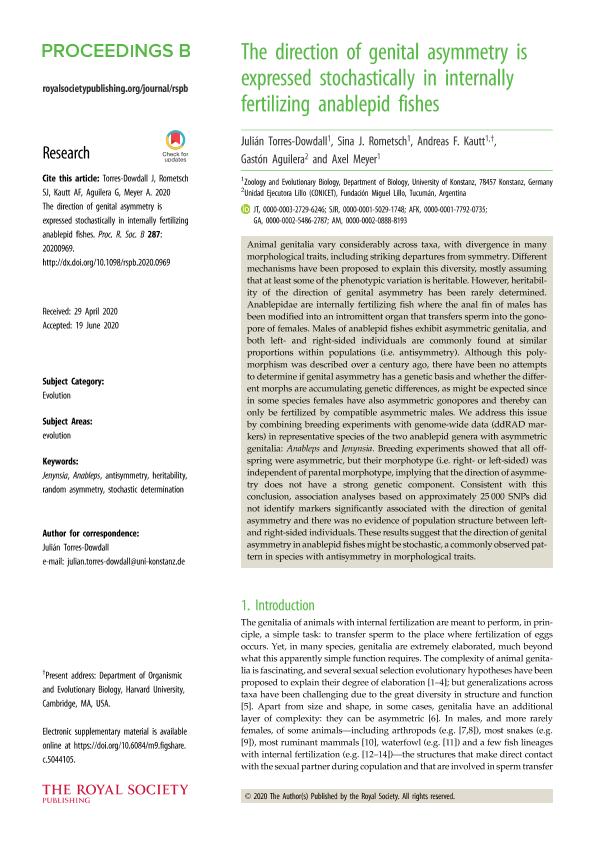
Animal genitalia vary considerably across taxa, with divergence in many morphological traits, including striking departures from symmetry. Different mechanisms have been proposed to explain this diversity, mostly assuming that at least some of the phenotypic variation is heritable. However, heritability of the direction of genital asymmetry has been rarely determined. Anablepidae are internally fertilizing fish where the anal fin of males has been modified into an intromittent organ that transfers sperm into the gonopore of females. Males of anablepid fishes exhibit asymmetric genitalia, and both left- and right-sided individuals are commonly found at similar proportions within populations (i.e. antisymmetry). Although this polymorphism was described over a century ago, there have been no attempts to determine if genital asymmetry has a genetic basis and whether the different morphs are accumulating genetic differences, as might be expected since in some species females have also asymmetric gonopores and thereby can only be fertilized by compatible asymmetric males. We address this issue by combining breeding experiments with genome-wide data (ddRAD markers) in representative species of the two anablepid genera with asymmetric genitalia: Anableps and Jenynsia. Breeding experiments showed that all offspring were asymmetric, but their morphotype (i.e. right- or left-sided) was independent of parental morphotype, implying that the direction of asymmetry does not have a strong genetic component. Consistent with this conclusion, association analyses based on approximately 25 000 SNPs did not identify markers significantly associated with the direction of genital asymmetry and there was no evidence of population structure between left- and right-sided individuals. These results suggest that the direction of genital asymmetry in anablepid fishes might be stochastic, a commonly observed pattern in species with antisymmetry in morphological traits.
Archivos asociados

Tamaño:
503.4Kb
Formato:
PDF
Licencia
 Excepto donde se diga explícitamente, este item se publica bajo la siguiente descripción:
Creative Commons Attribution-NonCommercial-ShareAlike 2.5 Unported (CC BY-NC-SA 2.5)
Excepto donde se diga explícitamente, este item se publica bajo la siguiente descripción:
Creative Commons Attribution-NonCommercial-ShareAlike 2.5 Unported (CC BY-NC-SA 2.5)
Identificadores
Colecciones
Articulos(UEL)
Articulos de UNIDAD EJECUTORA LILLO
Articulos de UNIDAD EJECUTORA LILLO
Citación
Torres Dowdall, Julián; Rometsch, Sina J.; Kautt, Andreas F.; Aguilera, Gaston; Meyer, Axel; The direction of genital asymmetry is expressed stochastically in internally fertilizing anablepid fishes: Random sidedness of genital asymmetry; The Royal Society; Proceedings of the Royal Society of London. Series B: Biological Sciences; 287; 1930; 7-2020
Compartir


Altmétricas