Artículo
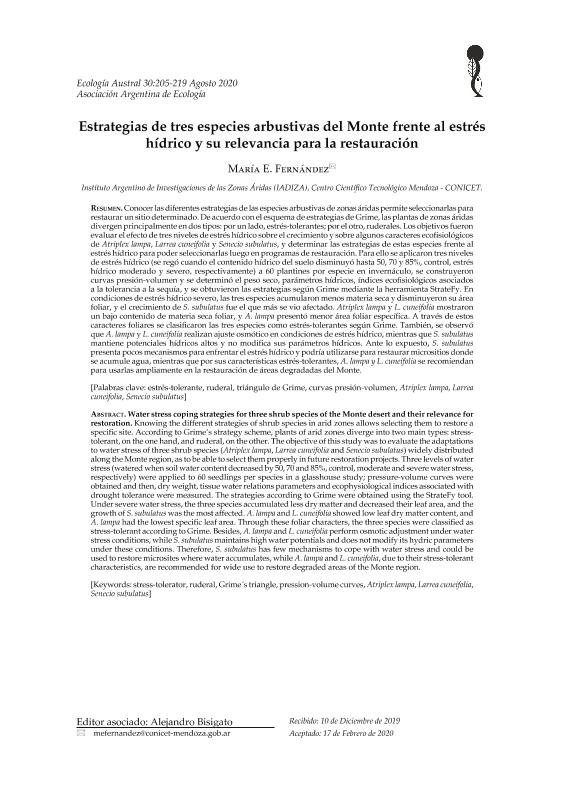
Conocer las diferentes estrategias de las especies arbustivas de zonas áridas permite seleccionarlas para restaurar un sitio determinado. De acuerdo con el esquema de estrategias de Grime, las plantas de zonas áridas divergen principalmente en dos tipos: por un lado, estrés-tolerantes; por el otro, ruderales. Los objetivos fueron evaluar el efecto de tres niveles de estrés hídrico sobre el crecimiento y sobre algunos caracteres ecofisiológicos de Atriplex lampa, Larrea cuneifolia y Senecio subulatus, y determinar las estrategias de estas especies frente al estrés hídrico para poder seleccionarlas luego en programas de restauración. Para ello se aplicaron tres niveles de estrés hídrico (se regó cuando el contenido hídrico del suelo disminuyó hasta 50, 70 y 85%, control, estrés hídrico moderado y severo, respectivamente) a 60 plantines por especie en invernáculo, se construyeron curvas presión-volumen y se determinó el peso seco, parámetros hídricos, índices ecofisiológicos asociados a la tolerancia a la sequía, y se obtuvieron las estrategias según Grime mediante la herramienta StrateFy. En condiciones de estrés hídrico severo, las tres especies acumularon menos materia seca y disminuyeron su área foliar, y el crecimiento de S. subulatus fue el que más se vio afectado. Atriplex lampa y L. cuneifolia mostraron un bajo contenido de materia seca foliar, y A. lampa presentó menor área foliar específica. A través de estos caracteres foliares se clasificaron las tres especies como estrés-tolerantes según Grime. También, se observó que A. lampa y L. cuneifolia realizan ajuste osmótico en condiciones de estrés hídrico, mientras que S. subulatus mantiene potenciales hídricos altos y no modifica sus parámetros hídricos. Ante lo expuesto, S. subulatus presenta pocos mecanismos para enfrentar el estrés hídrico y podría utilizarse para restaurar micrositios donde se acumule agua, mientras que por sus características estrés-tolerantes, A. lampa y L. cuneifolia se recomiendan para usarlas ampliamente en la restauración de áreas degradadas del Monte. Knowing the different strategies of shrub species in arid zones allows selecting them to restore a specific site. According to Grime’s strategy scheme, plants of arid zones diverge into two main types: stresstolerant, on the one hand, and ruderal, on the other. The objective of this study was to evaluate the adaptations to water stress of three shrub species (Atriplex lampa, Larrea cuneifolia and Senecio subulatus) widely distributed along the Monte region, as to be able to select them properly in future restoration projects. Three levels of water stress (watered when soil water content decreased by 50, 70 and 85%, control, moderate and severe water stress, respectively) were applied to 60 seedlings per species in a glasshouse study; pressure-volume curves were obtained and then, dry weight, tissue water relations parameters and ecophysiological indices associated with drought tolerance were measured. The strategies according to Grime were obtained using the StrateFy tool. Under severe water stress, the three species accumulated less dry matter and decreased their leaf area, and the growth of S. subulatus was the most affected. A. lampa and L. cuneifolia showed low leaf dry matter content, and A. lampa had the lowest specific leaf area. Through these foliar characters, the three species were classified as stress-tolerant according to Grime. Besides, A. lampa and L. cuneifolia perform osmotic adjustment under water stress conditions, while S. subulatus maintains high water potentials and does not modify its hydric parameters under these conditions. Therefore, S. subulatus has few mechanisms to cope with water stress and could be used to restore microsites where water accumulates, while A. lampa and L. cuneifolia, due to their stress-tolerant characteristics, are recommended for wide use to restore degraded areas of the Monte region.
Estrategias de tres especies arbustivas del Monte frente al estrés hídrico y su relevancia para la restauración
Título:
Water stress coping strategies for three shrub species of the Monte desert and their relevance for restoration

Fecha de publicación:
06/2020
Editorial:
Asociación Argentina de Ecología
Revista:
Ecología Austral
ISSN:
0327-5477
Idioma:
Español
Tipo de recurso:
Artículo publicado
Clasificación temática:
Resumen
Archivos asociados

Tamaño:
2.513Mb
Formato:
PDF
Licencia
 Excepto donde se diga explícitamente, este item se publica bajo la siguiente descripción:
Creative Commons Attribution 2.5 Unported (CC BY 2.5)
Excepto donde se diga explícitamente, este item se publica bajo la siguiente descripción:
Creative Commons Attribution 2.5 Unported (CC BY 2.5)
Identificadores
Colecciones
Articulos(IADIZA)
Articulos de INST. ARG DE INVEST. DE LAS ZONAS ARIDAS
Articulos de INST. ARG DE INVEST. DE LAS ZONAS ARIDAS
Citación
Fernández, María Emilia; Estrategias de tres especies arbustivas del Monte frente al estrés hídrico y su relevancia para la restauración; Asociación Argentina de Ecología; Ecología Austral; 30; 2; 6-2020; 205-219
Compartir

