Artículo
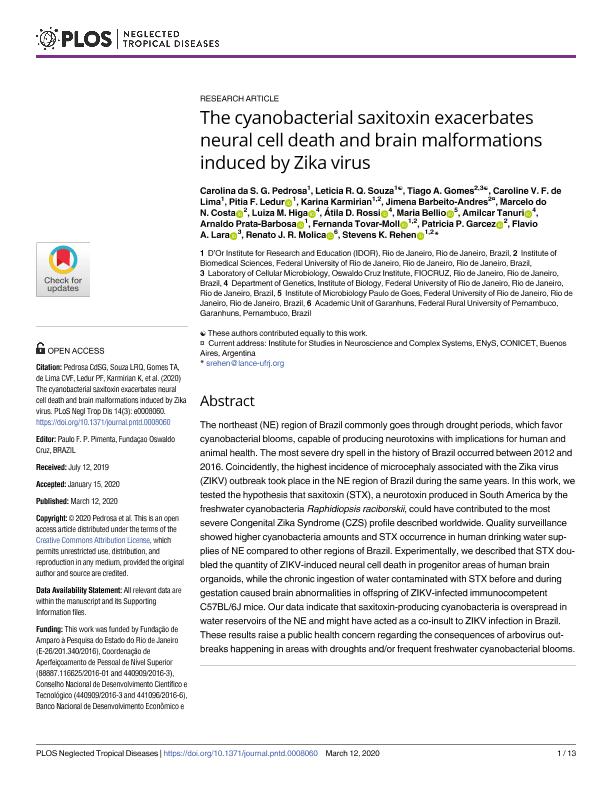
The cyanobacterial saxitoxin exacerbates neural cell death and brain malformations induced by zika virus
Pedrosa, Carolina da S. G.; Souza, Leticia R. Q.; Gomes, Tiago A.; de Lima, Caroline V. F.; Ledur, Pitia F.; Karmirian, Karina; Barbeito Andrés, Jimena ; Costa, Marcelo do N.; Higa, Luiza M.; Rossi, Átila D.; Bellio, Maria; Tanuri, Amilcar; Prata Barbosa, Arnaldo; Tovar Moll, Fernanda; Garcez, Patricia P.; Lara, Flavio A.; Molica, Renato J. R.; Rehen, Stevens K.
; Costa, Marcelo do N.; Higa, Luiza M.; Rossi, Átila D.; Bellio, Maria; Tanuri, Amilcar; Prata Barbosa, Arnaldo; Tovar Moll, Fernanda; Garcez, Patricia P.; Lara, Flavio A.; Molica, Renato J. R.; Rehen, Stevens K.
Fecha de publicación:
12/03/2020
Editorial:
Public Library of Science
Revista:
Neglected Tropical Diseases
ISSN:
1935-2727
e-ISSN:
1935-2735
Idioma:
Inglés
Tipo de recurso:
Artículo publicado
Clasificación temática:
Resumen
The northeast (NE) region of Brazil commonly goes through drought periods, which favor cyanobacterial blooms, capable of producing neurotoxins with implications for human and animal health. The most severe dry spell in the history of Brazil occurred between 2012 and 2016. Coincidently, the highest incidence of microcephaly associated with the Zika virus (ZIKV) outbreak took place in the NE region of Brazil during the same years. In this work, we tested the hypothesis that saxitoxin (STX), a neurotoxin produced in South America by the freshwater cyanobacteria Raphidiopsis raciborskii, could have contributed to the most severe Congenital Zika Syndrome (CZS) profile described worldwide. Quality surveillance showed higher cyanobacteria amounts and STX occurrence in human drinking water sup-plies of NE compared to other regions of Brazil. Experimentally, we described that STX dou-bled the quantity of ZIKV-induced neural cell death in progenitor areas of human brain organoids, while the chronic ingestion of water contaminated with STX before and during gestation caused brain abnormalities in offspring of ZIKV-infected immunocompetent C57BL/6J mice. Our data indicate that saxitoxin-producing cyanobacteria is overspread in water reservoirs of the NE and might have acted as a co-insult to ZIKV infection in Brazil. These results raise a public health concern regarding the consequences of arbovirus outbreaks happening in areas with droughts and/or frequent freshwater cyanobacterial blooms.
Palabras clave:
BRAIN DEVELOPMENT
,
NEUROSCIENCE
,
BRAZIL
Archivos asociados

Tamaño:
2.188Mb
Formato:
PDF
Licencia
 Excepto donde se diga explícitamente, este item se publica bajo la siguiente descripción:
Creative Commons Attribution 2.5 Unported (CC BY 2.5)
Excepto donde se diga explícitamente, este item se publica bajo la siguiente descripción:
Creative Commons Attribution 2.5 Unported (CC BY 2.5)
Identificadores
Colecciones
Articulos(ENYS)
Articulos de UNIDAD EJECUTORA DE ESTUDIOS EN NEUROCIENCIAS Y SISTEMAS COMPLEJOS
Articulos de UNIDAD EJECUTORA DE ESTUDIOS EN NEUROCIENCIAS Y SISTEMAS COMPLEJOS
Citación
Pedrosa, Carolina da S. G.; Souza, Leticia R. Q.; Gomes, Tiago A.; de Lima, Caroline V. F.; Ledur, Pitia F.; et al.; The cyanobacterial saxitoxin exacerbates neural cell death and brain malformations induced by zika virus; Public Library of Science; Neglected Tropical Diseases; 14; 3; 12-3-2020; 1-13
Compartir


Altmétricas