Artículo
Measurement of inverse agonism in β-adrenoceptors

Fecha de publicación:
12/2010
Editorial:
Elsevier Inc
Revista:
Methods In Enzymology.
ISSN:
0076-6879
Idioma:
Inglés
Tipo de recurso:
Artículo publicado
Clasificación temática:
Resumen
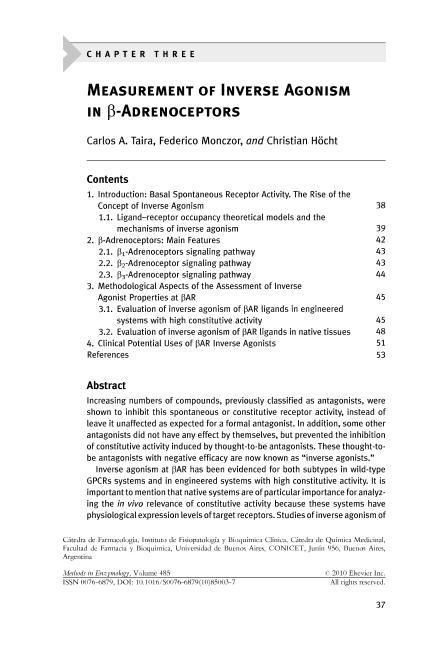
Increasing numbers of compounds, previously classified as antagonists, were shown to inhibit this spontaneous or constitutive receptor activity, instead of leave it unaffected as expected for a formal antagonist. In addition, some other antagonists did not have any effect by themselves, but prevented the inhibition of constitutive activity induced by thought-to-be antagonists. These thought-to-be antagonists with negative efficacy are now known as “inverse agonists.” Inverse agonism at βAR has been evidenced for both subtypes in wild-type GPCRs systems and in engineered systems with high constitutive activity. It is important to mention that native systems are of particular importance for analyzing the in vivo relevance of constitutive activity because these systems have physiological expression levels of target receptors. Studies of inverse agonism of β blockers in physiological setting have also evidenced that pathophysiological conditions can affect pharmacodynamic properties of these ligands. To date, hundreds of clinically well-known drugs have been tested and classified for this property. Prominent examples include the beta-blockers propranolol, alprenolol, pindolol, and timolol used for treating hypertension, angina pectoris, and arrhythmia that act on the β2ARs, metoprolol, and bisoprolol used for treating hypertension, coronary heart disease, and arrhythmias by acting on β1ARs. Inverse agonists seem to be useful in the treatment of chronic disease characterized by harmful effects resulting from β1AR and β2AR overactivation, such as heart failure and asthma, respectively.
Archivos asociados

Tamaño:
246.8Kb
Formato:
PDF
Licencia
 Excepto donde se diga explícitamente, este item se publica bajo la siguiente descripción:
Atribución-NoComercial-SinDerivadas 2.5 Argentina (CC BY-NC-ND 2.5 AR)
Excepto donde se diga explícitamente, este item se publica bajo la siguiente descripción:
Atribución-NoComercial-SinDerivadas 2.5 Argentina (CC BY-NC-ND 2.5 AR)
Identificadores
Colecciones
Articulos(OCA HOUSSAY)
Articulos de OFICINA DE COORDINACION ADMINISTRATIVA HOUSSAY
Articulos de OFICINA DE COORDINACION ADMINISTRATIVA HOUSSAY
Citación
Höcht, Christian; Taira, Carlos Alberto; Monczor, Federico; Measurement of inverse agonism in β-adrenoceptors; Elsevier Inc; Methods In Enzymology.; 485; 12-2010; 37-60
Compartir

