Artículo
Immunopeptidomic Data Integration to Artificial Neural Networks Enhances Protein-Drug Immunogenicity Prediction
Barra, Carolina; Ackaert, Chloe; Reynisson, Birkir; Schockaert, Jana; Jessen, Leon Eyrich; Watson, Mark; Jang, Anne; Comtois Marotte, Simon; Goulet, Jean Philippe; Pattijn, Sofie; Paramithiotis, Eustache; Nielsen, Morten
Fecha de publicación:
06/2020
Editorial:
Frontiers Media S.A.
Revista:
Frontiers in Immunology
ISSN:
1664-3224
Idioma:
Inglés
Tipo de recurso:
Artículo publicado
Clasificación temática:
Resumen
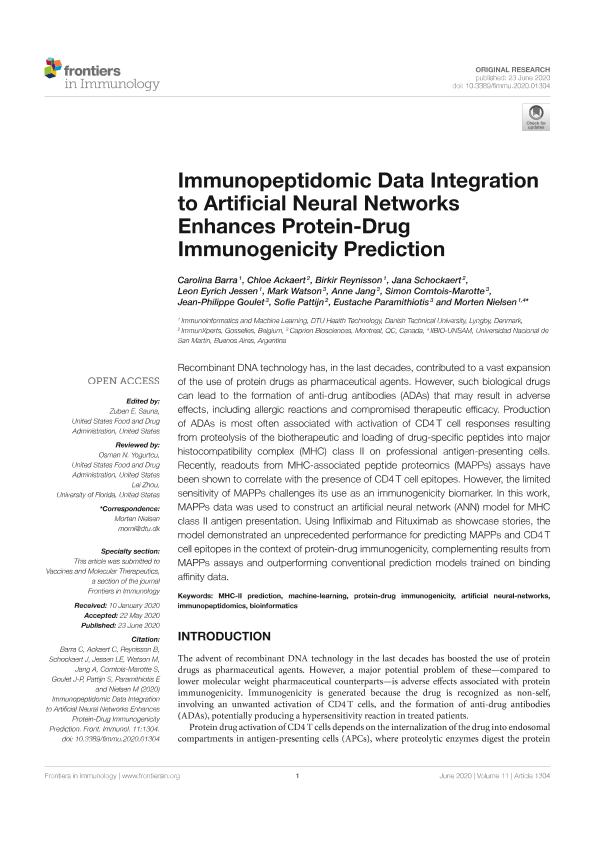
Recombinant DNA technology has, in the last decades, contributed to a vast expansion of the use of protein drugs as pharmaceutical agents. However, such biological drugs can lead to the formation of anti-drug antibodies (ADAs) that may result in adverse effects, including allergic reactions and compromised therapeutic efficacy. Production of ADAs is most often associated with activation of CD4 T cell responses resulting from proteolysis of the biotherapeutic and loading of drug-specific peptides into major histocompatibility complex (MHC) class II on professional antigen-presenting cells. Recently, readouts from MHC-associated peptide proteomics (MAPPs) assays have been shown to correlate with the presence of CD4 T cell epitopes. However, the limited sensitivity of MAPPs challenges its use as an immunogenicity biomarker. In this work, MAPPs data was used to construct an artificial neural network (ANN) model for MHC class II antigen presentation. Using Infliximab and Rituximab as showcase stories, the model demonstrated an unprecedented performance for predicting MAPPs and CD4 T cell epitopes in the context of protein-drug immunogenicity, complementing results from MAPPs assays and outperforming conventional prediction models trained on binding affinity data.
Archivos asociados

Tamaño:
1.441Mb
Formato:
PDF
Licencia
 Excepto donde se diga explícitamente, este item se publica bajo la siguiente descripción:
Creative Commons Attribution-NonCommercial-ShareAlike 2.5 Unported (CC BY-NC-SA 2.5)
Excepto donde se diga explícitamente, este item se publica bajo la siguiente descripción:
Creative Commons Attribution-NonCommercial-ShareAlike 2.5 Unported (CC BY-NC-SA 2.5)
Identificadores
Colecciones
Articulos (IIBIO)
Articulos de INSTITUTO DE INVESTIGACIONES BIOTECNOLOGICAS
Articulos de INSTITUTO DE INVESTIGACIONES BIOTECNOLOGICAS
Citación
Barra, Carolina; Ackaert, Chloe; Reynisson, Birkir; Schockaert, Jana; Jessen, Leon Eyrich; et al.; Immunopeptidomic Data Integration to Artificial Neural Networks Enhances Protein-Drug Immunogenicity Prediction; Frontiers Media S.A.; Frontiers in Immunology; 11; 6-2020; 1-13
Compartir


Altmétricas