Mostrar el registro sencillo del ítem
dc.contributor.author
Iramain, Maximiliano Alberto
dc.contributor.author
Brandan, Silvia Antonia
dc.date.available
2021-09-18T01:58:05Z
dc.date.issued
2018-05-09
dc.identifier.citation
Iramain, Maximiliano Alberto; Brandan, Silvia Antonia; Structural and vibrational study on the acid, hexa-hydrated and anhydrous trisodic salts of antiviral drug Foscarnet; Lupine Publishers; Drug Designing & Intellectual Properties International Journal; 1; 3; 9-5-2018; 90-106
dc.identifier.issn
2637-4706
dc.identifier.uri
http://hdl.handle.net/11336/140787
dc.description.abstract
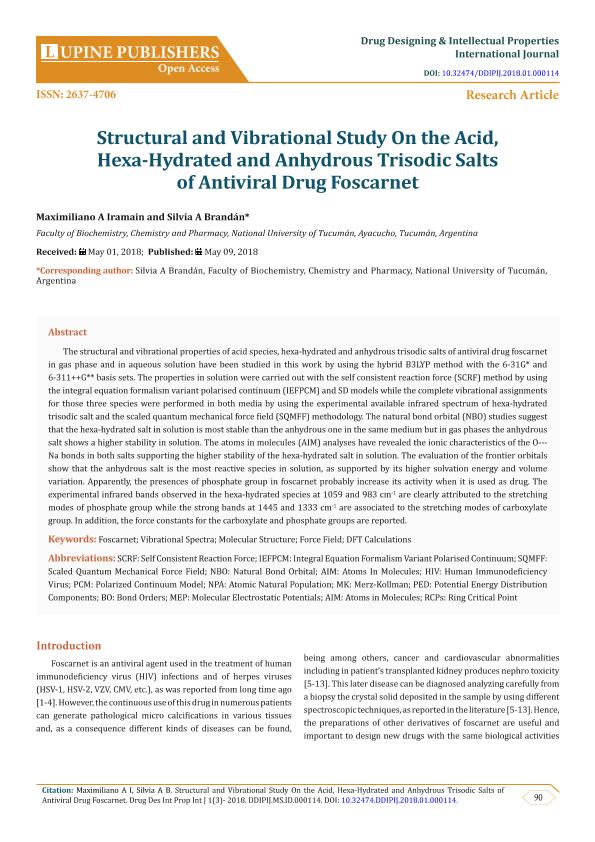
The structural and vibrational properties of acid species, hexa-hydrated and anhydrous trisodic salts of antiviral drug foscarnetin gas phase and in aqueous solution have been studied in this work by using the hybrid B3LYP method with the 6-31G* and6-311++G** basis sets. The properties in solution were carried out with the self consistent reaction force (SCRF) method by usingthe integral equation formalism variant polarised continuum (IEFPCM) and SD models while the complete vibrational assignmentsfor those three species were performed in both media by using the experimental available infrared spectrum of hexa-hydratedtrisodic salt and the scaled quantum mechanical force field (SQMFF) methodology. The natural bond orbital (NBO) studies suggestthat the hexa-hydrated salt in solution is most stable than the anhydrous one in the same medium but in gas phases the anhydroussalt shows a higher stability in solution. The atoms in molecules (AIM) analyses have revealed the ionic characteristics of the O---Na bonds in both salts supporting the higher stability of the hexa-hydrated salt in solution. The evaluation of the frontier orbitalsshow that the anhydrous salt is the most reactive species in solution, as supported by its higher solvation energy and volumevariation. Apparently, the presences of phosphate group in foscarnet probably increase its activity when it is used as drug. Theexperimental infrared bands observed in the hexa-hydrated species at 1059 and 983 cm-1 are clearly attributed to the stretchingmodes of phosphate group while the strong bands at 1445 and 1333 cm-1 are associated to the stretching modes of carboxylategroup. In addition, the force constants for the carboxylate and phosphate groups are reported.
dc.format
application/pdf
dc.language.iso
eng
dc.publisher
Lupine Publishers
dc.rights
info:eu-repo/semantics/openAccess
dc.rights.uri
https://creativecommons.org/licenses/by-nc-sa/2.5/ar/
dc.subject
FOSCARNET
dc.subject
VIBRATIONAL SPECTRA
dc.subject
MOLECULAR STRUCTURE
dc.subject
FORCE FIELD
dc.subject.classification
Otras Ciencias Químicas
dc.subject.classification
Ciencias Químicas
dc.subject.classification
CIENCIAS NATURALES Y EXACTAS
dc.title
Structural and vibrational study on the acid, hexa-hydrated and anhydrous trisodic salts of antiviral drug Foscarnet
dc.type
info:eu-repo/semantics/article
dc.type
info:ar-repo/semantics/artículo
dc.type
info:eu-repo/semantics/publishedVersion
dc.date.updated
2021-07-30T18:56:32Z
dc.journal.volume
1
dc.journal.number
3
dc.journal.pagination
90-106
dc.journal.pais
Estados Unidos
dc.journal.ciudad
Nueva York
dc.description.fil
Fil: Iramain, Maximiliano Alberto. Universidad Nacional de Tucuman. Facultad de Bioquimica, Quimica y Farmacia. Instituto de Quimica Inorganica. Cátedra de Química General.; Argentina. Consejo Nacional de Investigaciones Científicas y Técnicas. Centro Científico Tecnológico Conicet - Tucumán; Argentina
dc.description.fil
Fil: Brandan, Silvia Antonia. Universidad Nacional de Tucuman. Facultad de Bioquimica, Quimica y Farmacia. Instituto de Quimica Inorganica. Cátedra de Química General.; Argentina
dc.journal.title
Drug Designing & Intellectual Properties International Journal
dc.relation.alternativeid
info:eu-repo/semantics/altIdentifier/url/https://lupinepublishers.com/drug-designing-journal/fulltext/structural-and-vibrational-study-on-the-acid-hexa-hydrated-and-anhydrous-trisodic-salts-of-antiviral-drug-foscarnet.ID.000114.php
dc.relation.alternativeid
info:eu-repo/semantics/altIdentifier/doi/http://dx.doi.org/10.32474/DDIPIJ.2018.01.000114
Archivos asociados

Tamaño:
1.555Mb
Formato:
PDF