Artículo
Lack of Gαi2 proteins in adipocytes attenuates diet-induced obesity
Leiss, Veronika; Schönsiegel, Annika; Gnad, Thorsten; Kerner, Johannes; Kaur, Jyotsna; Sartorius, Tina; Machann, Jürgen; Schick, Fritz; Birnbaumer, Lutz ; Häring, Hans Ulrich; Pfeifer, Alexander; Nürnberg, Bernd
; Häring, Hans Ulrich; Pfeifer, Alexander; Nürnberg, Bernd
Fecha de publicación:
10/2020
Editorial:
Elsevier
Revista:
Molecular Metabolism
ISSN:
2212-8778
Idioma:
Inglés
Tipo de recurso:
Artículo publicado
Clasificación temática:
Resumen
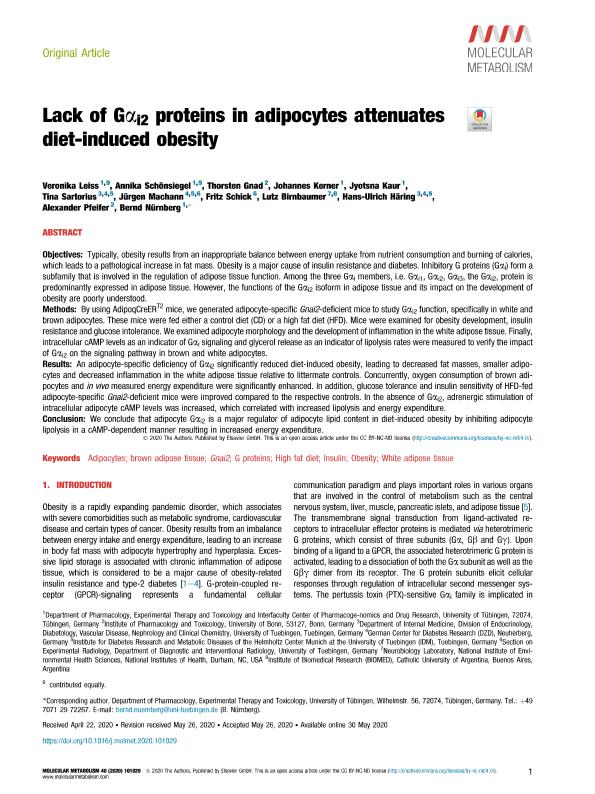
Objectives: Typically, obesity results from an inappropriate balance between energy uptake from nutrient consumption and burning of calories, which leads to a pathological increase in fat mass. Obesity is a major cause of insulin resistance and diabetes. Inhibitory G proteins (Gαi) form a subfamily that is involved in the regulation of adipose tissue function. Among the three Gαi members, i.e. Gαi1, Gαi2, Gαi3, the Gαi2, protein is predominantly expressed in adipose tissue. However, the functions of the Gαi2 isoform in adipose tissue and its impact on the development of obesity are poorly understood. Methods: By using AdipoqCreERT2 mice, we generated adipocyte-specific Gnai2-deficient mice to study Gαi2 function, specifically in white and brown adipocytes. These mice were fed either a control diet (CD) or a high fat diet (HFD). Mice were examined for obesity development, insulin resistance and glucose intolerance. We examined adipocyte morphology and the development of inflammation in the white adipose tissue. Finally, intracellular cAMP levels as an indicator of Gαi signaling and glycerol release as an indicator of lipolysis rates were measured to verify the impact of Gαi2 on the signaling pathway in brown and white adipocytes. Results: An adipocyte-specific deficiency of Gαi2 significantly reduced diet-induced obesity, leading to decreased fat masses, smaller adipocytes and decreased inflammation in the white adipose tissue relative to littermate controls. Concurrently, oxygen consumption of brown adipocytes and in vivo measured energy expenditure were significantly enhanced. In addition, glucose tolerance and insulin sensitivity of HFD-fed adipocyte-specific Gnai2-deficient mice were improved compared to the respective controls. In the absence of Gαi2, adrenergic stimulation of intracellular adipocyte cAMP levels was increased, which correlated with increased lipolysis and energy expenditure. Conclusion: We conclude that adipocyte Gαi2 is a major regulator of adipocyte lipid content in diet-induced obesity by inhibiting adipocyte lipolysis in a cAMP-dependent manner resulting in increased energy expenditure.
Archivos asociados

Tamaño:
2.822Mb
Formato:
PDF
Licencia
 Excepto donde se diga explícitamente, este item se publica bajo la siguiente descripción:
Atribución-NoComercial-SinDerivadas 2.5 Argentina (CC BY-NC-ND 2.5 AR)
Excepto donde se diga explícitamente, este item se publica bajo la siguiente descripción:
Atribución-NoComercial-SinDerivadas 2.5 Argentina (CC BY-NC-ND 2.5 AR)
Identificadores
Colecciones
Articulos(BIOMED)
Articulos de INSTITUTO DE INVESTIGACIONES BIOMEDICAS
Articulos de INSTITUTO DE INVESTIGACIONES BIOMEDICAS
Citación
Leiss, Veronika; Schönsiegel, Annika; Gnad, Thorsten; Kerner, Johannes; Kaur, Jyotsna; et al.; Lack of Gαi2 proteins in adipocytes attenuates diet-induced obesity; Elsevier; Molecular Metabolism; 40; 10-2020; 1-13
Compartir


Altmétricas