Artículo
Cell-free biosensors for rapid detection of water contaminants
Jung, Jaeyoung K.; Alam, Khalid K.; Verosloff, Matthew S.; Capdevila, Daiana Andrea ; Desmau, Morgane; Clauer, Phillip R.; Lee, Jeong Wook; Nguyen, Peter Q.; Pastén, Pablo A.; Matiasek, Sandrine J.; Gaillard, Jean-François; Giedroc, David Peter; Collins, James J.; Lucks, Julius B.
; Desmau, Morgane; Clauer, Phillip R.; Lee, Jeong Wook; Nguyen, Peter Q.; Pastén, Pablo A.; Matiasek, Sandrine J.; Gaillard, Jean-François; Giedroc, David Peter; Collins, James J.; Lucks, Julius B.
Fecha de publicación:
07/2020
Editorial:
Nature Publishing Group
Revista:
Nature Biotechnology
ISSN:
1087-0156
e-ISSN:
1546-1696
Idioma:
Inglés
Tipo de recurso:
Artículo publicado
Clasificación temática:
Resumen
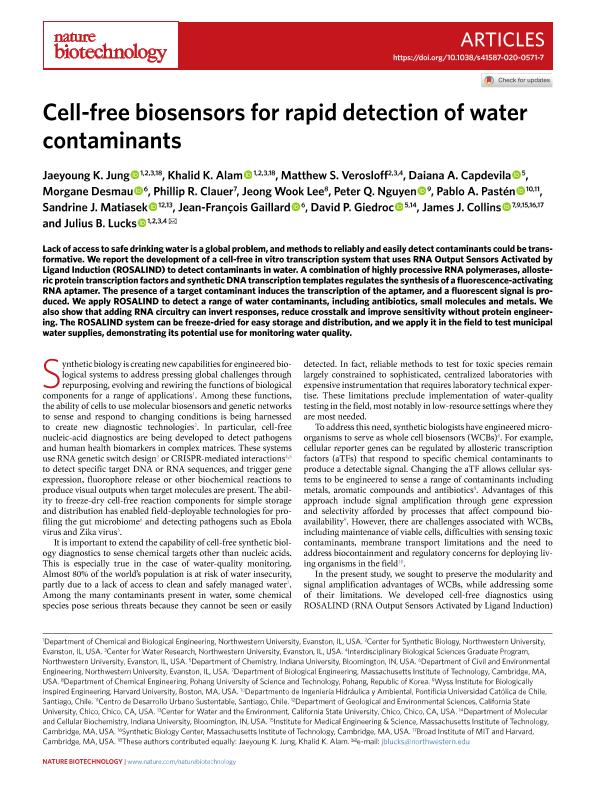
Lack of access to safe drinking water is a global problem, and methods to reliably and easily detect contaminants could be transformative. We report the development of a cell-free in vitro transcription system that uses RNA Output Sensors Activated by Ligand Induction (ROSALIND) to detect contaminants in water. A combination of highly processive RNA polymerases, allosteric protein transcription factors and synthetic DNA transcription templates regulates the synthesis of a fluorescence-activating RNA aptamer. The presence of a target contaminant induces the transcription of the aptamer, and a fluorescent signal is produced. We apply ROSALIND to detect a range of water contaminants, including antibiotics, small molecules and metals. We also show that adding RNA circuitry can invert responses, reduce crosstalk and improve sensitivity without protein engineering. The ROSALIND system can be freeze-dried for easy storage and distribution, and we apply it in the field to test municipal water supplies, demonstrating its potential use for monitoring water quality.
Archivos asociados

Tamaño:
6.215Mb
Formato:
PDF
Licencia
 Excepto donde se diga explícitamente, este item se publica bajo la siguiente descripción:
Creative Commons Attribution-NonCommercial-ShareAlike 2.5 Unported (CC BY-NC-SA 2.5)
Excepto donde se diga explícitamente, este item se publica bajo la siguiente descripción:
Creative Commons Attribution-NonCommercial-ShareAlike 2.5 Unported (CC BY-NC-SA 2.5)
Identificadores
Colecciones
Articulos(IIBBA)
Articulos de INST.DE INVEST.BIOQUIMICAS DE BS.AS(I)
Articulos de INST.DE INVEST.BIOQUIMICAS DE BS.AS(I)
Citación
Jung, Jaeyoung K.; Alam, Khalid K.; Verosloff, Matthew S.; Capdevila, Daiana Andrea; Desmau, Morgane; et al.; Cell-free biosensors for rapid detection of water contaminants; Nature Publishing Group; Nature Biotechnology; 38; 12; 7-2020; 1451-1459
Compartir


Altmétricas