Artículo
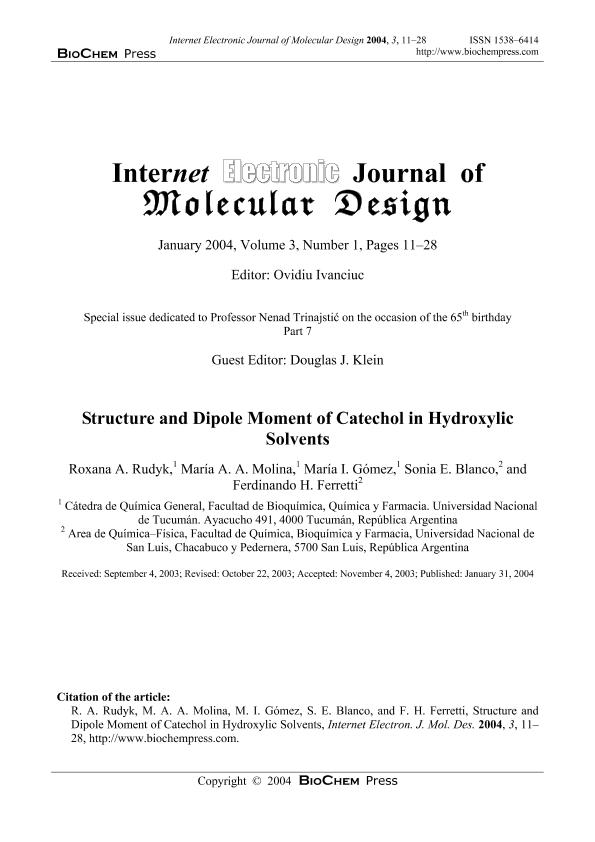
Structure and dipole moment of catechol in hydroxylic solvents
Rudyk, Roxana Amelia; Molina, María A. A.; Gómez, María Inés; Blanco, Sonia Encarnacion ; Ferretti, Ferdinando Hector
; Ferretti, Ferdinando Hector
Fecha de publicación:
01/2004
Editorial:
BioChem Press
Revista:
Internet Electronic Journal of Molecular Design
ISSN:
1538-6414
Idioma:
Inglés
Tipo de recurso:
Artículo publicado
Clasificación temática:
Resumen
Motivation. Various classes of flavonoids of great importance for medicine have a molecular structure containing a resorcinol in its A-ring whereas the B-ring is a catechol derivative. With a future view to establishing correlations between the physicochemical and biological properties of flavonoids and catechols and with the specific aim of explaining the dipole moment of catechol in water, we investigated the molecular conformations and solute-solvent interactions of catechol in ethanol, methanol and water. Method. Basis sets at two levels of theory: HF/6-31G(d,p) and B3LYP/6-31G(d,p) were used for calculations. Onsager's method was used to analyze the solvent effects on the conformers of catechol. Results. A conformational equilibrium between the two main conformers of non-solvated catechol was proposed. The total energies, dipole moments, structural molecular and reactivity parameters of the conformers and transition states involved were calculated. These theoretical magnitudes were correlated with properties of the solvating solvents. The properties of solute-solvent association complexes formed by a molecule of catechol and three molecules of water by means of intermolecular hydrogen bonds were also calculated. Conclusions. The stability of the conformer that has one intramolecular hydrogen bond increases with the hydrogen-bond donor capability and polarity of the solvents. The dipole moment of catechol in water (11.45 D) is due to the solute-solvent association complexes, which are the predominant forms of the compound in aqueous solutions.
Archivos asociados

Tamaño:
271.5Kb
Formato:
PDF
Licencia
 Excepto donde se diga explícitamente, este item se publica bajo la siguiente descripción:
Creative Commons Attribution-NonCommercial-ShareAlike 2.5 Unported (CC BY-NC-SA 2.5)
Excepto donde se diga explícitamente, este item se publica bajo la siguiente descripción:
Creative Commons Attribution-NonCommercial-ShareAlike 2.5 Unported (CC BY-NC-SA 2.5)
Identificadores
Colecciones
Articulos(IMIBIO-SL)
Articulos de INST. MULTIDICIPLINARIO DE INV. BIO. DE SAN LUIS
Articulos de INST. MULTIDICIPLINARIO DE INV. BIO. DE SAN LUIS
Citación
Rudyk, Roxana Amelia; Molina, María A. A.; Gómez, María Inés; Blanco, Sonia Encarnacion; Ferretti, Ferdinando Hector; Structure and dipole moment of catechol in hydroxylic solvents; BioChem Press; Internet Electronic Journal of Molecular Design; 3; 1; 1-2004; 11-28
Compartir

