Artículo
Taphonomic analysis of micromammal remains from striped owl (Pseudoscops Clamator) pellets in northeastern Buenos Aires province, Argentina: implications for archaeological sites formation

Fecha de publicación:
07/2015
Editorial:
Wiley
Revista:
International Journal of Osteoarchaeology
ISSN:
1047-482X
Idioma:
Inglés
Tipo de recurso:
Artículo publicado
Clasificación temática:
Resumen
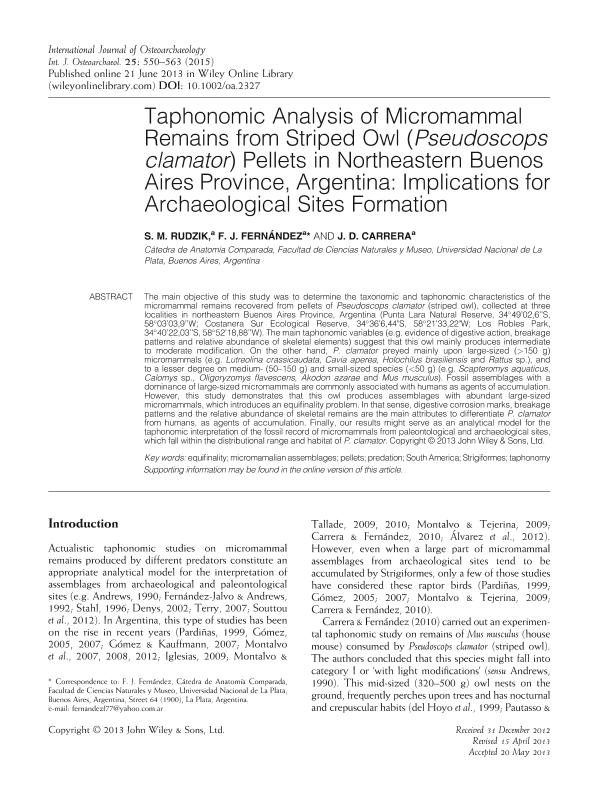
The main objective of this study was to determine the taxonomic and taphonomic characteristics of the micromammal remains recovered from pellets of Pseudoscops clamator (striped owl), collected at three localities in northeastern Buenos Aires Province, Argentina (Punta Lara Natural Reserve, 34°49'02,6''S, 58°03'03,9''W; Costanera Sur Ecological Reserve, 34°36'6,44" S, 58°21'33,22" W; Los Robles Park, 34°40'22,03''S, 58°52'18,88''W). The main taphonomic variables (e.g. evidence of digestive action, breakage patterns and relative abundance of skeletal elements) suggest that this owl mainly produces intermediate to moderate modification. On the other hand, P. clamator preyed mainly upon large-sized (>150 g) micromammals (e.g. Lutreolina crassicaudata, Cavia aperea, Holochilus brasiliensis and Rattus sp.), and to a lesser degree on medium- (50–150 g) and small-sized species (<50 g) (e.g. Scapteromys aquaticus, Calomys sp., Oligoryzomys flavescens, Akodon azarae and Mus musculus). Fossil assemblages with a dominance of large-sized micromammals are commonly associated with humans as agents of accumulation. However, this study demonstrates that this owl produces assemblages with abundant large-sized micromammals, which introduces an equifinality problem. In that sense, digestive corrosion marks, breakage patterns and the relative abundance of skeletal remains are the main attributes to differentiate P. clamator from humans, as agents of accumulation. Finally, our results might serve as an analytical model for the taphonomic interpretation of the fossil record of micromammals from paleontological and archaeological sites, which fall within the distributional range and habitat of P. clamator.
Archivos asociados

Tamaño:
1.748Mb
Formato:
PDF
Licencia
 Excepto donde se diga explícitamente, este item se publica bajo la siguiente descripción:
Creative Commons Attribution-NonCommercial-ShareAlike 2.5 Unported (CC BY-NC-SA 2.5)
Excepto donde se diga explícitamente, este item se publica bajo la siguiente descripción:
Creative Commons Attribution-NonCommercial-ShareAlike 2.5 Unported (CC BY-NC-SA 2.5)
Identificadores
Colecciones
Articulos(CCT - LA PLATA)
Articulos de CTRO.CIENTIFICO TECNOL.CONICET - LA PLATA
Articulos de CTRO.CIENTIFICO TECNOL.CONICET - LA PLATA
Citación
Carrera, Joaquín Daniel; Rudzik, Martín; Fernández, Fernando Julián; Taphonomic analysis of micromammal remains from striped owl (Pseudoscops Clamator) pellets in northeastern Buenos Aires province, Argentina: implications for archaeological sites formation; Wiley; International Journal of Osteoarchaeology; 25; 4; 7-2015; 550-563
Compartir


Altmétricas