Artículo
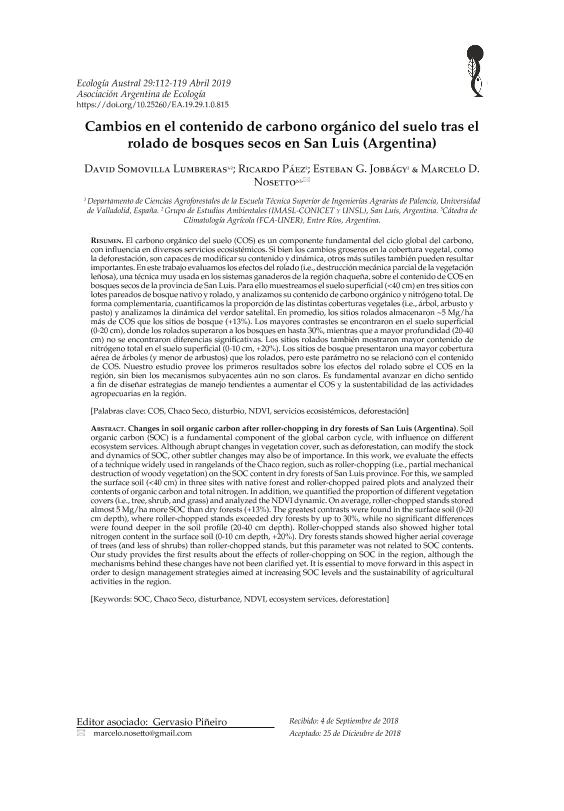
El carbono orgánico del suelo (COS) es un componente fundamental del ciclo global de este elemento con influencia en diversos servicios ecosistémicos.Si bien los cambios groseros en la cobertura vegetal, como la deforestación, son capaces de modificar su stock y dinámica, otros más sutiles también pueden también ser importantes. En este trabajo evaluamos los efectos de una técnica ampliamente utilizada en los sistemas ganaderos de la región chaqueña, como es el rolado (destrucción mecánica parcial de la vegetación leñosa),sobre el contenido de COS en bosques secos de la provincia de San Luis. Para esto, muestreamos el suelo superficial (< 40 cm) en tres sitios con lotes pareados de bosque nativo y rolado y analizamos su contenido de carbono orgánico y nitrógeno total. Complementariamente, cuantificamos la proporción de las distintas coberturas vegetales (árbol, arbusto y pasto) y analizamos la dinámica del verdor satelital. En promedio, los sitios rolados almacenaron casi 5 toneladas más de COS por hectárea que los sitios de bosque (+13%). Los mayores contrastes se encontraron en el suelo superficial (0-20 cm), donde los rolados superaron a los bosques en hasta 30%, mientras que a mayor profundidad (20-40 cm) no se encontraron diferencias significativas. Los sitios rolados también mostraron mayor contenido de nitrógeno total en el suelo superficial (0-10 cm, +20%).Los sitios de bosque presentaron una mayor cobertura aérea de árboles(y menor de arbustos) que los rolados, pero las mismas no se relacionaron al contenido de COS. Nuestro estudio provee los primeros resultados sobre los efectos del rolado sobre el COS en la región, sin bien los mecanismos detrás de estos cambios aún no se esclarecen. Es fundamental avanzar en dicho sentido a fin de diseñar estrategias de manejo tendientes a aumentar el COS y la sustentabilidad de las actividades agropecuarias en la región. Soil organic carbon (SOC) is a fundamental component of the global carbon cycle, with influence on different ecosystem services. Although abrupt changes in vegetation cover, such as deforestation, can modify the stock and dynamics of SOC, other subtler changes may also be of importance. In this work, we evaluate the effects of a technique widely used in rangelands of the Chaco region, such as roller-chopping (i.e., partial mechanical destruction of woody vegetation) on the SOC content in dry forests of San Luis province. For this, we sampled the surface soil (<40 cm) in three sites with native forest and roller-chopped paired plots and analyzed their contents of organic carbon and total nitrogen. In addition, we quantified the proportion of different vegetation covers (i.e., tree, shrub, and grass) and analyzed the NDVI dynamic. On average, roller-chopped stands stored almost 5 Mg/ha more SOC than dry forests (+13%). The greatest contrasts were found in the surface soil (0-20 cm depth), where roller-chopped stands exceeded dry forests by up to 30%, while no significant differences were found deeper in the soil profile (20-40 cm depth). Roller-chopped stands also showed higher total nitrogen content in the surface soil (0-10 cm depth, +20%). Dry forests stands showed higher aerial coverage of trees (and less of shrubs) than roller-chopped stands, but this parameter was not related to SOC contents. Our study provides the first results about the effects of roller-chopping on SOC in the region, although the mechanisms behind these changes have not been clarified yet. It is essential to move forward in this aspect in order to design management strategies aimed at increasing SOC levels and the sustainability of agricultural activities in the region.
Cambios del carbono orgánico del suelo tras el rolado de bosques secos en San Luis (Argentina)
Título:
Changes in soil organic carbon after roller-chopping in dry forests of San Luis (Argentina)
Somovilla Lumbreras, David; Paez, Ricardo Andrés ; Jobbagy Gampel, Esteban Gabriel
; Nosetto, Marcelo Daniel
; Jobbagy Gampel, Esteban Gabriel
; Nosetto, Marcelo Daniel
; Jobbagy Gampel, Esteban Gabriel
; Nosetto, Marcelo Daniel
Fecha de publicación:
04/2019
Editorial:
Asociación Argentina de Ecología
Revista:
Ecología Austral
ISSN:
0327-5477
Idioma:
Español
Tipo de recurso:
Artículo publicado
Clasificación temática:
Resumen
Palabras clave:
CHACO SECO
,
DEFORESTATION
,
DISTURBANCE
,
ECOSYSTEM SERVICES
,
NDVI
,
SOC
Archivos asociados

Tamaño:
1.041Mb
Formato:
PDF
Licencia
 Excepto donde se diga explícitamente, este item se publica bajo la siguiente descripción:
Creative Commons Attribution 2.5 Unported (CC BY 2.5)
Excepto donde se diga explícitamente, este item se publica bajo la siguiente descripción:
Creative Commons Attribution 2.5 Unported (CC BY 2.5)
Identificadores
Colecciones
Articulos(IMASL)
Articulos de INST. DE MATEMATICA APLICADA DE SAN LUIS
Articulos de INST. DE MATEMATICA APLICADA DE SAN LUIS
Citación
Somovilla Lumbreras, David; Paez, Ricardo Andrés; Jobbagy Gampel, Esteban Gabriel; Nosetto, Marcelo Daniel; Cambios del carbono orgánico del suelo tras el rolado de bosques secos en San Luis (Argentina); Asociación Argentina de Ecología; Ecología Austral; 29; 1; 4-2019; 112-119
Compartir


Altmétricas