Mostrar el registro sencillo del ítem
dc.contributor.author
Caviedes Vidal, Enrique Juan Raul
dc.contributor.author
Afik, Daniel
dc.contributor.author
Martínez del Río, Carlos
dc.contributor.author
Karasov, William
dc.date.available
2021-07-16T20:55:14Z
dc.date.issued
2000-01
dc.identifier.citation
Caviedes Vidal, Enrique Juan Raul; Afik, Daniel; Martínez del Río, Carlos; Karasov, William; Dietary modulation of intestinal enzymes of the house sparrow (Passer domesticus): Testing an adaptive hypothesis; Elsevier Science Inc.; Comparative Biochemistry and Physiology Part A: Molecular and Integrative Physiology; 125; 1; 1-2000; 11-24
dc.identifier.issn
1095-6433
dc.identifier.uri
http://hdl.handle.net/11336/136364
dc.description.abstract
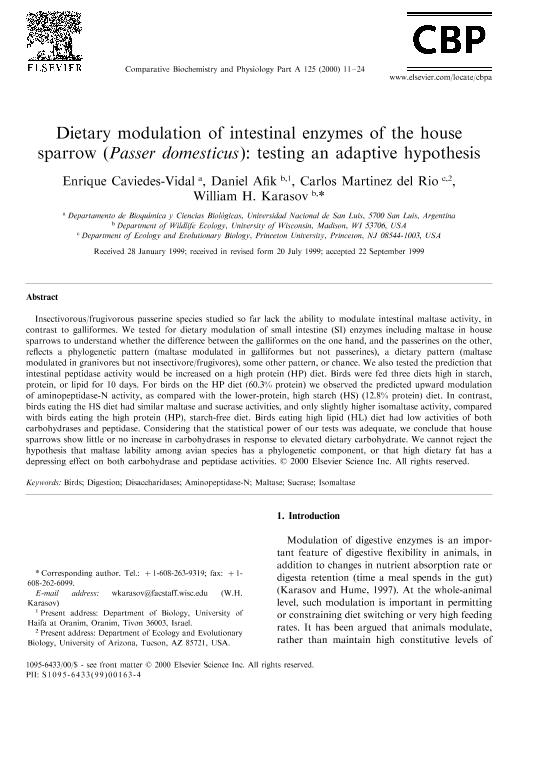
Insectivorous/frugivorous passerine species studied so far lack the ability to modulate intestinal maltase activity, in contrast to galliformes. We tested for dietary modulation of small intestine (SI) enzymes including maltase in house sparrows to understand whether the difference between the galliformes on the one hand, and the passerines on the other, reflects a phylogenetic pattern (maltase modulated in galliformes but not passerines), a dietary pattern (maltase modulated in granivores but not insectivore/frugivores), some other pattern, or chance. We also tested the prediction that intestinal peptidase activity would be increased on a high protein (HP) diet. Birds were fed three diets high in starch, protein, or lipid for 10 days. For birds on the HP diet (60.3% protein) we observed the predicted upward modulation of aminopeptidase-N activity, as compared with the lower-protein, high starch (HS) (12.8% protein) diet. In contrast, birds eating the HS diet had similar maltase and sucrase activities, and only slightly higher isomaltase activity, compared with birds eating the high protein (HP), starch-free diet. Birds eating high lipid (HL) diet had low activities of both carbohydrases and peptidase. Considering that the statistical power of our tests was adequate, we conclude that house sparrows show little or no increase in carbohydrases in response to elevated dietary carbohydrate. We cannot reject the hypothesis that maltase lability among avian species has a phylogenetic component, or that high dietary fat has a depressing effect on both carbohydrase and peptidase activities.
dc.format
application/pdf
dc.language.iso
eng
dc.publisher
Elsevier Science Inc.
dc.rights
info:eu-repo/semantics/openAccess
dc.rights.uri
https://creativecommons.org/licenses/by-nc-sa/2.5/ar/
dc.subject
BIRDS
dc.subject
DIGESTION
dc.subject
DISACCHARIDASES
dc.subject
AMINOPEPTIDASE-N
dc.subject
MALTASE
dc.subject
SUCRASE
dc.subject
ISOMALTASE
dc.subject.classification
Bioquímica y Biología Molecular
dc.subject.classification
Ciencias Biológicas
dc.subject.classification
CIENCIAS NATURALES Y EXACTAS
dc.title
Dietary modulation of intestinal enzymes of the house sparrow (Passer domesticus): Testing an adaptive hypothesis
dc.type
info:eu-repo/semantics/article
dc.type
info:ar-repo/semantics/artículo
dc.type
info:eu-repo/semantics/publishedVersion
dc.date.updated
2021-02-17T20:12:06Z
dc.journal.volume
125
dc.journal.number
1
dc.journal.pagination
11-24
dc.journal.pais
Estados Unidos
dc.description.fil
Fil: Caviedes Vidal, Enrique Juan Raul. Consejo Nacional de Investigaciones Científicas y Técnicas. Centro Científico Tecnológico Conicet - San Luis. Instituto Multidisciplinario de Investigaciones Biológicas de San Luis. Universidad Nacional de San Luis. Facultad de Ciencias Físico Matemáticas y Naturales. Instituto Multidisciplinario de Investigaciones Biológicas de San Luis; Argentina. Universidad Nacional de San Luis. Facultad de Química, Bioquímica y Farmacia. Departamento de Bioquímica y Ciencias Biológicas; Argentina
dc.description.fil
Fil: Afik, Daniel. University of Wisconsin; Estados Unidos
dc.description.fil
Fil: Martínez del Río, Carlos. University of Princeton; Estados Unidos
dc.description.fil
Fil: Karasov, William. University of Wisconsin; Estados Unidos
dc.journal.title
Comparative Biochemistry and Physiology Part A: Molecular and Integrative Physiology
dc.relation.alternativeid
info:eu-repo/semantics/altIdentifier/url/https://www.sciencedirect.com/science/article/pii/S1095643399001634
dc.relation.alternativeid
info:eu-repo/semantics/altIdentifier/doi/https://doi.org/10.1016/S1095-6433(99)00163-4
Archivos asociados

Tamaño:
207.7Kb
Formato:
PDF