Artículo
Decoupling the spread of grasslands from the evolution of grazer-type herbivores in South America
Strömberg, Caroline A. E.; Dunn, Regan E.; Madden, Richard H.; Kohn, Matthew J.; Carlini, Alfredo Armando
Fecha de publicación:
02/2013
Editorial:
Macmillan Publishers
Revista:
Nature Communications
e-ISSN:
2041-1723
Idioma:
Inglés
Tipo de recurso:
Artículo publicado
Clasificación temática:
Resumen
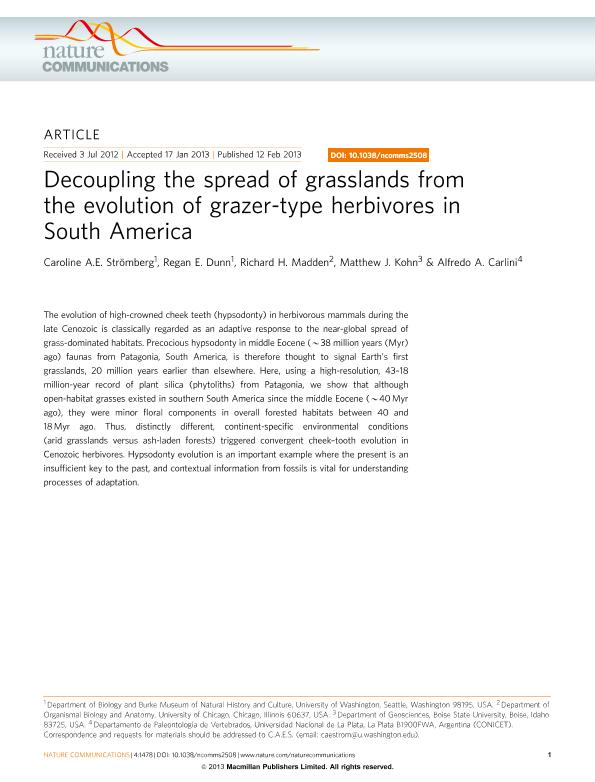
The evolution of high-crowned cheek teeth (hypsodonty) in herbivorous mammals during the late Cenozoic is classically regarded as an adaptive response to the near-global spread of grass-dominated habitats. Precocious hypsodonty in middle Eocene (B38 million years (Myr) ago) faunas from Patagonia, South America, is therefore thought to signal Earth’s first grasslands, 20 million years earlier than elsewhere. Here, using a high-resolution, 43–18 million-year record of plant silica (phytoliths) from Patagonia, we show that although open-habitat grasses existed in southern South America since the middle Eocene (B40 Myr ago), they were minor floral components in overall forested habitats between 40 and 18 Myr ago. Thus, distinctly different, continent-specific environmental conditions (arid grasslands versus ash-laden forests) triggered convergent cheek–tooth evolution in Cenozoic herbivores. Hypsodonty evolution is an important example where the present is an insufficient key to the past, and contextual information from fossils is vital for understanding processes of adaptation.
Palabras clave:
Phytolith
,
Grasslands
,
Paleogene
,
South America
Archivos asociados

Tamaño:
869.6Kb
Formato:
PDF
Licencia
 Excepto donde se diga explícitamente, este item se publica bajo la siguiente descripción:
Creative Commons Attribution-NonCommercial-ShareAlike 2.5 Unported (CC BY-NC-SA 2.5)
Excepto donde se diga explícitamente, este item se publica bajo la siguiente descripción:
Creative Commons Attribution-NonCommercial-ShareAlike 2.5 Unported (CC BY-NC-SA 2.5)
Identificadores
Colecciones
Articulos(CCT - LA PLATA)
Articulos de CTRO.CIENTIFICO TECNOL.CONICET - LA PLATA
Articulos de CTRO.CIENTIFICO TECNOL.CONICET - LA PLATA
Citación
Strömberg, Caroline A. E.; Dunn, Regan E.; Madden, Richard H.; Kohn, Matthew J.; Carlini, Alfredo Armando; Decoupling the spread of grasslands from the evolution of grazer-type herbivores in South America; Macmillan Publishers; Nature Communications; 4; 2-2013; 1-8; 1478
Compartir


Altmétricas