Artículo
Thyroid hormone synthesis continues despite biallelic thyroglobulin mutation with cell death
Zhang, Xiaohan; Kellogg, Aaron P.; Citterio, Cintia Eliana ; Zhang, Hao; Larkin, Dennis; Morishita, Yoshiaki; Targovnik, Hector Manuel
; Balbi, Viviana A.; Arvan, Peter
; Zhang, Hao; Larkin, Dennis; Morishita, Yoshiaki; Targovnik, Hector Manuel
; Balbi, Viviana A.; Arvan, Peter
; Zhang, Hao; Larkin, Dennis; Morishita, Yoshiaki; Targovnik, Hector Manuel
; Balbi, Viviana A.; Arvan, Peter
Fecha de publicación:
06/2021
Editorial:
American Society for Clinical Investigation
Revista:
JCI Insight
ISSN:
2379-3708
Idioma:
Inglés
Tipo de recurso:
Artículo publicado
Clasificación temática:
Resumen
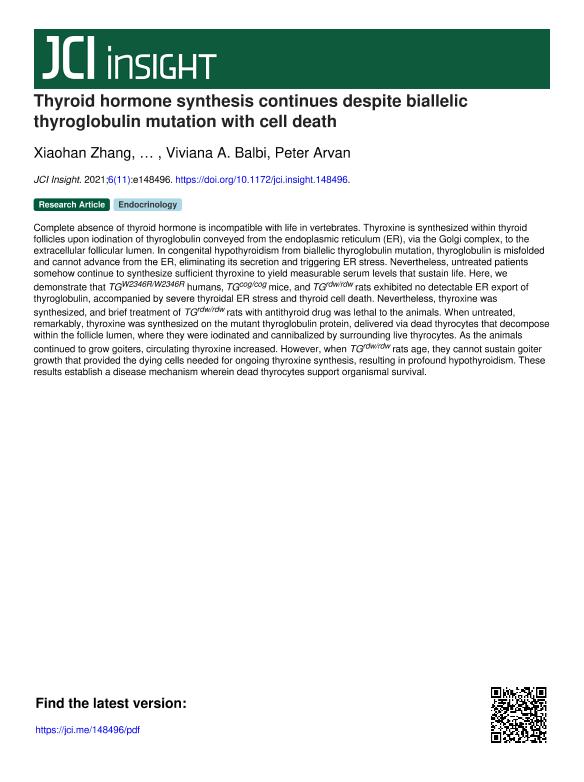
Complete absence of thyroid hormone is incompatible with life in vertebrates. Thyroxine is synthesized within thyroid follicles upon iodination of thyroglobulin conveyed from the endoplasmic reticulum (ER), via the Golgi complex, to the extracellular follicular lumen. In congenital hypothyroidism from biallelic thyroglobulin mutation, thyroglobulin is misfolded and cannot advance from the ER, eliminating its secretion and triggering ER stress. Nevertheless, untreated patients somehow continue to synthesize sufficient thyroxine to yield measurable serum levels that sustain life. Here, we demonstrate that TGW2346R/W2346R humans, TGcog/cog mice, and TGrdw/rdw rats exhibited no detectable ER export of thyroglobulin, accompanied by severe thyroidal ER stress and thyroid cell death. Nevertheless, thyroxine was synthesized, and brief treatment of TGrdw/rdw rats with antithyroid drug was lethal to the animals. When untreated, remarkably, thyroxine was synthesized on the mutant thyroglobulin protein, delivered via dead thyrocytes that decompose within the follicle lumen, where they were iodinated and cannibalized by surrounding live thyrocytes. As the animals continued to grow goiters, circulating thyroxine increased. However, when TGrdw/rdw rats age, they cannot sustain goiter growth that provided the dying cells needed for ongoing thyroxine synthesis, resulting in profound hypothyroidism. These results establish a disease mechanism wherein dead thyrocytes support organismal survival.
Palabras clave:
Endocrinology
,
Thyroid disease
Archivos asociados

Tamaño:
5.156Mb
Formato:
PDF
Licencia
 Excepto donde se diga explícitamente, este item se publica bajo la siguiente descripción:
Creative Commons Attribution-NonCommercial-ShareAlike 2.5 Unported (CC BY-NC-SA 2.5)
Excepto donde se diga explícitamente, este item se publica bajo la siguiente descripción:
Creative Commons Attribution-NonCommercial-ShareAlike 2.5 Unported (CC BY-NC-SA 2.5)
Identificadores
Colecciones
Articulos(INIGEM)
Articulos de INSTITUTO DE INMUNOLOGIA, GENETICA Y METABOLISMO
Articulos de INSTITUTO DE INMUNOLOGIA, GENETICA Y METABOLISMO
Citación
Zhang, Xiaohan; Kellogg, Aaron P.; Citterio, Cintia Eliana; Zhang, Hao; Larkin, Dennis; et al.; Thyroid hormone synthesis continues despite biallelic thyroglobulin mutation with cell death; American Society for Clinical Investigation; JCI Insight; 6; 11; 6-2021; 1-17
Compartir


Altmétricas