Artículo
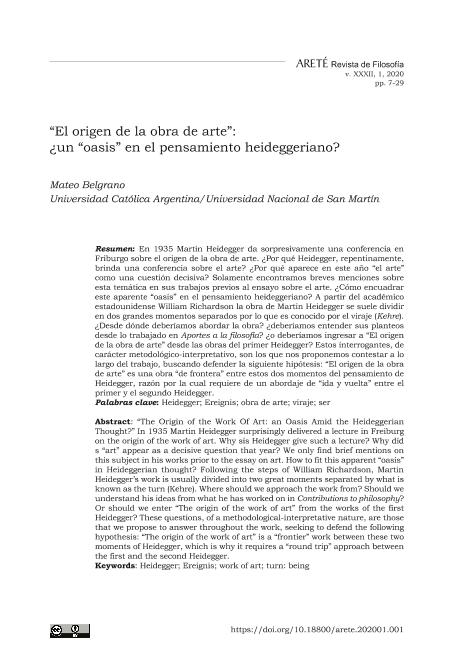
En 1935 Martin Heidegger da sorpresivamente una conferencia en Friburgo sobre el origen de la obra de arte. ¿Por qué Heidegger, repentinamente, brinda una conferencia sobre el arte? ¿Por qué aparece en este año “el arte” como una cuestión decisiva? Solamente encontramos breves menciones sobre esta temática en sus trabajos previos al ensayo sobre el arte. ¿Cómo encuadrar este aparente “oasis” en el pensamiento heideggeriano? A partir del académico estadounidense William Richardson la obra de Martin Heidegger se suele dividir en dos grandes momentos separados por lo que es conocido por el viraje (Kehre). ¿Desde dónde deberíamos abordar la obra? ¿deberíamos entender sus planteos desde lo trabajado en Aportes a la filosofía? ¿o deberíamos ingresar a “El origen de la obra de arte” desde las obras del primer Heidegger? Estos interrogantes, de carácter metodológico-interpretativo, son los que nos proponemos contestar a lo largo del trabajo, buscando defender la siguiente hipótesis: “El origen de la obra de arte” es una obra “de frontera” entre estos dos momentos del pensamiento de Heidegger, razón por la cual requiere de un abordaje de “ida y vuelta” entre el primer y el segundo Heidegger. In 1935 Martin Heidegger surprisingly delivered a lecture in Freiburg on the origin of the work of art. Why sis Heidegger give such a lecture? Why did s “art” appear as a decisive question that year? We only find brief mentions on this subject in his works prior to the essay on art. How to fit this apparent “oasis” in Heideggerian thought? Following the steps of William Richardson, Martin Heidegger’s work is usually divided into two great moments separated by what is known as the turn (Kehre). Where should we approach the work from? Should we understand his ideas from what he has worked on in Contributions to philosophy? Or should we enter “The origin of the work of art” from the works of the first Heidegger? These questions, of a methodological-interpretative nature, are those that we propose to answer throughout the work, seeking to defend the following hypothesis: “The origin of the work of art” is a “frontier” work between these two moments of Heidegger, which is why it requires a “round trip” approach between the first and the second Heidegger.
"El origen de la obra de arte":¿un "oasis" en el pensamiento heideggeriano?
Título:
“The Origin of the Work Of Art: an Oasis Amid the Heideggerian Thought?”

Fecha de publicación:
06/2020
Editorial:
Pontifica Universidad Católica del Perú. Departamento de Humanidades
Revista:
Areté
ISSN:
1016-913X
Idioma:
Español
Tipo de recurso:
Artículo publicado
Clasificación temática:
Resumen
Palabras clave:
EREIGNIS
,
HEIDEGGER
,
TURN: BEING
,
WORK OF ART
Archivos asociados

Tamaño:
450.6Kb
Formato:
PDF
Licencia
 Excepto donde se diga explícitamente, este item se publica bajo la siguiente descripción:
Creative Commons Attribution 2.5 Unported (CC BY 2.5)
Excepto donde se diga explícitamente, este item se publica bajo la siguiente descripción:
Creative Commons Attribution 2.5 Unported (CC BY 2.5)
Identificadores
Colecciones
Articulos(SEDE CENTRAL)
Articulos de SEDE CENTRAL
Articulos de SEDE CENTRAL
Citación
Belgrano, Mateo; "El origen de la obra de arte":¿un "oasis" en el pensamiento heideggeriano?; Pontifica Universidad Católica del Perú. Departamento de Humanidades; Areté; 32; 1; 6-2020; 7-29
Compartir


Altmétricas