Mostrar el registro sencillo del ítem
dc.contributor.author
Revon Rivière, Gabriel
dc.contributor.author
Banavali, Shripad
dc.contributor.author
Heississen, Laila
dc.contributor.author
Garcia, Wendy Gomez
dc.contributor.author
Abdolkarimi, Babak
dc.contributor.author
Vaithilingum, Manickavallie
dc.contributor.author
Li, Chi Kong
dc.contributor.author
Leung, Ping Chung
dc.contributor.author
Malik, Prabhat
dc.contributor.author
Pasquier, Eddy
dc.contributor.author
Epelman, Sidnei
dc.contributor.author
Chantada, Guillermo Luis
dc.contributor.author
André, Nicolas
dc.date.available
2021-06-08T17:20:09Z
dc.date.issued
2019-05
dc.identifier.citation
Revon Rivière, Gabriel; Banavali, Shripad; Heississen, Laila; Garcia, Wendy Gomez; Abdolkarimi, Babak; et al.; Metronomic chemotherapy for children in low- and middle-income countries: Survey of current practices and opinions of pediatric oncologists; American Society of Clinical Oncology; Journal of Global Oncology; 2019; 5; 5-2019; 1-8
dc.identifier.issn
2378-9506
dc.identifier.uri
http://hdl.handle.net/11336/133437
dc.description.abstract
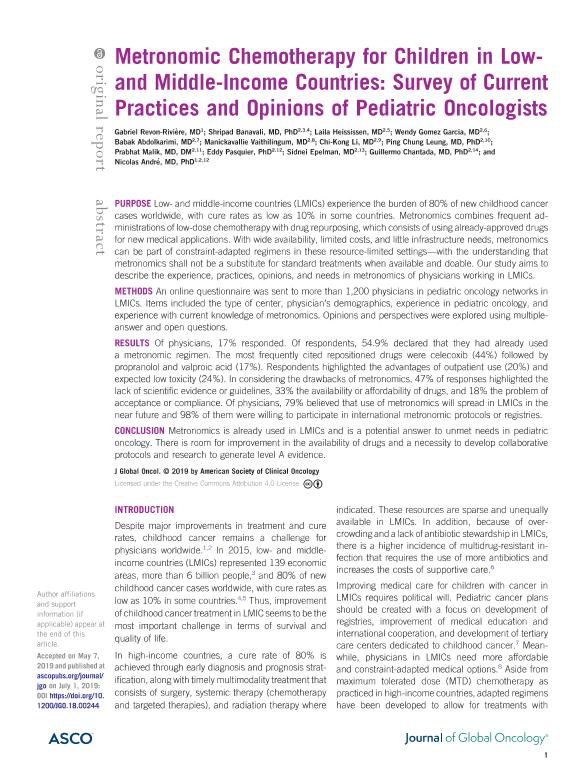
PURPOSE Low- and middle-income countries (LMICs) experience the burden of 80% of new childhood cancer cases worldwide, with cure rates as low as 10% in some countries. Metronomics combines frequent administrations of low-dose chemotherapy with drug repurposing, which consists of using already-approved drugs for new medical applications. With wide availability, limited costs, and little infrastructure needs, metronomics can be part of constraint-adapted regimens in these resource-limited settings?with the understanding that metronomics shall not be a substitute for standard treatments when available and doable. Our study aims to describe the experience, practices, opinions, and needs in metronomics of physicians working in LMICs. METHODS An online questionnaire was sent to more than 1,200 physicians in pediatric oncology networks in LMICs. Items included the type of center, physician?s demographics, experience in pediatric oncology, and experience with current knowledge of metronomics. Opinions and perspectives were explored using multiple-answer and open questions. RESULTS Of physicians, 17% responded. Of respondents, 54.9% declared that they had already used a metronomic regimen. The most frequently cited repositioned drugs were celecoxib (44%) followed by propranolol and valproic acid (17%). Respondents highlighted the advantages of outpatient use (20%) and expected low toxicity (24%). In considering the drawbacks of metronomics, 47% of responses highlighted the lack of scientific evidence or guidelines, 33% the availability or affordability of drugs, and 18% the problem of acceptance or compliance. Of physicians, 79% believed that use of metronomics will spread in LMICs in the near future and 98% of them were willing to participate in international metronomic protocols or registries. CONCLUSION Metronomics is already used in LMICs and is a potential answer to unmet needs in pediatric oncology. There is room for improvement in the availability of drugs and a necessity to develop collaborative protocols and research to generate level A evidence.
dc.format
application/pdf
dc.language.iso
eng
dc.publisher
American Society of Clinical Oncology
dc.rights
info:eu-repo/semantics/openAccess
dc.rights.uri
https://creativecommons.org/licenses/by-nc-sa/2.5/ar/
dc.subject
CHEMOTHERAPY
dc.subject
PEDIATRIC
dc.subject
CANCER
dc.subject.classification
Oncología
dc.subject.classification
Medicina Clínica
dc.subject.classification
CIENCIAS MÉDICAS Y DE LA SALUD
dc.title
Metronomic chemotherapy for children in low- and middle-income countries: Survey of current practices and opinions of pediatric oncologists
dc.type
info:eu-repo/semantics/article
dc.type
info:ar-repo/semantics/artículo
dc.type
info:eu-repo/semantics/publishedVersion
dc.date.updated
2021-05-27T12:38:36Z
dc.journal.volume
2019
dc.journal.number
5
dc.journal.pagination
1-8
dc.journal.pais
Estados Unidos
dc.description.fil
Fil: Revon Rivière, Gabriel. Hopital la Timone; Francia
dc.description.fil
Fil: Banavali, Shripad. Homi Bhabha National Institute; India. Metronomics Global Health Initiative; Francia. Tata Memorial Hospital; India
dc.description.fil
Fil: Heississen, Laila. Metronomics Global Health Initiative; Francia. Universite Mohammed V. Rabat; Otros paises de África
dc.description.fil
Fil: Garcia, Wendy Gomez. Metronomics Global Health Initiative; Francia
dc.description.fil
Fil: Abdolkarimi, Babak. Metronomics Global Health Initiative; Francia
dc.description.fil
Fil: Vaithilingum, Manickavallie. Metronomics Global Health Initiative; Francia
dc.description.fil
Fil: Li, Chi Kong. Metronomics Global Health Initiative; Francia
dc.description.fil
Fil: Leung, Ping Chung. Chinese University Of Hong Kong; República de China. Metronomics Global Health Initiative; Francia
dc.description.fil
Fil: Malik, Prabhat. All India Institute Of Medical Sciences; India. Metronomics Global Health Initiative; Francia
dc.description.fil
Fil: Pasquier, Eddy. Metronomics Global Health Initiative; Francia
dc.description.fil
Fil: Epelman, Sidnei. Metronomics Global Health Initiative; Francia
dc.description.fil
Fil: Chantada, Guillermo Luis. Metronomics Global Health Initiative; Francia. Gobierno de la Ciudad de Buenos Aires. Hospital de Pediatría "Juan P. Garrahan"; Argentina. Consejo Nacional de Investigaciones Científicas y Técnicas; Argentina
dc.description.fil
Fil: André, Nicolas. Hopital la Timone; Francia. Metronomics Global Health Initiative; Francia
dc.journal.title
Journal of Global Oncology
dc.relation.alternativeid
info:eu-repo/semantics/altIdentifier/doi/http://dx.doi.org/10.1200/JGO.18.00244
dc.relation.alternativeid
info:eu-repo/semantics/altIdentifier/url/https://ascopubs.org/doi/10.1200/JGO.18.00244
Archivos asociados

Tamaño:
919.4Kb
Formato:
PDF