Artículo
Relict sand wedges in southern Patagonia and their stratigraphic and paleo-environmental significance
Bockheim, J.; Coronato, Andrea Maria Josefa ; Rabassa, Jorge Oscar
; Ercolano, Bettina; Ponce, Juan Federico
; Rabassa, Jorge Oscar
; Ercolano, Bettina; Ponce, Juan Federico
; Rabassa, Jorge Oscar
; Ercolano, Bettina; Ponce, Juan Federico
Fecha de publicación:
06/2009
Editorial:
Pergamon-Elsevier Science Ltd
Revista:
Quaternary Science Reviews
ISSN:
0277-3791
Idioma:
Inglés
Tipo de recurso:
Artículo publicado
Clasificación temática:
Resumen
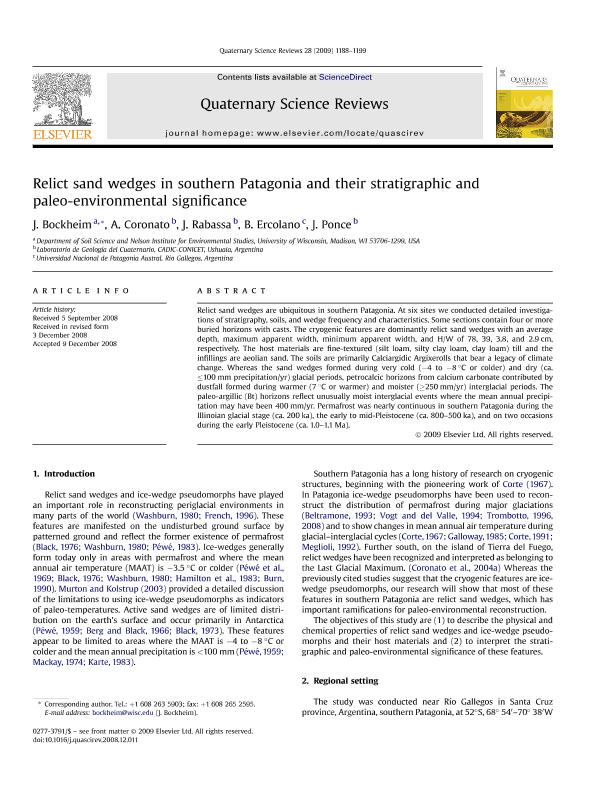
Relict sand wedges are ubiquitous in southern Patagonia. At six sites we conducted detailed investigations of stratigraphy, soils, and wedge frequency and characteristics. Some sections contain four or more buried horizons with casts. The cryogenic features are dominantly relict sand wedges with an average depth, maximum apparent width, minimum apparent width, and H/W of 78, 39, 3.8, and 2.9 cm, respectively. The host materials are fine-textured (silt loam, silty clay loam, clay loam) till and the infillings are aeolian sand. The soils are primarily Calciargidic Argixerolls that bear a legacy of climate change. Whereas the sand wedges formed during very cold (-4 to -8 °C or colder) and dry (ca. ≤100 mm precipitation/yr) glacial periods, petrocalcic horizons from calcium carbonate contributed by dustfall formed during warmer (7 °C or warmer) and moister (≥250 mm/yr) interglacial periods. The paleo-argillic (Bt) horizons reflect unusually moist interglacial events where the mean annual precipitation may have been 400 mm/yr. Permafrost was nearly continuous in southern Patagonia during the Illinoian glacial stage (ca. 200 ka), the early to mid-Pleistocene (ca. 800-500 ka), and on two occasions during the early Pleistocene (ca. 1.0-1.1 Ma).
Archivos asociados

Tamaño:
1.371Mb
Formato:
PDF
Licencia
 Excepto donde se diga explícitamente, este item se publica bajo la siguiente descripción:
Creative Commons Attribution-NonCommercial-ShareAlike 2.5 Unported (CC BY-NC-SA 2.5)
Excepto donde se diga explícitamente, este item se publica bajo la siguiente descripción:
Creative Commons Attribution-NonCommercial-ShareAlike 2.5 Unported (CC BY-NC-SA 2.5)
Identificadores
Colecciones
Articulos(CADIC)
Articulos de CENTRO AUSTRAL DE INVESTIGACIONES CIENTIFICAS
Articulos de CENTRO AUSTRAL DE INVESTIGACIONES CIENTIFICAS
Citación
Bockheim, J.; Coronato, Andrea Maria Josefa; Rabassa, Jorge Oscar; Ercolano, Bettina; Ponce, Juan Federico; Relict sand wedges in southern Patagonia and their stratigraphic and paleo-environmental significance; Pergamon-Elsevier Science Ltd; Quaternary Science Reviews; 28; 13-14; 6-2009; 1188-1199
Compartir


Altmétricas