Artículo
Variation in woody vegetation among sites with different disturbance histories in the Argentine Chaco

Fecha de publicación:
03/10/2003
Editorial:
Elsevier Science
Revista:
Forest Ecology and Management
ISSN:
0378-1127
Idioma:
Inglés
Tipo de recurso:
Artículo publicado
Clasificación temática:
Resumen
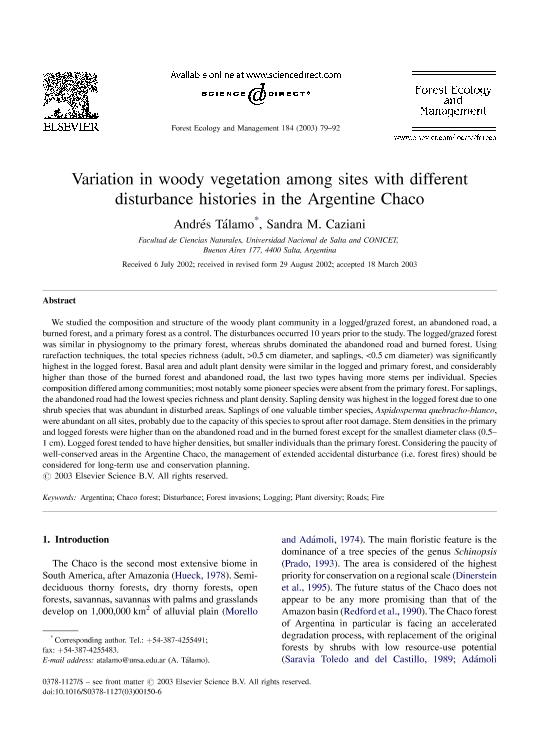
We studied the composition and structure of the woody plant community in a logged/grazed forest, an abandoned road, a burned forest, and a primary forest as a control. The disturbances occurred 10 years prior to the study. The logged/grazed forest was similar in physiognomy to the primary forest, whereas shrubs dominated the abandoned road and burned forest. Using rarefaction techniques, the total species richness (adult, >0.5 cm diameter, and saplings, <0.5 cm diameter) was significantly highest in the logged forest. Basal area and adult plant density were similar in the logged and primary forest, and considerably higher than those of the burned forest and abandoned road, the last two types having more stems per individual. Species composition differed among communities; most notably some pioneer species were absent from the primary forest. For saplings, the abandoned road had the lowest species richness and plant density. Sapling density was highest in the logged forest due to one shrub species that was abundant in disturbed areas. Saplings of one valuable timber species, Aspidosperma quebracho-blanco, were abundant on all sites, probably due to the capacity of this species to sprout after root damage. Stem densities in the primary and logged forests were higher than on the abandoned road and in the burned forest except for the smallest diameter class (0.5-1 cm). Logged forest tended to have higher densities, but smaller individuals than the primary forest. Considering the paucity of well-conserved areas in the Argentine Chaco, the management of extended accidental disturbance (i.e. forest fires) should be considered for long-term use and conservation planning.
Archivos asociados

Tamaño:
277.4Kb
Formato:
PDF
Licencia
 Excepto donde se diga explícitamente, este item se publica bajo la siguiente descripción:
Creative Commons Attribution-NonCommercial-ShareAlike 2.5 Unported (CC BY-NC-SA 2.5)
Excepto donde se diga explícitamente, este item se publica bajo la siguiente descripción:
Creative Commons Attribution-NonCommercial-ShareAlike 2.5 Unported (CC BY-NC-SA 2.5)
Identificadores
Colecciones
Articulos(CCT - SALTA-JUJUY)
Articulos de CTRO.CIENTIFICO TECNOL.CONICET - SALTA-JUJUY
Articulos de CTRO.CIENTIFICO TECNOL.CONICET - SALTA-JUJUY
Citación
Tálamo, Andrés; Caziani, Sandra Monica; Variation in woody vegetation among sites with different disturbance histories in the Argentine Chaco; Elsevier Science; Forest Ecology and Management; 184; 1-3; 3-10-2003; 79-92
Compartir


Altmétricas