Artículo
Interneuron NMDA receptor ablation induces hippocampus-prefrontal cortex functional hypoconnectivity after adolescence in a mouse model of schizophrenia

Fecha de publicación:
04/2020
Editorial:
Society for Neuroscience
Revista:
Journal of Neuroscience
ISSN:
0270-6474
Idioma:
Inglés
Tipo de recurso:
Artículo publicado
Clasificación temática:
Resumen
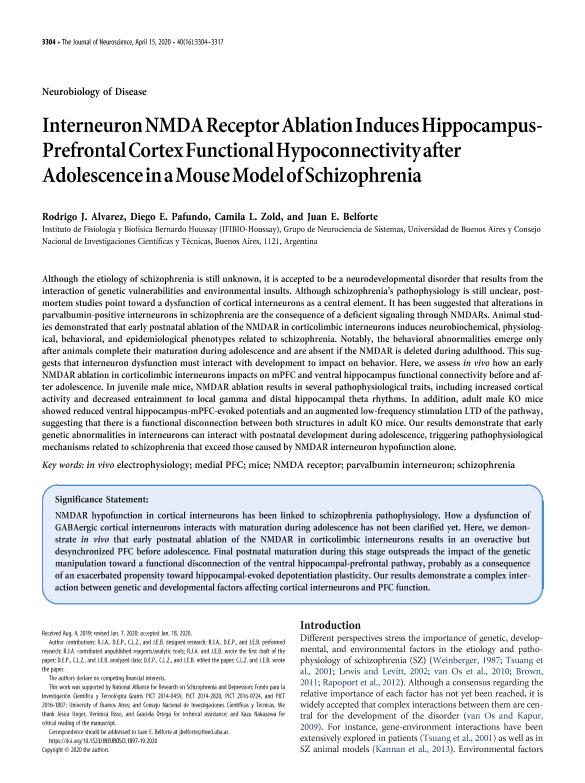
Although the etiology of schizophrenia is still unknown, it is accepted to be a neurodevelopmental disorder that results from the interaction of genetic vulnerabilities and environmental insults. Although schizophrenia’s pathophysiology is still unclear, postmortem studies point toward a dysfunction of cortical interneurons as a central element. It has been suggested that alterations in parvalbumin-positive interneurons in schizophrenia are the consequence of a deficient signaling through NMDARs. Animal studies demonstrated that early postnatal ablation of the NMDAR in corticolimbic interneurons induces neurobiochemical, physiological, behavioral, and epidemiological phenotypes related to schizophrenia. Notably, the behavioral abnormalities emerge only after animals complete their maturation during adolescence and are absent if the NMDAR is deleted during adulthood. This suggests that interneuron dysfunction must interact with development to impact on behavior. Here, we assess in vivo how an early NMDAR ablation in corticolimbic interneurons impacts on mPFC and ventral hippocampus functional connectivity before and after adolescence. In juvenile male mice, NMDAR ablation results in several pathophysiological traits, including increased cortical activity and decreased entrainment to local gamma and distal hippocampal theta rhythms. In addition, adult male KO mice showed reduced ventral hippocampus-mPFC-evoked potentials and an augmented low-frequency stimulation LTD of the pathway, suggesting that there is a functional disconnection between both structures in adult KO mice. Our results demonstrate that early genetic abnormalities in interneurons can interact with postnatal development during adolescence, triggering pathophysiological mechanisms related to schizophrenia that exceed those caused by NMDAR interneuron hypofunction alone.
Archivos asociados

Tamaño:
3.157Mb
Formato:
PDF
Licencia
 Excepto donde se diga explícitamente, este item se publica bajo la siguiente descripción:
Creative Commons Attribution-NonCommercial-ShareAlike 2.5 Unported (CC BY-NC-SA 2.5)
Excepto donde se diga explícitamente, este item se publica bajo la siguiente descripción:
Creative Commons Attribution-NonCommercial-ShareAlike 2.5 Unported (CC BY-NC-SA 2.5)
Identificadores
Colecciones
Articulos(IFIBIO HOUSSAY)
Articulos de INSTITUTO DE FISIOLOGIA Y BIOFISICA BERNARDO HOUSSAY
Articulos de INSTITUTO DE FISIOLOGIA Y BIOFISICA BERNARDO HOUSSAY
Citación
Alvarez, Rodrigo Javier; Pafundo, Diego Esteban; Zold, Camila Lidia; Belforte, Juan Emilio; Interneuron NMDA receptor ablation induces hippocampus-prefrontal cortex functional hypoconnectivity after adolescence in a mouse model of schizophrenia; Society for Neuroscience; Journal of Neuroscience; 40; 16; 4-2020; 3304-3317
Compartir


Altmétricas