Mostrar el registro sencillo del ítem
dc.contributor.author
Pessi, Priscila Jael
dc.contributor.author
Folatelli, Gaston
dc.contributor.author
Anderson, J. P.
dc.contributor.author
Bersten, Melina Cecilia
dc.contributor.author
Burns, C.
dc.contributor.author
Contreras, C.
dc.contributor.author
Davis, S.
dc.contributor.author
Englert Urrutia, Brenda Nahir
dc.contributor.author
Hamuy, M.
dc.contributor.author
Hsiao, Eric
dc.contributor.author
Martinez, Laureano
dc.contributor.author
Morrell, Nidia Irene
dc.contributor.author
Phillips, M. M.
dc.contributor.author
Suntzeff, N.
dc.contributor.author
Stritzinger, M. D.
dc.date.available
2021-04-15T03:20:51Z
dc.date.issued
2019-07-11
dc.identifier.citation
Pessi, Priscila Jael; Folatelli, Gaston; Anderson, J. P.; Bersten, Melina Cecilia; Burns, C.; et al.; Comparison of the optical light curves of hydrogen-rich and hydrogen-poor type II supernovae; Wiley Blackwell Publishing, Inc; Monthly Notices of the Royal Astronomical Society; 488; 3; 11-7-2019; 4239-4257
dc.identifier.issn
0035-8711
dc.identifier.uri
http://hdl.handle.net/11336/130077
dc.description.abstract
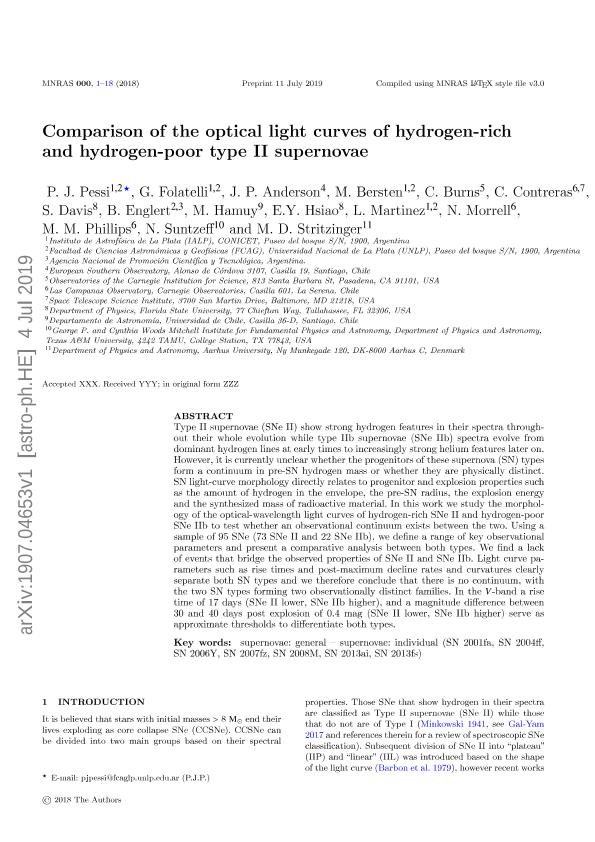
Type II supernovae (SNe II) show strong hydrogen features in their spectra throughout their whole evolution, while type IIb supernovae (SNe IIb) spectra evolve from dominant hydrogen lines at early times to increasingly strong helium features later on. However, it is currently unclear whether the progenitors of these SN types form a continuum in pre-SN hydrogen mass or whether they are physically distinct. SN light-curve morphology directly relates to progenitor and explosion properties such as the amount of hydrogen in the envelope, the pre-SN radius, the explosion energy, and the synthesized mass of radioactive material. In this work, we study the morphology of the optical-wavelength light curves of hydrogen-rich SNe II and hydrogen-poor SNe IIb to test whether an observational continuum exists between the two. Using a sample of 95 SNe (73 SNe II and 22 SNe IIb), we define a range of key observational parameters and present a comparative analysis between both types. We find a lack of events that bridge the observed properties of SNe II and IIb. Light-curve parameters such as rise times and post-maximum decline rates and curvatures clearly separate both SN types and we therefore conclude that there is no continuum, with the two SN types forming two observationally distinct families. In the V band a rise time of 17 d (SNe II lower and SNe IIb higher), and a magnitude difference between 30 and 40 d post-explosion of 0.4 mag (SNe II lower and SNe IIb higher) serve as approximate thresholds to differentiate both types.
dc.format
application/pdf
dc.language.iso
eng
dc.publisher
Wiley Blackwell Publishing, Inc
dc.rights
info:eu-repo/semantics/openAccess
dc.rights.uri
https://creativecommons.org/licenses/by-nc-sa/2.5/ar/
dc.subject
SN 2004FF
dc.subject
SN 2006Y
dc.subject
SN 2007FZ
dc.subject
SN 2008M
dc.subject
SN 2013AI
dc.subject
SN 2013FS)
dc.subject
SUPERNOVAE: GENERAL – SUPERNOVAE: INDIVIDUAL (SN 2001FA
dc.subject.classification
Astronomía
dc.subject.classification
Ciencias Físicas
dc.subject.classification
CIENCIAS NATURALES Y EXACTAS
dc.title
Comparison of the optical light curves of hydrogen-rich and hydrogen-poor type II supernovae
dc.type
info:eu-repo/semantics/article
dc.type
info:ar-repo/semantics/artículo
dc.type
info:eu-repo/semantics/publishedVersion
dc.date.updated
2020-11-19T22:00:32Z
dc.journal.volume
488
dc.journal.number
3
dc.journal.pagination
4239-4257
dc.journal.pais
Reino Unido
dc.journal.ciudad
Londres
dc.description.fil
Fil: Pessi, Priscila Jael. Consejo Nacional de Investigaciones Científicas y Técnicas. Centro Científico Tecnológico Conicet - La Plata. Instituto de Astrofísica La Plata. Universidad Nacional de La Plata. Facultad de Ciencias Astronómicas y Geofísicas. Instituto de Astrofísica La Plata; Argentina. Universidad Nacional de La Plata. Facultad de Ciencias Astronómicas y Geofísicas; Argentina
dc.description.fil
Fil: Folatelli, Gaston. Universidad Nacional de La Plata. Facultad de Ciencias Astronómicas y Geofísicas; Argentina. Consejo Nacional de Investigaciones Científicas y Técnicas. Centro Científico Tecnológico Conicet - La Plata. Instituto de Astrofísica La Plata. Universidad Nacional de La Plata. Facultad de Ciencias Astronómicas y Geofísicas. Instituto de Astrofísica La Plata; Argentina
dc.description.fil
Fil: Anderson, J. P.. European Southern Observatory Chile.; Chile
dc.description.fil
Fil: Bersten, Melina Cecilia. Universidad Nacional de La Plata. Facultad de Ciencias Astronómicas y Geofísicas; Argentina. Consejo Nacional de Investigaciones Científicas y Técnicas. Centro Científico Tecnológico Conicet - La Plata. Instituto de Astrofísica La Plata. Universidad Nacional de La Plata. Facultad de Ciencias Astronómicas y Geofísicas. Instituto de Astrofísica La Plata; Argentina
dc.description.fil
Fil: Burns, C.. Observatories Of The Carnegie Institution For Science; Estados Unidos
dc.description.fil
Fil: Contreras, C.. Las Campanas Observatory; Chile. Space Telescope Science Institute; Estados Unidos
dc.description.fil
Fil: Davis, S.. Florida State University; Estados Unidos
dc.description.fil
Fil: Englert Urrutia, Brenda Nahir. Ministerio de Ciencia. Tecnología e Innovación Productiva. Agencia Nacional de Promoción Científica y Tecnológica; Argentina. Universidad Nacional de La Plata. Facultad de Ciencias Astronómicas y Geofísicas; Argentina
dc.description.fil
Fil: Hamuy, M.. Universidad de Chile; Chile
dc.description.fil
Fil: Hsiao, Eric. Florida State University; Estados Unidos
dc.description.fil
Fil: Martinez, Laureano. Universidad Nacional de La Plata. Facultad de Ciencias Astronómicas y Geofísicas; Argentina. Consejo Nacional de Investigaciones Científicas y Técnicas. Centro Científico Tecnológico Conicet - La Plata. Instituto de Astrofísica La Plata. Universidad Nacional de La Plata. Facultad de Ciencias Astronómicas y Geofísicas. Instituto de Astrofísica La Plata; Argentina
dc.description.fil
Fil: Morrell, Nidia Irene. Las Campanas Observatory; Chile. Consejo Nacional de Investigaciones Científicas y Técnicas. Centro Científico Tecnológico Conicet - La Plata. Instituto de Astrofísica La Plata. Universidad Nacional de La Plata. Facultad de Ciencias Astronómicas y Geofísicas. Instituto de Astrofísica La Plata; Argentina
dc.description.fil
Fil: Phillips, M. M.. Las Campanas Observatory; Chile
dc.description.fil
Fil: Suntzeff, N.. Texas A&M University; Estados Unidos
dc.description.fil
Fil: Stritzinger, M. D.. University Aarhus; Dinamarca
dc.journal.title
Monthly Notices of the Royal Astronomical Society
dc.relation.alternativeid
info:eu-repo/semantics/altIdentifier/url/https://academic.oup.com/mnras/article/488/3/4239/5531326
dc.relation.alternativeid
info:eu-repo/semantics/altIdentifier/doi/http://dx.doi.org/10.1093/mnras/stz1855
dc.relation.alternativeid
info:eu-repo/semantics/altIdentifier/url/https://arxiv.org/abs/1907.04653
Archivos asociados

Tamaño:
1.491Mb
Formato:
PDF