Artículo
The exceptional Herbig Ae star HD 101412: The first detection of resolved magnetically split lines and the presence of chemical spots in a Herbig star
Hubrig, S.; Schöller, M.; Savanov, I.; Gonzalez, Jorge Federico ; Cowley, C. R.; Schütz, O.; Arlt, R.; Rüdiger, G.
; Cowley, C. R.; Schütz, O.; Arlt, R.; Rüdiger, G.
Fecha de publicación:
04/2010
Editorial:
Wiley Vch Verlag
Revista:
Astronomische Nachrichten
ISSN:
0004-6337
Idioma:
Inglés
Tipo de recurso:
Artículo publicado
Clasificación temática:
Resumen
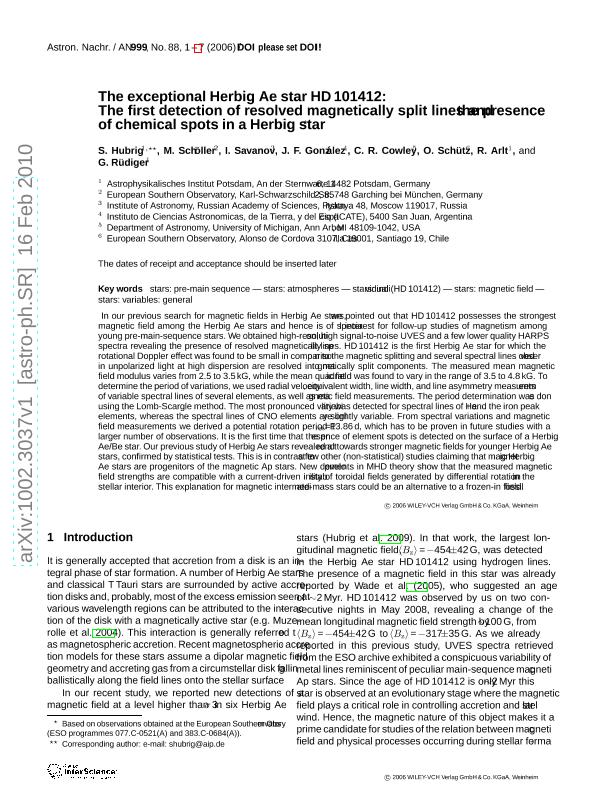
In our previous search for magnetic fields in Herbig Ae stars, we pointed out that HD 101412 possesses the strongest magnetic field among the Herbig Ae stars and hence is of special interest for follow-up studies of magnetism among young pre-main-sequence stars. We obtained high-resolution, high signal-to-noise UVES and a few lower quality HARPS spectra revealing the presence of resolved magnetically split lines. HD 101412 is the first Herbig Ae star for which the rotational Doppler effect was found to be small in comparison to the magnetic splitting and several spectral lines observed in unpolarized light at high dispersion are resolved into magnetically split components. The measured mean magnetic field modulus varies from 2.5 to 3.5 kG, while the mean quadratic field was found to vary in the range of 3.5 to 4.8 kG. To determine the period of variations, we used radial velocity, equivalent width, line width, and line asymmetry measurements of variable spectral lines of several elements, as well as magnetic field measurements. The period determination was done using the Lomb-Scargle method. The most pronounced variability was detected for spectral lines of He I and the iron peak elements, whereas the spectral lines of CNO elements are only slightly variable. From spectral variations and magnetic field measurements we derived a potential rotation period P_rot=13.86 d, which has to be proven in future studies with a larger number of observations. It is the first time that the presence of element spots is detected on the surface of a Herbig Ae/Be star. Our previous study of Herbig Ae stars revealed a trend towards stronger magnetic fields for younger Herbig Ae stars, confirmed by statistical tests. This is in contrast to a few other (non-statistical) studies claiming that magnetic Herbig Ae stars are progenitors of the magnetic Ap stars. New developments in MHD theory show that the measured magnetic field strengths are compatible with a current-driven instability of toroidal fields generated by differential rotation in the stellar interior. This explanation for magnetic intermediate-mass stars could be an alternative to a frozen-in fossil field.
Archivos asociados

Tamaño:
474.4Kb
Formato:
PDF
Licencia
 Excepto donde se diga explícitamente, este item se publica bajo la siguiente descripción:
Creative Commons Attribution-NonCommercial-ShareAlike 2.5 Unported (CC BY-NC-SA 2.5)
Excepto donde se diga explícitamente, este item se publica bajo la siguiente descripción:
Creative Commons Attribution-NonCommercial-ShareAlike 2.5 Unported (CC BY-NC-SA 2.5)
Identificadores
Colecciones
Articulos(ICATE)
Articulos de INST.D/CS ASTRONOMICAS D/LA TIERRA Y DEL ESPACIO
Articulos de INST.D/CS ASTRONOMICAS D/LA TIERRA Y DEL ESPACIO
Citación
Hubrig, S.; Schöller, M.; Savanov, I.; Gonzalez, Jorge Federico; Cowley, C. R.; et al.; The exceptional Herbig Ae star HD 101412: The first detection of resolved magnetically split lines and the presence of chemical spots in a Herbig star; Wiley Vch Verlag; Astronomische Nachrichten; 331; 4; 4-2010; 361-367
Compartir

