Artículo
Transition metals as dopants on nickel borides: Their catalytic activity effect on hydrogenation reactions
Acosta, Delicia Ester ; Ramírez, Norma; Erdamnn, Eleonora; Gonzo, Elio Emilio
; Destefanis, Hugo Alberto
; Ramírez, Norma; Erdamnn, Eleonora; Gonzo, Elio Emilio
; Destefanis, Hugo Alberto
; Ramírez, Norma; Erdamnn, Eleonora; Gonzo, Elio Emilio
; Destefanis, Hugo Alberto
Fecha de publicación:
04/2008
Editorial:
Elsevier Science
Revista:
Catalysis Today
ISSN:
0920-5861
Idioma:
Inglés
Tipo de recurso:
Artículo publicado
Clasificación temática:
Resumen
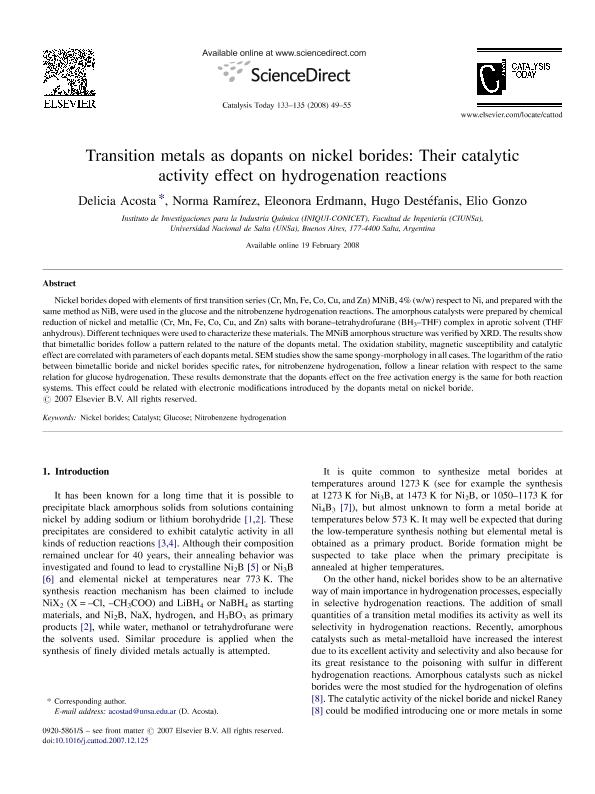
Nickel borides doped with elements of first transition series (Cr, Mn, Fe, Co, Cu, and Zn) MNiB, 4% (w/w) respect to Ni, and prepared with the same method as NiB, were used in the glucose and the nitrobenzene hydrogenation reactions. The amorphous catalysts were prepared by chemical reduction of nickel and metallic (Cr, Mn, Fe, Co, Cu, and Zn) salts with borane-tetrahydrofurane (BH3-THF) complex in aprotic solvent (THF anhydrous). Different techniques were used to characterize these materials. The MNiB amorphous structure was verified by XRD. The results show that bimetallic borides follow a pattern related to the nature of the dopants metal. The oxidation stability, magnetic susceptibility and catalytic effect are correlated with parameters of each dopants metal. SEM studies show the same spongy-morphology in all cases. The logarithm of the ratio between bimetallic boride and nickel borides specific rates, for nitrobenzene hydrogenation, follow a linear relation with respect to the same relation for glucose hydrogenation. These results demonstrate that the dopants effect on the free activation energy is the same for both reaction systems. This effect could be related with electronic modifications introduced by the dopants metal on nickel boride.
Palabras clave:
CATALYST
,
GLUCOSE
,
NICKEL BORIDES
,
NITROBENZENE HYDROGENATION
Archivos asociados

Tamaño:
944.5Kb
Formato:
PDF
Licencia
 Excepto donde se diga explícitamente, este item se publica bajo la siguiente descripción:
Creative Commons Attribution-NonCommercial-ShareAlike 2.5 Unported (CC BY-NC-SA 2.5)
Excepto donde se diga explícitamente, este item se publica bajo la siguiente descripción:
Creative Commons Attribution-NonCommercial-ShareAlike 2.5 Unported (CC BY-NC-SA 2.5)
Identificadores
Colecciones
Articulos(INIQUI)
Articulos de INST.DE INVEST.PARA LA INDUSTRIA QUIMICA (I)
Articulos de INST.DE INVEST.PARA LA INDUSTRIA QUIMICA (I)
Citación
Acosta, Delicia Ester; Ramírez, Norma; Erdamnn, Eleonora; Gonzo, Elio Emilio; Destefanis, Hugo Alberto; Transition metals as dopants on nickel borides: Their catalytic activity effect on hydrogenation reactions; Elsevier Science; Catalysis Today; 133-135; 1-4; 4-2008; 49-55
Compartir


Altmétricas