Artículo
Changes in the Expression of the Alzheimer's Disease-Associated Presenilin Gene in Drosophila Heart Leads to Cardiac Dysfunction
Li, A.; Zhou, C.; Moore, J.; Zhang, P.; Tsai, T. H.; Lee, H. C.; Romano, D. M.; McKee, M. L.; Schoenfeld, D. A.; Serra, M. J.; Raygor, K.; Cantiello, Horacio Fabio ; Fujimoto, J. G.; Tanzi, R. E.
; Fujimoto, J. G.; Tanzi, R. E.
Fecha de publicación:
04/2011
Editorial:
Bentham Science Publishers
Revista:
Current Alzheimer Research
ISSN:
1567-2050
Idioma:
Inglés
Tipo de recurso:
Artículo publicado
Clasificación temática:
Resumen
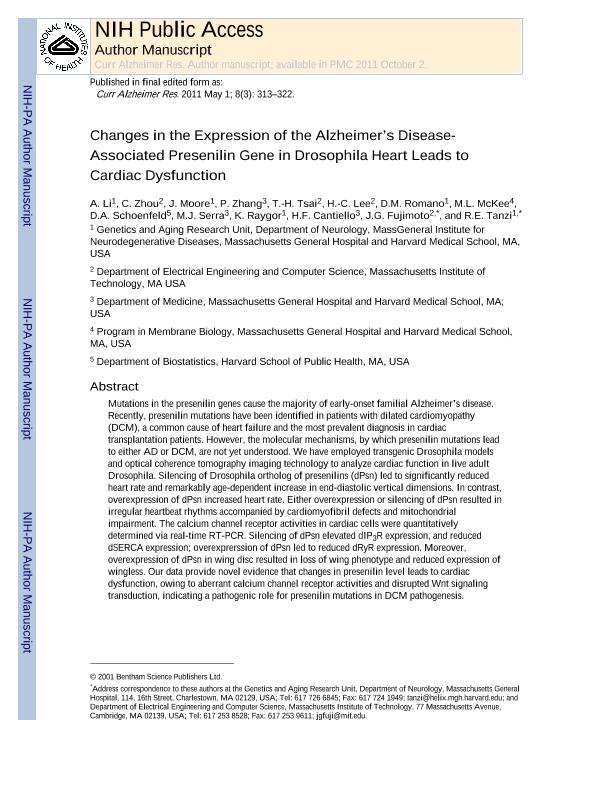
Mutations in the presenilin genes cause the majority of early-onset familial Alzheimers disease. Recently, presenilin mutations have been identified in patients with dilated cardiomyopathy (DCM), a common cause of heart failure and the most prevalent diagnosis in cardiac transplantation patients. However, the molecular mechanisms, by which presenilin mutations lead to either AD or DCM, are not yet understood. We have employed transgenic Drosophila models and optical coherence tomography imaging technology to analyze cardiac function in live adult Drosophila. Silencing of Drosophila ortholog of presenilins (dPsn) led to significantly reduced heart rate and remarkably age-dependent increase in end-diastolic vertical dimensions. In contrast, overexpression of dPsn increased heart rate. Either overexpression or silencing of dPsn resulted in irregular heartbeat rhythms accompanied by cardiomyofibril defects and mitochondrial impairment. The calcium channel receptor activities in cardiac cells were quantitatively determined via real-time RT-PCR. Silencing of dPsn elevated dIP3R expression, and reduced dSERCA expression; overexprerssion of dPsn led to reduced dRyR expression. Moreover, overexpression of dPsn in wing disc resulted in loss of wing phenotype and reduced expression of wingless. Our data provide novel evidence that changes in presenilin level leads to cardiac dysfunction, owing to aberrant calcium channel receptor activities and disrupted Wnt signaling transduction, indicating a pathogenic role for presenilin mutations in DCM pathogenesis.
Palabras clave:
Alzheimer'S Disease-Associated Presenilin Gene
,
Cardiac Disfunction
Archivos asociados

Tamaño:
2.631Mb
Formato:
PDF
Licencia
 Excepto donde se diga explícitamente, este item se publica bajo la siguiente descripción:
Creative Commons Attribution-NonCommercial-ShareAlike 2.5 Unported (CC BY-NC-SA 2.5)
Excepto donde se diga explícitamente, este item se publica bajo la siguiente descripción:
Creative Commons Attribution-NonCommercial-ShareAlike 2.5 Unported (CC BY-NC-SA 2.5)
Identificadores
Colecciones
Articulos(OCA HOUSSAY)
Articulos de OFICINA DE COORDINACION ADMINISTRATIVA HOUSSAY
Articulos de OFICINA DE COORDINACION ADMINISTRATIVA HOUSSAY
Citación
Li, A.; Zhou, C.; Moore, J.; Zhang, P.; Tsai, T. H.; et al.; Changes in the Expression of the Alzheimer's Disease-Associated Presenilin Gene in Drosophila Heart Leads to Cardiac Dysfunction; Bentham Science Publishers; Current Alzheimer Research; 8; 3; 4-2011; 313-322
Compartir


Altmétricas