Artículo
Suppressing aneuploidy-associated phenotypes improves the fitness of Trisomy 21 Cells
Hwang, Sunyoung; Williams, Jessica F.; Kneissig, Maja; Lioudyno, Maria; Rivera, Isabel; Helguera, Pablo Rodolfo ; Busciglio, Jorge; Storchova, Zuzana; King, Megan C.; Torres, Martin Eduardo
; Busciglio, Jorge; Storchova, Zuzana; King, Megan C.; Torres, Martin Eduardo
Fecha de publicación:
11/2019
Editorial:
Elsevier B.V.
Revista:
Cell Reports
ISSN:
2211-1247
Idioma:
Inglés
Tipo de recurso:
Artículo publicado
Clasificación temática:
Resumen
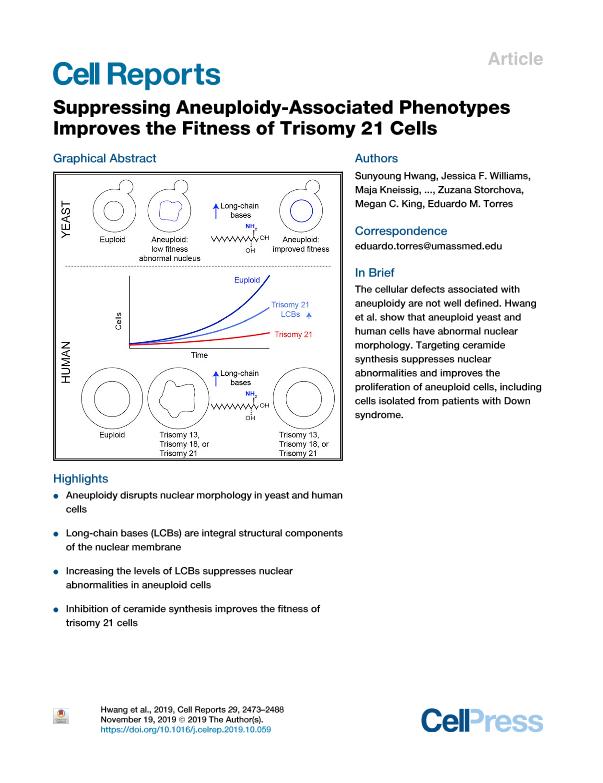
An abnormal number of chromosomes, or aneuploidy, accounts for most spontaneous abortions, causes developmental defects, and is associated with aging and cancer. The molecular mechanisms by which aneuploidy disrupts cellular function remain largely unknown. Here, we show that aneuploidy disrupts the morphology of the nucleus. Mutations that increase the levels of long-chain bases suppress nuclear abnormalities of aneuploid yeast independent of karyotype identity. Quantitative lipidomics indicates that long-chain bases are integral components of the nuclear membrane in yeast. Cells isolated from patients with Down syndrome also show that abnormal nuclear morphologies and increases in long-chain bases not only suppress these abnormalities but also improve their fitness. We obtained similar results with cells isolated from patients with Patau or Edward syndrome, indicating that increases in long-chain bases improve the fitness of aneuploid cells in yeast and humans. Targeting lipid biosynthesis pathways represents an important strategy to suppress nuclear abnormalities in aneuploidy-associated diseases. The cellular defects associated with aneuploidy are not well defined. Hwang et al. show that aneuploid yeast and human cells have abnormal nuclear morphology. Targeting ceramide synthesis suppresses nuclear abnormalities and improves the proliferation of aneuploid cells, including cells isolated from patients with Down syndrome.
Archivos asociados

Tamaño:
2.985Mb
Formato:
PDF
Licencia
 Excepto donde se diga explícitamente, este item se publica bajo la siguiente descripción:
Creative Commons Attribution-NonCommercial-ShareAlike 2.5 Unported (CC BY-NC-SA 2.5)
Excepto donde se diga explícitamente, este item se publica bajo la siguiente descripción:
Creative Commons Attribution-NonCommercial-ShareAlike 2.5 Unported (CC BY-NC-SA 2.5)
Identificadores
Colecciones
Articulos(INIMEC - CONICET)
Articulos de INSTITUTO DE INV. MEDICAS MERCEDES Y MARTIN FERREYRA
Articulos de INSTITUTO DE INV. MEDICAS MERCEDES Y MARTIN FERREYRA
Citación
Hwang, Sunyoung; Williams, Jessica F.; Kneissig, Maja; Lioudyno, Maria; Rivera, Isabel; et al.; Suppressing aneuploidy-associated phenotypes improves the fitness of Trisomy 21 Cells; Elsevier B.V.; Cell Reports; 29; 8; 11-2019; 2473-2488.e5
Compartir


Altmétricas