Artículo
RW Doradus: A solar-type shallow contact binary with a new orbital period investigation
Sarotsakulchai, Thawicharat; Qian, Sheng Bang; Soonthornthum, Boonrucksar; Fernandez Lajus, Eduardo Eusebio ; Liu, Nian Ping; Zhou, Xiao; Zhang, Jia; Liao, Wen Ping; Reichart, Daniel E.; Haislip, Joshua B.; Kouprianov, Vladimir V.; Poshyachinda, Saran
; Liu, Nian Ping; Zhou, Xiao; Zhang, Jia; Liao, Wen Ping; Reichart, Daniel E.; Haislip, Joshua B.; Kouprianov, Vladimir V.; Poshyachinda, Saran
Fecha de publicación:
23/01/2019
Editorial:
Astronomical Soc Japan
Revista:
Publications Of The Astronomical Society Of Japan
ISSN:
0004-6264
Idioma:
Inglés
Tipo de recurso:
Artículo publicado
Clasificación temática:
Resumen
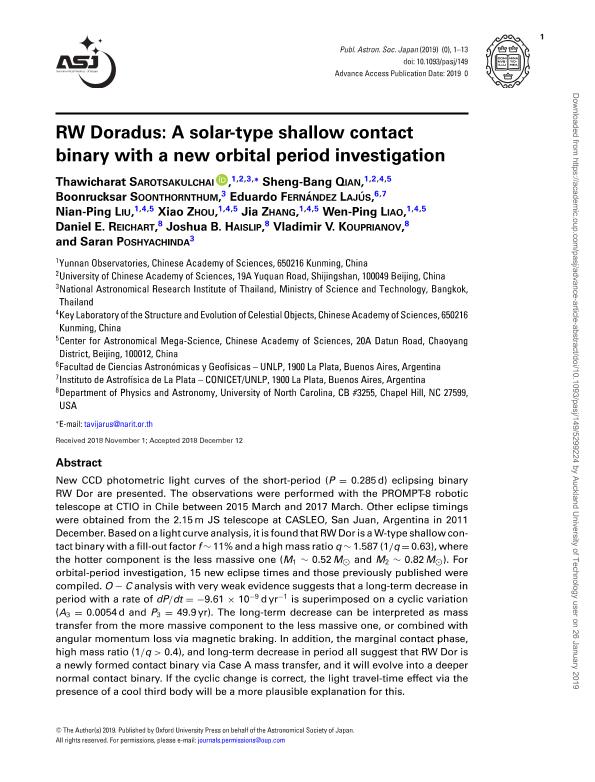
New CCD photometric light curves of the short-period (P = 0.285 d) eclipsing binary RW Dor are presented. The observations were performed with the PROMPT-8 robotic telescope at CTIO in Chile between 2015 March and 2017 March. Other eclipse timings were obtained from the 2.15 m JS telescope at CASLEO, San Juan, Argentina in 2011 December. Based on a light curve analysis, it is found that RW Dor is a W-type shallow contact binary with a fill-out factor f ∼ 11% and a high mass ratio q ∼ 1.587 (1/q = 0.63), where the hotter component is the less massive one (M1 ∼ 0.52 M and M2 ∼ 0.82 M). For orbital-period investigation, 15 new eclipse times and those previously published were compiled. O − C analysis with very weak evidence suggests that a long-term decrease in period with a rate of dP/dt = −9.61 × 10⁻⁹ d yr−1 is superimposed on a cyclic variation(A3 = 0.0054 d and P3 = 49.9 yr). The long-term decrease can be interpreted as mass transfer from the more massive component to the less massive one, or combined with angular momentum loss via magnetic braking. In addition, the marginal contact phase, high mass ratio (1/q > 0.4), and long-term decrease in period all suggest that RW Dor is a newly formed contact binary via Case A mass transfer, and it will evolve into a deepernormal contact binary. If the cyclic change is correct, the light travel-time effect via the presence of a cool third body will be a more plausible explanation for this.
Archivos asociados

Tamaño:
1.190Mb
Formato:
PDF
Licencia
 Excepto donde se diga explícitamente, este item se publica bajo la siguiente descripción:
Creative Commons Attribution-NonCommercial-ShareAlike 2.5 Unported (CC BY-NC-SA 2.5)
Excepto donde se diga explícitamente, este item se publica bajo la siguiente descripción:
Creative Commons Attribution-NonCommercial-ShareAlike 2.5 Unported (CC BY-NC-SA 2.5)
Identificadores
Colecciones
Articulos(IALP)
Articulos de INST.DE ASTROFISICA LA PLATA
Articulos de INST.DE ASTROFISICA LA PLATA
Citación
Sarotsakulchai, Thawicharat; Qian, Sheng Bang; Soonthornthum, Boonrucksar; Fernandez Lajus, Eduardo Eusebio; Liu, Nian Ping; et al.; RW Doradus: A solar-type shallow contact binary with a new orbital period investigation; Astronomical Soc Japan; Publications Of The Astronomical Society Of Japan; 71; 2; 23-1-2019; 1-13
Compartir


Altmétricas