Artículo
Accumulation of inorganic polyphosphate enables stress endurance and catalytic vigour in Pseudomonas putida KT2440

Fecha de publicación:
05/2013
Editorial:
Biomed Central
Revista:
Microbial Cell Factories
ISSN:
1475-2859
Idioma:
Inglés
Tipo de recurso:
Artículo publicado
Clasificación temática:
Resumen
Background
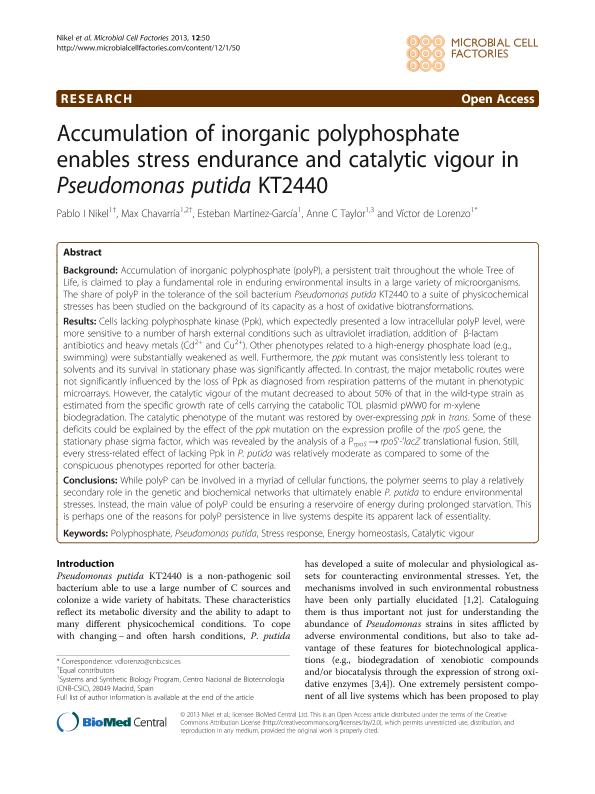
Accumulation of inorganic polyphosphate (polyP), a persistent trait throughout the whole Tree of Life, is claimed to play a fundamental role in enduring environmental insults in a large variety of microorganisms. The share of polyP in the tolerance of the soil bacterium Pseudomonas putida KT2440 to a suite of physicochemical stresses has been studied on the background of its capacity as a host of oxidative biotransformations.
Results
Cells lacking polyphosphate kinase (Ppk), which expectedly presented a low intracellular polyP level, were more sensitive to a number of harsh external conditions such as ultraviolet irradiation, addition of β-lactam antibiotics and heavy metals (Cd2+ and Cu2+). Other phenotypes related to a high-energy phosphate load (e.g., swimming) were substantially weakened as well. Furthermore, the ppk mutant was consistently less tolerant to solvents and its survival in stationary phase was significantly affected. In contrast, the major metabolic routes were not significantly influenced by the loss of Ppk as diagnosed from respiration patterns of the mutant in phenotypic microarrays. However, the catalytic vigour of the mutant decreased to about 50% of that in the wild-type strain as estimated from the specific growth rate of cells carrying the catabolic TOL plasmid pWW0 for m- xylene biodegradation. The catalytic phenotype of the mutant was restored by over-expressing ppk in trans. Some of these deficits could be explained by the effect of the ppk mutation on the expression profile of the rpoS gene, the stationary phase sigma factor, which was revealed by the analysis of a P rpoS → rpoS‘-’lacZ translational fusion. Still, every stress-related effect of lacking Ppk in P. putida was relatively moderate as compared to some of the conspicuous phenotypes reported for other bacteria.
Conclusions
While polyP can be involved in a myriad of cellular functions, the polymer seems to play a relatively secondary role in the genetic and biochemical networks that ultimately enable P. putida to endure environmental stresses. Instead, the main value of polyP could be ensuring a reservoire of energy during prolonged starvation. This is perhaps one of the reasons for polyP persistence in live systems despite its apparent lack of essentiality.
Archivos asociados

Tamaño:
1.576Mb
Formato:
PDF
Licencia
 Excepto donde se diga explícitamente, este item se publica bajo la siguiente descripción:
Creative Commons Attribution 2.5 Unported (CC BY 2.5)
Excepto donde se diga explícitamente, este item se publica bajo la siguiente descripción:
Creative Commons Attribution 2.5 Unported (CC BY 2.5)
Identificadores
Colecciones
Articulos(IIB-INTECH)
Articulos de INST.DE INVEST.BIOTECNOLOGICAS - INSTITUTO TECNOLOGICO CHASCOMUS
Articulos de INST.DE INVEST.BIOTECNOLOGICAS - INSTITUTO TECNOLOGICO CHASCOMUS
Citación
Nikel, Pablo Ivan; Chavarría, Max; Martínez García, Esteban; Taylor, Ann C.; de Lorenzo, Víctor; Accumulation of inorganic polyphosphate enables stress endurance and catalytic vigour in Pseudomonas putida KT2440; Biomed Central; Microbial Cell Factories; 12; 5-2013; 50-62
Compartir

