Artículo
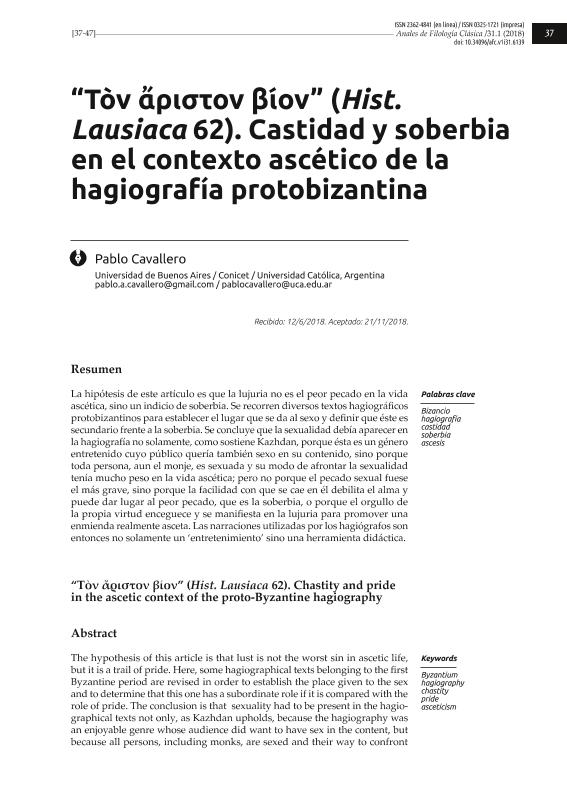
La hipótesis de este artículo es que la lujuria no es el peor pecado en la vida ascética, sino un indicio de soberbia. Se recorren diversos textos hagiográficos protobizantinos para establecer el lugar que se da al sexo y definir que éste es secundario frente a la soberbia. Se concluye que la sexualidad debía aparecer en la hagiografía no solamente, como sostiene Kazhdan, porque ésta es un género entretenido cuyo público quería también sexo en su contenido, sino porque toda persona, aun el monje, es sexuada y su modo de afrontar la sexualidad tenía mucho peso en la vida ascética; pero no porque el pecado sexual fuese el más grave, sino porque la facilidad con que se cae en él debilita el alma y puede dar lugar al peor pecado, que es la soberbia, o porque el orgullo de la propia virtud enceguece y se manifiesta en la lujuria para promover una enmienda realmente asceta. Las narraciones utilizadas por los hagiógrafos son entonces no solamente un ‘entretenimiento’ sino una herramienta didáctica. The hypothesis of this article is that lust is not the worst sin in ascetic life, but it is a trail of pride. Here, some hagiographical texts belonging to the first Byzantine period are revised in order to establish the place given to the sex and to determine that this one has a subordinate role if it is compared with the role of pride. The conclusion is that sexuality had to be present in the hagiographical texts not only, as Kazhdan upholds, because the hagiography was an enjoyable genre whose audience did want to have sex in the content, but because all persons, including monks, are sexed and their way to confront the sexuality had a prevalent importance in ascetic life; but not because the sexual sin were the most serious, but because the ease to fall in it weakens the soul and it gives rise to the worst of the sins, the pride; or because the man’s arrogance about his own virtue blinds him and becomes evident in the lust, in order to promote a really ascetic amendment. Then, the stories which are told by the hagiographers are not only an ‘entertainment’ but a didactic tool.
Τὸν ἄριστον βιοι” (Hist. Lausiaca 62). Castidad y soberbia en el contexto ascético de la hagiografía protobizantina
Título:
“Τὸν ἄριστον βίον” (Hist. Lausiaca 62). Chastity and pride in the ascetic context of the proto-Byzantine hagiography

Fecha de publicación:
23/05/2019
Editorial:
Universidad de Buenos Aires. Facultad de Filosofía y letras. Instituto de Filología clásica
Revista:
Anales de Filología Clásica
e-ISSN:
2362-4841
Idioma:
Español
Tipo de recurso:
Artículo publicado
Clasificación temática:
Resumen
Palabras clave:
BIZANCIO
,
HAGIOGRAFÍA
,
SEXO
,
CASTIDAD
,
ASCESIS
,
SOBERBIA
Archivos asociados

Tamaño:
478.0Kb
Formato:
PDF
Licencia
 Excepto donde se diga explícitamente, este item se publica bajo la siguiente descripción:
Creative Commons Attribution-ShareAlike 2.5 Unported (CC BY-SA 2.5)
Excepto donde se diga explícitamente, este item se publica bajo la siguiente descripción:
Creative Commons Attribution-ShareAlike 2.5 Unported (CC BY-SA 2.5)
Identificadores
Colecciones
Articulos(SEDE CENTRAL)
Articulos de SEDE CENTRAL
Articulos de SEDE CENTRAL
Citación
Cavallero, Pablo Adrian; Τὸν ἄριστον βιοι” (Hist. Lausiaca 62). Castidad y soberbia en el contexto ascético de la hagiografía protobizantina; Universidad de Buenos Aires. Facultad de Filosofía y letras. Instituto de Filología clásica; Anales de Filología Clásica; 1; 31; 23-5-2019; 37-47
Compartir


Altmétricas