Artículo
Mastering tricyclic ring systems for desirable functional cannabinoid activity
Petrov, Ravil R.; Knight, Lindsay; Chen, Shao Rui; Wager Miller, Jim; McDaniel, Steven W.; Diaz, Fanny; Barth, Francis; Pan, Hui Lin; Mackie, Ken; Cavasotto, Claudio Norberto ; Diaz, Philippe
; Diaz, Philippe
Fecha de publicación:
11/2013
Editorial:
Elsevier Masson
Revista:
European Journal Of Medical Chemistry
ISSN:
0223-5234
Idioma:
Inglés
Tipo de recurso:
Artículo publicado
Clasificación temática:
Resumen
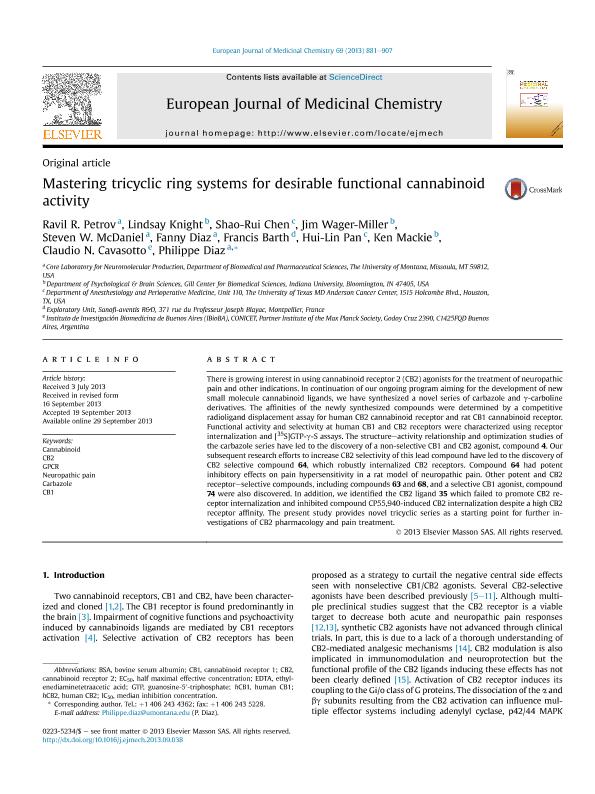
There is growing interest in using cannabinoid receptor 2 (CB2) agonists for the treatment of neuropathic pain and other indications. In continuation of our ongoing program aiming for the development of new small molecule cannabinoid ligands, we have synthesized a novel series of carbazole and γ-carboline derivatives. The affinities of the newly synthesized compounds were determined by a competitive radioligand displacement assay for human CB2 cannabinoid receptor and rat CB1 cannabinoid receptor. Functional activity and selectivity at human CB1 and CB2 receptors were characterized using receptor internalization and [35S]GTP-γ-S assays. The structure–activity relationship and optimization studies of the carbazole series have led to the discovery of a non-selective CB1 and CB2 agonist, compound 4. Our subsequent research efforts to increase CB2 selectivity of this lead compound have led to the discovery of CB2 selective compound 64, which robustly internalized CB2 receptors. Compound 64 had potent inhibitory effects on pain hypersensitivity in a rat model of neuropathic pain. Other potent and CB2 receptor–selective compounds, including compounds 63 and 68, and a selective CB1 agonist, compound 74 were also discovered. In addition, we identified the CB2 ligand 35 which failed to promote CB2 receptor internalization and inhibited compound CP55,940-induced CB2 internalization despite a high CB2 receptor affinity. The present study provides novel tricyclic series as a starting point for further investigations of CB2 pharmacology and pain treatment.
Archivos asociados

Tamaño:
2.487Mb
Formato:
PDF
Licencia
 Excepto donde se diga explícitamente, este item se publica bajo la siguiente descripción:
Atribución-NoComercial-SinDerivadas 2.5 Argentina (CC BY-NC-ND 2.5 AR)
Excepto donde se diga explícitamente, este item se publica bajo la siguiente descripción:
Atribución-NoComercial-SinDerivadas 2.5 Argentina (CC BY-NC-ND 2.5 AR)
Identificadores
Colecciones
Articulos(IBIOBA - MPSP)
Articulos de INST. D/INV.EN BIOMED.DE BS AS-CONICET-INST. PARTNER SOCIEDAD MAX PLANCK
Articulos de INST. D/INV.EN BIOMED.DE BS AS-CONICET-INST. PARTNER SOCIEDAD MAX PLANCK
Citación
Petrov, Ravil R.; Knight, Lindsay; Chen, Shao Rui; Wager Miller, Jim; McDaniel, Steven W.; et al.; Mastering tricyclic ring systems for desirable functional cannabinoid activity; Elsevier Masson; European Journal Of Medical Chemistry; 69; 11-2013; 881-907
Compartir


Altmétricas