Artículo
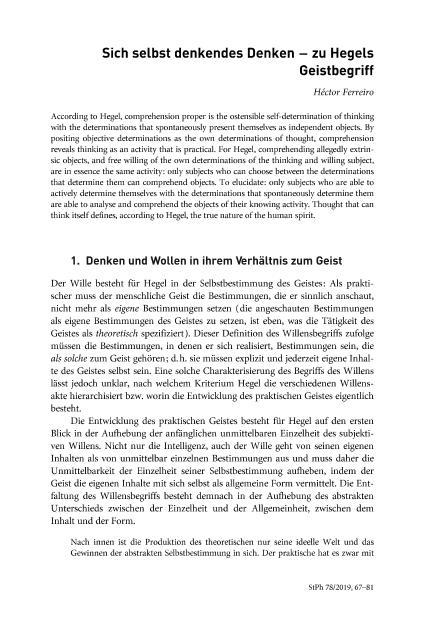
According to Hegel, comprehension proper is the ostensible self-determination of thinking with the determinations that spontaneously present themselves as independent objects. By positing objective determinations as the own determinations of thought, comprehension reveals thinking as an activity that is practical. For Hegel, comprehending allegedly extrinsic objects, and free willing of the own determinations of the thinking and willing subject, are in essence the same activity: only subjects who can choose between the determinations that determine them can comprehend objects. To elucidate: only subjects who are able to actively determine themselves with the determinations that spontaneously determine them are able to analyse and comprehend the objects of their knowing activity. Thought that can think itself defines, according to Hegel, the true nature of the human spirit. Das begreifende Denken ist für Hegel das sich selbst offenbare Selbstbestimmen des Geistes in der Bestimmung, die dem Denken zunächst als eine gegebene und selbstständige erscheint. Indem das Begreifen die Bestimmung, die am Anfang als eine fremde, d. h. als ein Gegenstand erscheint, als seine Selbst-bestimmung setzt, offenbart es das Denken überhaupt als ein als solches praktisches Tun. Das Begreifen von anscheinend fremden und selbständigen Gegenständen und das freie Wollen der eigenen Selbstbestimmungen sind für Hegel im Grunde dieselbe Tätigkeit: Begreifen kann nur, wer die Fähigkeit hat, sich dafür zu entschließen, was ihn bestimmt ? deutlicher ausgedrückt: Gegenstände begreifen kann nur, wer sich selbst in dem bestimmen kann, was ihn anfangs zwangsläufig bestimmt, d. h. wer darin wirklich frei sein kann. Diese in sich kreisende Bewegung, d. h. Denken, das sich selbst denkt, absolute Idealität, macht für Hegel das eigentliche Wesen des menschlichen Geistes aus.
Sich selbst denkendes Denken: Zu Hegels Geistbegriff

Fecha de publicación:
04/2019
Editorial:
Schwabe Verlag
Revista:
Studia Philosophica
ISSN:
0081-6825
e-ISSN:
2296-2883
Idioma:
Alemán
Tipo de recurso:
Artículo publicado
Clasificación temática:
Resumen
Palabras clave:
Geist
,
Erkenntnistheorie
,
Hegel
,
Idealismus
Archivos asociados

Tamaño:
97.15Kb
Formato:
PDF
Licencia
 Excepto donde se diga explícitamente, este item se publica bajo la siguiente descripción:
Creative Commons Attribution-NonCommercial-ShareAlike 2.5 Unported (CC BY-NC-SA 2.5)
Excepto donde se diga explícitamente, este item se publica bajo la siguiente descripción:
Creative Commons Attribution-NonCommercial-ShareAlike 2.5 Unported (CC BY-NC-SA 2.5)
Identificadores
Colecciones
Articulos(SEDE CENTRAL)
Articulos de SEDE CENTRAL
Articulos de SEDE CENTRAL
Citación
Ferreiro, Hector Alberto; Sich selbst denkendes Denken: Zu Hegels Geistbegriff; Schwabe Verlag; Studia Philosophica; 78; 4-2019; 67-81
Compartir

