Artículo
Microbial shifts following five years of cover cropping and tillage practices in fertile agroecosystems
Kim, Nakian; Zabaloy, Maria Celina ; Riggins, Chance W.; Rodríguez Zas, Sandra; Villamil, Maria Bonita
; Riggins, Chance W.; Rodríguez Zas, Sandra; Villamil, Maria Bonita
Fecha de publicación:
11/2020
Editorial:
MDPI AG
Revista:
Microorganisms
ISSN:
2076-2607
Idioma:
Inglés
Tipo de recurso:
Artículo publicado
Clasificación temática:
Resumen
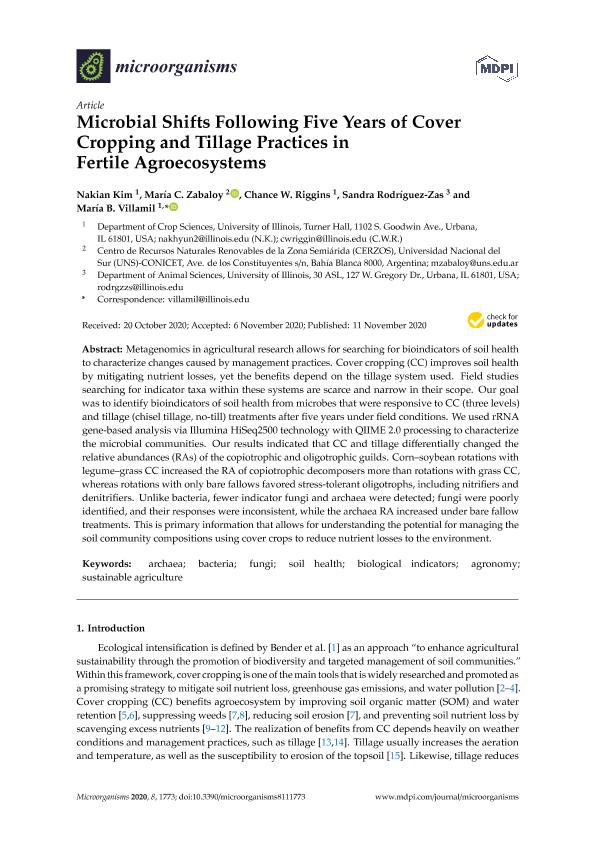
Metagenomics in agricultural research allows for searching for bioindicators of soil health to characterize changes caused by management practices. Cover cropping (CC) improves soil health by mitigating nutrient losses, yet the benefits depend on the tillage system used. Field studies searching for indicator taxa within these systems are scarce and narrow in their scope. Our goal was to identify bioindicators of soil health from microbes that were responsive to CC (three levels) and tillage (chisel tillage, no-till) treatments after five years under field conditions. We used rRNA gene-based analysis via Illumina HiSeq2500 technology with QIIME 2.0 processing to characterize the microbial communities. Our results indicated that CC and tillage differentially changed the relative abundances (RAs) of the copiotrophic and oligotrophic guilds. Corn–soybean rotations with legume–grass CC increased the RA of copiotrophic decomposers more than rotations with grass CC, whereas rotations with only bare fallows favored stress-tolerant oligotrophs, including nitrifiers and denitrifiers. Unlike bacteria, fewer indicator fungi and archaea were detected; fungi were poorly identified, and their responses were inconsistent, while the archaea RA increased under bare fallow treatments. This is primary information that allows for understanding the potential for managing the soil community compositions using cover crops to reduce nutrient losses to the environment.
Archivos asociados

Tamaño:
1.327Mb
Formato:
PDF
Licencia
 Excepto donde se diga explícitamente, este item se publica bajo la siguiente descripción:
Creative Commons Attribution 2.5 Unported (CC BY 2.5)
Excepto donde se diga explícitamente, este item se publica bajo la siguiente descripción:
Creative Commons Attribution 2.5 Unported (CC BY 2.5)
Identificadores
Colecciones
Articulos(CERZOS)
Articulos de CENTRO REC.NAT.RENOVABLES DE ZONA SEMIARIDA(I)
Articulos de CENTRO REC.NAT.RENOVABLES DE ZONA SEMIARIDA(I)
Citación
Kim, Nakian; Zabaloy, Maria Celina; Riggins, Chance W.; Rodríguez Zas, Sandra; Villamil, Maria Bonita; Microbial shifts following five years of cover cropping and tillage practices in fertile agroecosystems; MDPI AG; Microorganisms; 8; 11; 11-2020; 1-21,1773
Compartir


Altmétricas