Mostrar el registro sencillo del ítem
dc.contributor.author
Cochetti, Yanina Roxana
dc.contributor.author
Arcos, Camilo
dc.contributor.author
Kanaan, S.
dc.contributor.author
Meilland, A.
dc.contributor.author
Cidale, Lydia Sonia
dc.contributor.author
Cure, M.
dc.date.available
2021-01-05T12:12:42Z
dc.date.issued
2019-01
dc.identifier.citation
Cochetti, Yanina Roxana; Arcos, Camilo; Kanaan, S.; Meilland, A.; Cidale, Lydia Sonia; et al.; Spectro-interferometric observations of a sample of Be stars: Setting limits to the geometry and kinematics of stable Be disks; EDP Sciences; Astronomy and Astrophysics; 621; A123; 1-2019; 1-29
dc.identifier.issn
0004-6361
dc.identifier.uri
http://hdl.handle.net/11336/121463
dc.description.abstract
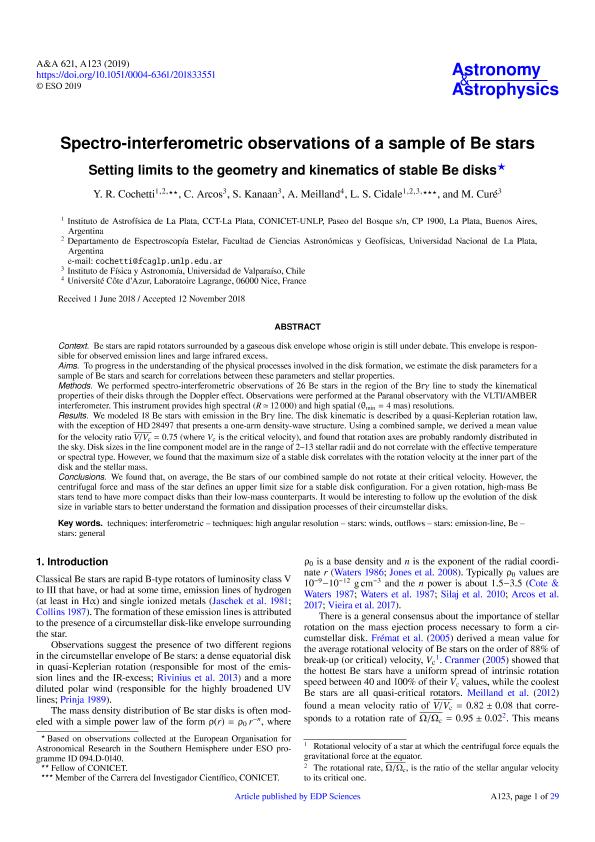
Context. Be stars are rapid rotators surrounded by a gaseous disk envelope whose origin is still under debate. This envelope is responsible for observed emission lines and large infrared excess. Aims. To progress in the understanding of the physical processes involved in the disk formation, we estimate the disk parameters for a sample of Be stars and search for correlations between these parameters and stellar properties. Methods. We performed spectro-interferometric observations of 26 Be stars in the region of the Brγ line to study the kinematical properties of their disks through the Doppler effect. Observations were performed at the Paranal observatory with the VLTI/AMBER interferometer. This instrument provides high spectral (R ' 12 000) and high spatial (θmin = 4 mas) resolutions. Results. We modeled 18 Be stars with emission in the Brγ line. The disk kinematic is described by a quasi-Keplerian rotation law, with the exception of HD 28497 that presents a one-arm density-wave structure. Using a combined sample, we derived a mean value for the velocity ratio V/Vc = 0.75 (where Vc is the critical velocity), and found that rotation axes are probably randomly distributed in the sky. Disk sizes in the line component model are in the range of 2–13 stellar radii and do not correlate with the effective temperature or spectral type. However, we found that the maximum size of a stable disk correlates with the rotation velocity at the inner part of the disk and the stellar mass. Conclusions. We found that, on average, the Be stars of our combined sample do not rotate at their critical velocity. However, the centrifugal force and mass of the star defines an upper limit size for a stable disk configuration. For a given rotation, high-mass Be stars tend to have more compact disks than their low-mass counterparts. It would be interesting to follow up the evolution of the disk size in variable stars to better understand the formation and dissipation processes of their circumstellar disks.
dc.format
application/pdf
dc.language.iso
eng
dc.publisher
EDP Sciences
dc.rights
info:eu-repo/semantics/openAccess
dc.rights.uri
https://creativecommons.org/licenses/by-nc-sa/2.5/ar/
dc.subject
techniques: interferometric
dc.subject
techniques: high angular resolution
dc.subject
stars: winds, outflows
dc.subject
stars: emission-line, Be
dc.subject
stars: general
dc.subject.classification
Astronomía
dc.subject.classification
Ciencias Físicas
dc.subject.classification
CIENCIAS NATURALES Y EXACTAS
dc.title
Spectro-interferometric observations of a sample of Be stars: Setting limits to the geometry and kinematics of stable Be disks
dc.type
info:eu-repo/semantics/article
dc.type
info:ar-repo/semantics/artículo
dc.type
info:eu-repo/semantics/publishedVersion
dc.date.updated
2020-09-25T16:53:12Z
dc.journal.volume
621
dc.journal.number
A123
dc.journal.pagination
1-29
dc.journal.pais
Francia
dc.journal.ciudad
Paris
dc.conicet.avisoEditorial
w
dc.description.fil
Fil: Cochetti, Yanina Roxana. Consejo Nacional de Investigaciones Científicas y Técnicas. Centro Científico Tecnológico Conicet - La Plata. Instituto de Astrofísica La Plata. Universidad Nacional de La Plata. Facultad de Ciencias Astronómicas y Geofísicas. Instituto de Astrofísica La Plata; Argentina. Universidad Nacional de La Plata. Facultad de Ciencias Astronómicas y Geofísicas; Argentina
dc.description.fil
Fil: Arcos, Camilo. Universidad de Valparaíso; Chile
dc.description.fil
Fil: Kanaan, S.. Universidad de Valparaíso; Chile
dc.description.fil
Fil: Meilland, A.. Université Côte d’Azur; Francia
dc.description.fil
Fil: Cidale, Lydia Sonia. Consejo Nacional de Investigaciones Científicas y Técnicas. Centro Científico Tecnológico Conicet - La Plata. Instituto de Astrofísica La Plata. Universidad Nacional de La Plata. Facultad de Ciencias Astronómicas y Geofísicas. Instituto de Astrofísica La Plata; Argentina. Universidad de Valparaíso; Chile
dc.description.fil
Fil: Cure, M.. Universidad de Valparaíso; Chile
dc.journal.title
Astronomy and Astrophysics
dc.relation.alternativeid
info:eu-repo/semantics/altIdentifier/url/https://arxiv.org/abs/1811.11055
dc.relation.alternativeid
info:eu-repo/semantics/altIdentifier/doi/http://dx.doi.org/10.1051/0004-6361/201833551
dc.relation.alternativeid
info:eu-repo/semantics/altIdentifier/url/https://www.aanda.org/articles/aa/full_html/2019/01/aa33551-18/aa33551-18.html
Archivos asociados

Tamaño:
3.140Mb
Formato:
PDF