Artículo
Yucatán carnivorans shed light on the great American biotic interchange
Schubert, Dirk W.; Chatters, James C.; Arroyo Cabrales, Joaquín; Samuels, Joshua X.; Soibelzon, Leopoldo Héctor ; Prevosti, Francisco Juan
; Widga, Christopher; Nava, Alberto; Rissolo, Dominique; Erreguerena, Pilar Luna
; Prevosti, Francisco Juan
; Widga, Christopher; Nava, Alberto; Rissolo, Dominique; Erreguerena, Pilar Luna
; Prevosti, Francisco Juan
; Widga, Christopher; Nava, Alberto; Rissolo, Dominique; Erreguerena, Pilar Luna
Fecha de publicación:
01/05/2019
Editorial:
The Royal Society
Revista:
Biology Letters
ISSN:
1744-9561
Idioma:
Inglés
Tipo de recurso:
Artículo publicado
Clasificación temática:
Resumen
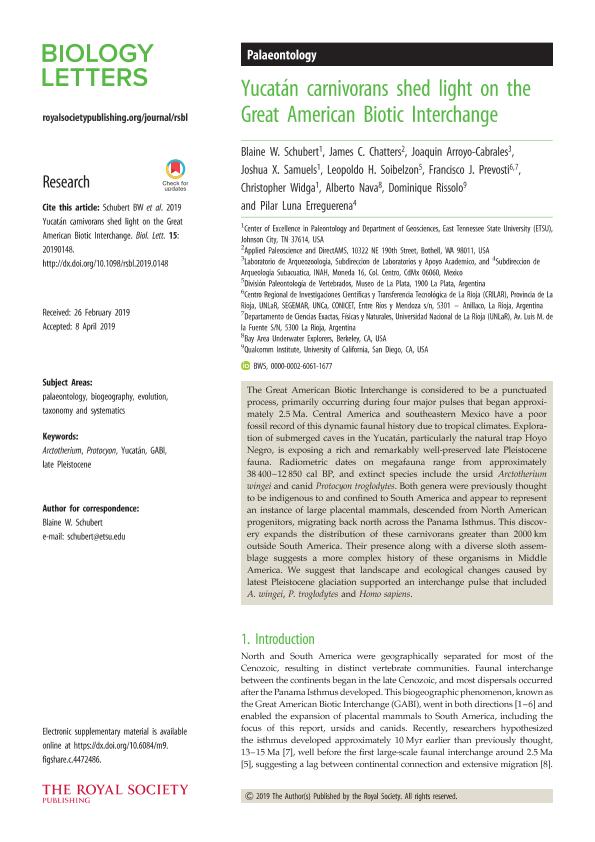
The Great American Biotic Interchange is considered to be a punctuated process, primarily occurring during four major pulses that began approximately 2.5 Ma. Central America and southeastern Mexico have a poor fossil record of this dynamic faunal history due to tropical climates. Exploration of submerged caves in the Yucatán, particularly the natural trap Hoyo Negro, is exposing a rich and remarkably well-preserved late Pleistocene fauna. Radiometric dates on megafauna range from approximately 38 400-12 850 cal BP, and extinct species include the ursid Arctotherium wingei and canid Protocyon troglodytes. Both genera were previously thought to be indigenous to and confined to South America and appear to represent an instance of large placental mammals, descended from North American progenitors, migrating back north across the Panama Isthmus. This discovery expands the distribution of these carnivorans greater than 2000 km outside South America. Their presence along with a diverse sloth assemblage suggests a more complex history of these organisms in Middle America. We suggest that landscape and ecological changes caused by latest Pleistocene glaciation supported an interchange pulse that included A. wingei, P. troglodytes and Homo sapiens.
Palabras clave:
ARCTOTHERIUM
,
GABI
,
LATE PLEISTOCENE
,
PROTOCYON
,
YUCATÁN
Archivos asociados

Tamaño:
745.1Kb
Formato:
PDF
Licencia
 Excepto donde se diga explícitamente, este item se publica bajo la siguiente descripción:
Creative Commons Attribution-NonCommercial-ShareAlike 2.5 Unported (CC BY-NC-SA 2.5)
Excepto donde se diga explícitamente, este item se publica bajo la siguiente descripción:
Creative Commons Attribution-NonCommercial-ShareAlike 2.5 Unported (CC BY-NC-SA 2.5)
Identificadores
Colecciones
Articulos(CRILAR)
Articulos de CENTRO REGIONAL DE INV. CIENTIFICAS Y TRANSFERENCIA TECNOLOGICA DE ANILLACO
Articulos de CENTRO REGIONAL DE INV. CIENTIFICAS Y TRANSFERENCIA TECNOLOGICA DE ANILLACO
Citación
Schubert, Dirk W.; Chatters, James C.; Arroyo Cabrales, Joaquín; Samuels, Joshua X.; Soibelzon, Leopoldo Héctor; et al.; Yucatán carnivorans shed light on the great American biotic interchange; The Royal Society; Biology Letters; 15; 5; 1-5-2019; 1-6
Compartir


Altmétricas