Mostrar el registro sencillo del ítem
dc.contributor.author
Fernández, Mercedes
dc.contributor.author
Muñoz, Nahuel Antu
dc.date.available
2020-12-18T17:10:51Z
dc.date.issued
2019-12
dc.identifier.citation
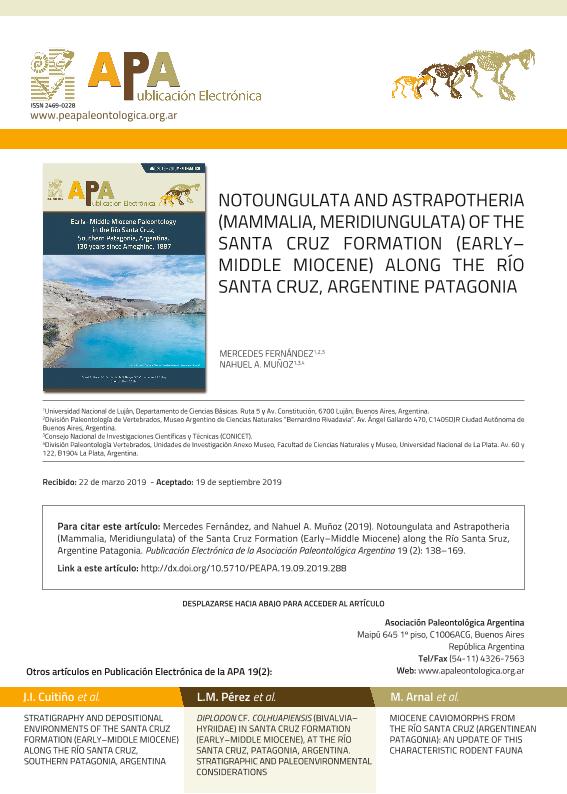
Fernández, Mercedes; Muñoz, Nahuel Antu; Notoungulata and Astrapotheria (Mammalia, Meridiungulata) of the Santa Cruz Formation (Early Miocene) at Río Santa Cruz, Argentine Patagonia; Asociacion Paleontologica Argentina; Publicación Electrónica de la Asociación Paleontológica Argentina; 19; 2; 12-2019; 138-169
dc.identifier.issn
2469-0228
dc.identifier.uri
http://hdl.handle.net/11336/120862
dc.description.abstract
This contribution details new records of Notoungulata and Astrapotheria from the exposures of the Santa Cruz Formation in the Río Santa Cruz (Early-Middle Miocene; Province of Santa Cruz). The astrapothere Astrapotherium sp. Burmeister, the notoungulate toxodonts Homalodotherium sp. Flower, Nesodon sp. Owen and Adinotherium sp. Ameghino, and the typotheres Hegetotherium mirabile Ameghino, Interatherium sp. Ameghino, Protypotherium sp. Ameghino, P. attenuatum Ameghino, P. australe Ameghino and P. praerutilum Ameghino are recognized in the localities Barrancas Blancas and Segundas Barrancas Blancas. Nesodon imbricatus Owen was recorded in the former and Adinotherium ovinum (Owen) in the latter locality. The typothere Pachyrukhos moyani Ameghino was identified only in Segundas Barrancas Blancas, but with numerous specimens. Only the large ungulates Astrapotherium magnum (Owen) and Adinotherium sp. were recorded in Yaten Huageno. At a generic level, Barrancas Blancas and Segundas Barrancas Blancas only differ by the presence of Pachyrukhos Ameghino in the latter; at Yaten Huageno the Typotheria, Homalodotheriidae and Nesodon have not been recorded. The general faunal composition, including the larger samples from Barrancas Blancas and Segundas Barrancas Blancas, matches the record from the better-known Santacrucian localities from the Atlantic coast. This faunal similarity implies that similar environmental conditions prevailed in the two areas, indicating that the localities from Río Santa Cruz, as the Atlantic coastal localities, would have constituted a complex mosaic of open and closed habitats.
dc.description.abstract
Esta contribución involucra un reporte faunístico de los nuevos registros de Notoungulata y Astrapotheria provenientes de los yacimientos de la Formación Santa Cruz del Río Santa Cruz (Mioceno Temprano–Medio; provincia de Santa Cruz). El astrapoterio Astrapotherium sp., los notoungulados toxodontes Homalodotherium sp. Flower, Nesodon sp. Owen y Adinotherium sp. Ameghino, y los tipoterios Hegetotherium mirabile Ameghino, Interatherium sp. Ameghino, Protypotherium sp. Ameghino, P. attenuatum Ameghino, P. australe Ameghino y P. praerutilum Ameghino fueron reconocidos en Barrancas Blancas y Segunda Barrancas Blancas. Las especies Nesodon imbricatus Owen y Adinotherium ovinum (Owen) fueron identificados en la primera y en la segunda localidad, respectivamente. El tipoterio Pachyrukhos moyani Ameghino fue identificado únicamente en Segundas Barrancas Blancas, pero a través de numerosos ejemplares. Solo los ungulados de gran talla Astrapotherium magnum (Owen) y Adinotherium sp. fueron reconocidos en Yaten Huageno. A un nivel supraespecífico, Barrancas Blancas y Segundas Barrancas Blancas difieren por la presencia de Pachyrukhos Ameghino en la segunda, mientras que en Yaten Huageno los Typotheria, Homalodotheriidae y Nesodon no han sido identificados. La composición faunística general, incluyendo las grandes muestras provenientes de Barrancas Blancas y Segundas Barrancas Blancas, coincide con la registrada en las localidades Santacrucenses más conocidas de la costa Atlántica. Esta similitud faunística permite inferir, preliminarmente, similares condiciones ambientales, indicando que las localidades del Río Santa Cruz podrían haber constituido un complejo mosaico de ambientes abiertos y cerrados.
dc.format
application/pdf
dc.language.iso
eng
dc.publisher
Asociacion Paleontologica Argentina
dc.rights
info:eu-repo/semantics/openAccess
dc.rights.uri
https://creativecommons.org/licenses/by-nc/2.5/ar/
dc.subject
AMEGHINO
dc.subject
ASTRAPOTHERES
dc.subject
NOTOUNGULATES
dc.subject
SANTACRUCIAN
dc.subject
TOXODONTIA
dc.subject
TYPOTHERIA
dc.subject.classification
Paleontología
dc.subject.classification
Ciencias de la Tierra y relacionadas con el Medio Ambiente
dc.subject.classification
CIENCIAS NATURALES Y EXACTAS
dc.title
Notoungulata and Astrapotheria (Mammalia, Meridiungulata) of the Santa Cruz Formation (Early Miocene) at Río Santa Cruz, Argentine Patagonia
dc.title
Notoungulata y Astrapotheria (Mammalia, Meridiungulata) de la formación Santa Cruz (Mioceno temprano-medio) a lo largo del Río Santa Cruz, Patagonia Argentina
dc.type
info:eu-repo/semantics/article
dc.type
info:ar-repo/semantics/artículo
dc.type
info:eu-repo/semantics/publishedVersion
dc.date.updated
2020-11-26T17:47:08Z
dc.journal.volume
19
dc.journal.number
2
dc.journal.pagination
138-169
dc.journal.pais
Argentina
dc.journal.ciudad
Ciudad Autónoma de Buenos Aires
dc.description.fil
Fil: Fernández, Mercedes. Consejo Nacional de Investigaciones Científicas y Técnicas. Oficina de Coordinación Administrativa Parque Centenario. Museo Argentino de Ciencias Naturales "Bernardino Rivadavia"; Argentina. Universidad Nacional de Luján. Departamento de Ciencias Básicas; Argentina
dc.description.fil
Fil: Muñoz, Nahuel Antu. Universidad Nacional de Luján. Departamento de Ciencias Básicas; Argentina. Consejo Nacional de Investigaciones Científicas y Técnicas. Centro Científico Tecnológico Conicet - La Plata; Argentina. Universidad Nacional de La Plata. Facultad de Ciencias Naturales y Museo. División Paleontología Vertebrados; Argentina
dc.journal.title
Publicación Electrónica de la Asociación Paleontológica Argentina
dc.relation.alternativeid
info:eu-repo/semantics/altIdentifier/url/http://www.peapaleontologica.org.ar/index.php/peapa/article/view/288
dc.relation.alternativeid
info:eu-repo/semantics/altIdentifier/doi/http://dx.doi.org/10.5710/PEAPA.19.09.2019.288
Archivos asociados

Tamaño:
7.728Mb
Formato:
PDF