Artículo
Central role of G protein Gαi2 and Gαi2 + vomeronasal neurons in balancing territorial and infant-directed aggression of male mice
Trouillet, Anne Charlotte; Keller, Matthieu; Weiss, Jan; Leinders Zufall, Trese; Birnbaumer, Lutz ; Zufall, Frank; Chamero, Pablo
; Zufall, Frank; Chamero, Pablo
Fecha de publicación:
03/2019
Editorial:
National Academy of Sciences
Revista:
Proceedings of the National Academy of Sciences of The United States of America
ISSN:
0027-8424
Idioma:
Inglés
Tipo de recurso:
Artículo publicado
Clasificación temática:
Resumen
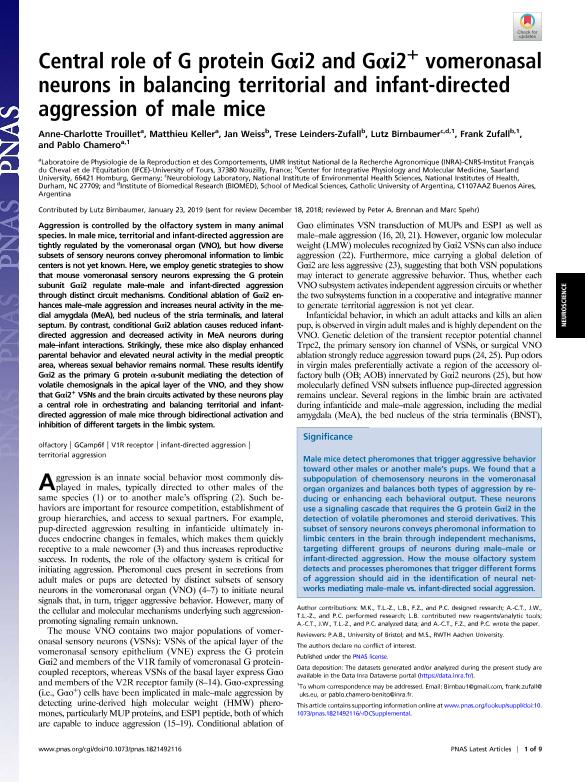
Aggression is controlled by the olfactory system in many animal species. In male mice, territorial and infant-directed aggression are tightly regulated by the vomeronasal organ (VNO), but how diverse subsets of sensory neurons convey pheromonal information to limbic centers is not yet known. Here, we employ genetic strategies to show that mouse vomeronasal sensory neurons expressing the G protein subunit Gαi2 regulate male-male and infant-directed aggression through distinct circuit mechanisms. Conditional ablation of Gαi2 enhances male-male aggression and increases neural activity in the medial amygdala (MeA), bed nucleus of the stria terminalis, and lateral septum. By contrast, conditional Gαi2 ablation causes reduced infantdirected aggression and decreased activity in MeA neurons during male-infant interactions. Strikingly, these mice also display enhanced parental behavior and elevated neural activity in the medial preoptic area, whereas sexual behavior remains normal. These results identify Gαi2 as the primary G protein a-subunit mediating the detection of volatile chemosignals in the apical layer of the VNO, and they show that Gαi2 + VSNs and the brain circuits activated by these neurons play a central role in orchestrating and balancing territorial and infantdirected aggression of male mice through bidirectional activation and inhibition of different targets in the limbic system.
Archivos asociados

Tamaño:
1.683Mb
Formato:
PDF
Licencia
 Excepto donde se diga explícitamente, este item se publica bajo la siguiente descripción:
Creative Commons Attribution-NonCommercial-ShareAlike 2.5 Unported (CC BY-NC-SA 2.5)
Excepto donde se diga explícitamente, este item se publica bajo la siguiente descripción:
Creative Commons Attribution-NonCommercial-ShareAlike 2.5 Unported (CC BY-NC-SA 2.5)
Identificadores
Colecciones
Articulos(BIOMED)
Articulos de INSTITUTO DE INVESTIGACIONES BIOMEDICAS
Articulos de INSTITUTO DE INVESTIGACIONES BIOMEDICAS
Citación
Trouillet, Anne Charlotte; Keller, Matthieu; Weiss, Jan; Leinders Zufall, Trese; Birnbaumer, Lutz; et al.; Central role of G protein Gαi2 and Gαi2 + vomeronasal neurons in balancing territorial and infant-directed aggression of male mice; National Academy of Sciences; Proceedings of the National Academy of Sciences of The United States of America; 116; 11; 3-2019; 5135-5143
Compartir


Altmétricas