Artículo
Contrasting patterns of sexual size dimorphism in the grasshoppers Dichroplus vittatus and D. pratensis (Acrididae, Melanoplinae)

Fecha de publicación:
12/2008
Editorial:
Orthopterists' Society
Revista:
Journal Of Orthoptera Research
ISSN:
1082-6467
Idioma:
Inglés
Tipo de recurso:
Artículo publicado
Clasificación temática:
Resumen
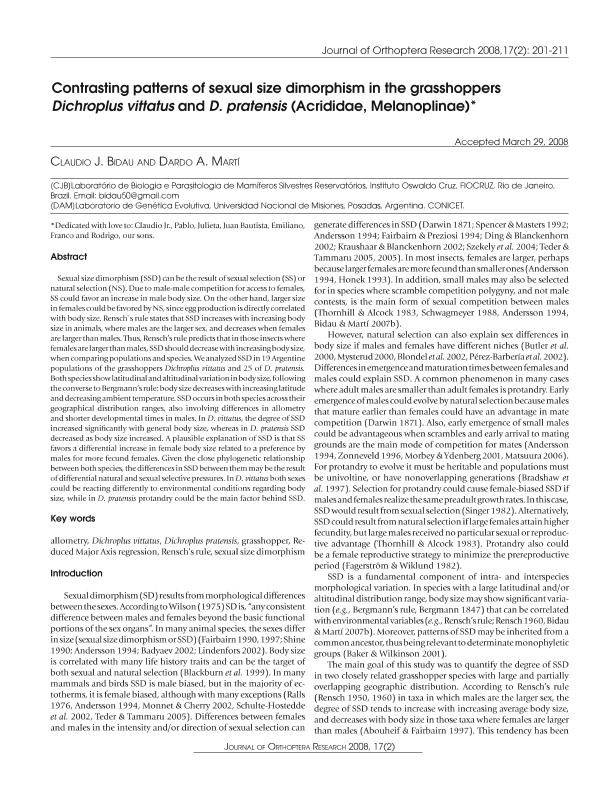
Sexual size dimorphism (SSD) can be the result of sexual selection (SS) or natural selection (NS). Due to male-male competition for access to females, SS could favor an increase in male body size. On the other hand, larger size in females could be favored by NS, since egg production is directly correlated with body size. Rensch`s rule states that SSD increases with increasing body size in animals, where males are the larger sex, and decreases when females are larger than males. Thus, Rensch’s rule predicts that in those insects where females are larger than males, SSD should decrease with increasing body size, when comparing populations and species. We analyzed SSD in 19 Argentine populations of the grasshoppers Dichroplus vittatus and 25 of D. pratensis. Both species show latitudinal and altitudinal variation in body size, following the converse to Bergmann’s rule: body size decreases with increasing latitude and decreasing ambient temperature. SSD occurs in both species across their geographical distribution ranges, also involving differences in allometry and shorter developmental times in males. In D. vittatus, the degree of SSD increased significantly with general body size, whereas in D. pratensis SSD decreased as body size increased. A plausible explanation of SSD is that SS favors a differential increase in female body size related to a preference by males for more fecund females. Given the close phylogenetic relationship between both species, the differences in SSD between them may be the result of differential natural and sexual selective pressures. In D. vittatus both sexes could be reacting differently to environmental conditions regarding body size, while in D. pratensis protandry could be the main factor behind SSD.
Palabras clave:
Sexual Size Dimorphisms
,
Natural Selection
Archivos asociados

Tamaño:
4.479Mb
Formato:
PDF
Licencia
 Excepto donde se diga explícitamente, este item se publica bajo la siguiente descripción:
Creative Commons Attribution-NonCommercial-ShareAlike 2.5 Unported (CC BY-NC-SA 2.5)
Excepto donde se diga explícitamente, este item se publica bajo la siguiente descripción:
Creative Commons Attribution-NonCommercial-ShareAlike 2.5 Unported (CC BY-NC-SA 2.5)
Identificadores
Colecciones
Articulos(CCT - NORDESTE)
Articulos de CTRO.CIENTIFICO TECNOL.CONICET - NORDESTE
Articulos de CTRO.CIENTIFICO TECNOL.CONICET - NORDESTE
Citación
Bidau, Claudio Juan; Marti, Dardo Andrea; Contrasting patterns of sexual size dimorphism in the grasshoppers Dichroplus vittatus and D. pratensis (Acrididae, Melanoplinae); Orthopterists' Society; Journal Of Orthoptera Research; 17; 2; 12-2008; 201-211
Compartir


Altmétricas