Artículo
Stable isotopes in hair reveal dietary protein sources with links to socioeconomic status and health
Ehleringer, James R.; Covarrubias Avalos, Stephannie; Tipple, Brett J.; Valenzuela, Luciano Oscar ; Cerling, Thure E.
; Cerling, Thure E.
Fecha de publicación:
08/2020
Editorial:
National Academy of Sciences
Revista:
Proceedings of the National Academy of Sciences of The United States of America
ISSN:
0027-8424
Idioma:
Inglés
Tipo de recurso:
Artículo publicado
Clasificación temática:
Resumen
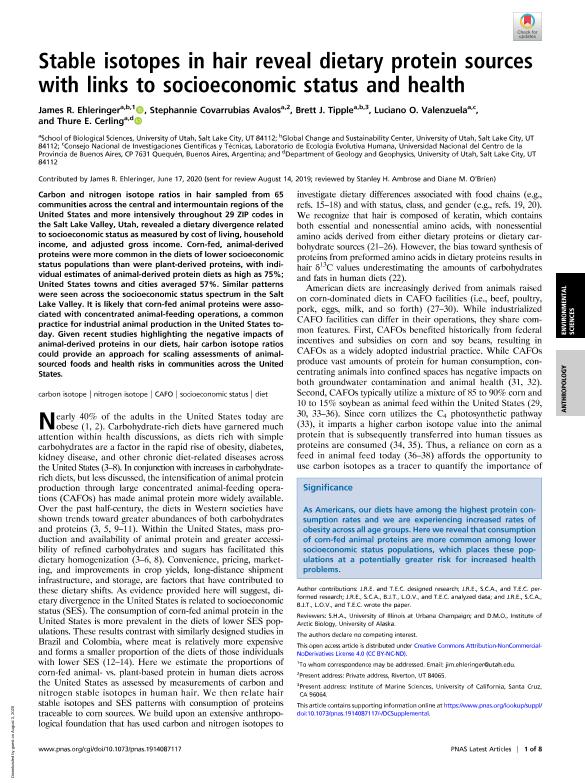
Carbon and nitrogen isotope ratios in hair sampled from 65 communities across the central and intermountain regions of the United States and more intensively throughout 29 ZIP codes in the Salt Lake Valley, Utah, revealed a dietary divergence related to socioeconomic status as measured by cost of living, household income, and adjusted gross income. Corn-fed, animal-derived proteins were more common in the diets of lower socioeconomic status populations than were plant-derived proteins, with individual estimates of animal-derived protein diets as high as 75%; United States towns and cities averaged 57%. Similar patterns were seen across the socioeconomic status spectrum in the Salt Lake Valley. It is likely that corn-fed animal proteins were associated with concentrated animal-feeding operations, a common practice for industrial animal production in the United States today. Given recent studies highlighting the negative impacts of animal-derived proteins in our diets, hair carbon isotope ratios could provide an approach for scaling assessments of animal-sourced foods and health risks in communities across the United States.
Palabras clave:
CARBON ISOTOPE
,
NITROGEN ISOTOPE
,
CAFO
,
SOCIOECONOMIC STATUS
,
DIET
Archivos asociados

Tamaño:
863.3Kb
Formato:
PDF
Licencia
 Excepto donde se diga explícitamente, este item se publica bajo la siguiente descripción:
Creative Commons Attribution-NonCommercial-ShareAlike 2.5 Unported (CC BY-NC-SA 2.5)
Excepto donde se diga explícitamente, este item se publica bajo la siguiente descripción:
Creative Commons Attribution-NonCommercial-ShareAlike 2.5 Unported (CC BY-NC-SA 2.5)
Identificadores
Colecciones
Articulos(CCT - TANDIL)
Articulos de CTRO CIENTIFICO TECNOLOGICO CONICET - TANDIL
Articulos de CTRO CIENTIFICO TECNOLOGICO CONICET - TANDIL
Citación
Ehleringer, James R.; Covarrubias Avalos, Stephannie; Tipple, Brett J.; Valenzuela, Luciano Oscar; Cerling, Thure E.; Stable isotopes in hair reveal dietary protein sources with links to socioeconomic status and health; National Academy of Sciences; Proceedings of the National Academy of Sciences of The United States of America; 117; 33; 8-2020; 1-8
Compartir


Altmétricas