Artículo
Naturally occurring mutations in the thyroglobulin gene
Vono-Toniolo, Jussara; Rivolta, Carina Marcela ; Targovnik, Hector Manuel
; Medeiros-Neto, Geraldo; Kopp, Peter
; Targovnik, Hector Manuel
; Medeiros-Neto, Geraldo; Kopp, Peter
; Targovnik, Hector Manuel
; Medeiros-Neto, Geraldo; Kopp, Peter
Fecha de publicación:
27/09/2005
Editorial:
Mary Ann Liebert
Revista:
Thyroid
ISSN:
1050-7256
Idioma:
Inglés
Tipo de recurso:
Artículo publicado
Clasificación temática:
Resumen
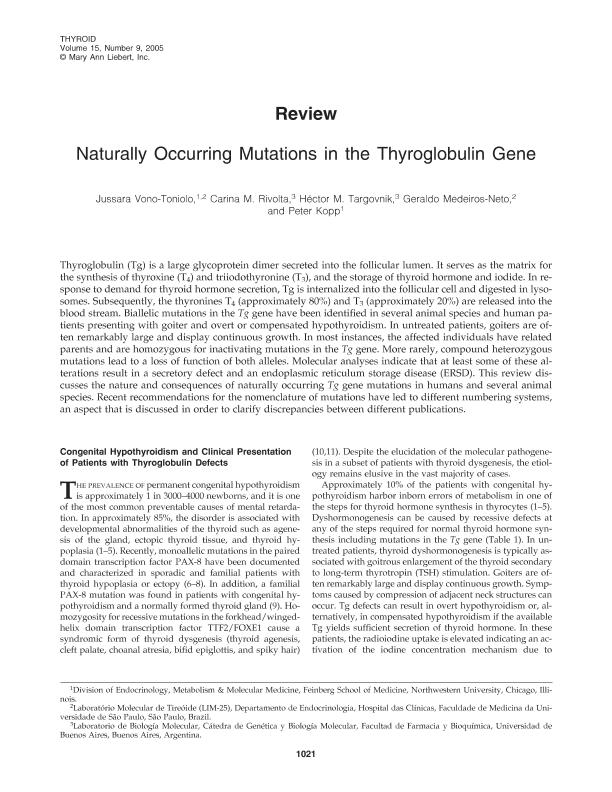
Thyroglobulin (Tg) is a large glycoprotein dimer secreted into the follicular lumen. It serves as the matrix for the synthesis of thyroxine (T 4) and triiodothyronine (T3), and the storage of thyroid hormone and iodide. In response to demand for thyroid hormone secretion, Tg is internalized into the follicular cell and digested in lysosomes. Subsequently, the thyronines T4 (approximately 80%) and T3 (approximately 20%) are released into the blood stream. Biallelic mutations in the Tg gene have been identified in several animal species and human patients presenting with goiter and overt or compensated hypothyroidism. In untreated patients, goiters are often remarkably large and display continuous growth. In most instances, the affected individuals have related parents and are homozygous for inactivating mutations in the Tg gene. More rarely, compound heterozygous mutations lead to a loss of function of both alleles. Molecular analyses indicate that at least some of these alterations result in a secretory defect and an endoplasmic reticulum storage disease (ERSD). This review discusses the nature and consequences of naturally occurring Tg gene mutations in humans and several animal species. Recent recommendations for the nomenclature of mutations have led to different numbering systems, an aspect that is discussed in order to clarify discrepancies between different publications.
Palabras clave:
THYROGLOBULIN
,
HYPOTHYROIDISM
Archivos asociados

Tamaño:
171.5Kb
Formato:
PDF
Licencia
 Excepto donde se diga explícitamente, este item se publica bajo la siguiente descripción:
Creative Commons Attribution-NonCommercial-ShareAlike 2.5 Unported (CC BY-NC-SA 2.5)
Excepto donde se diga explícitamente, este item se publica bajo la siguiente descripción:
Creative Commons Attribution-NonCommercial-ShareAlike 2.5 Unported (CC BY-NC-SA 2.5)
Identificadores
Colecciones
Articulos(INIGEM)
Articulos de INSTITUTO DE INMUNOLOGIA, GENETICA Y METABOLISMO
Articulos de INSTITUTO DE INMUNOLOGIA, GENETICA Y METABOLISMO
Citación
Vono-Toniolo, Jussara; Rivolta, Carina Marcela; Targovnik, Hector Manuel; Medeiros-Neto, Geraldo; Kopp, Peter; Naturally occurring mutations in the thyroglobulin gene; Mary Ann Liebert; Thyroid; 15; 9; 27-9-2005; 1021-1033
Compartir


Altmétricas