Artículo
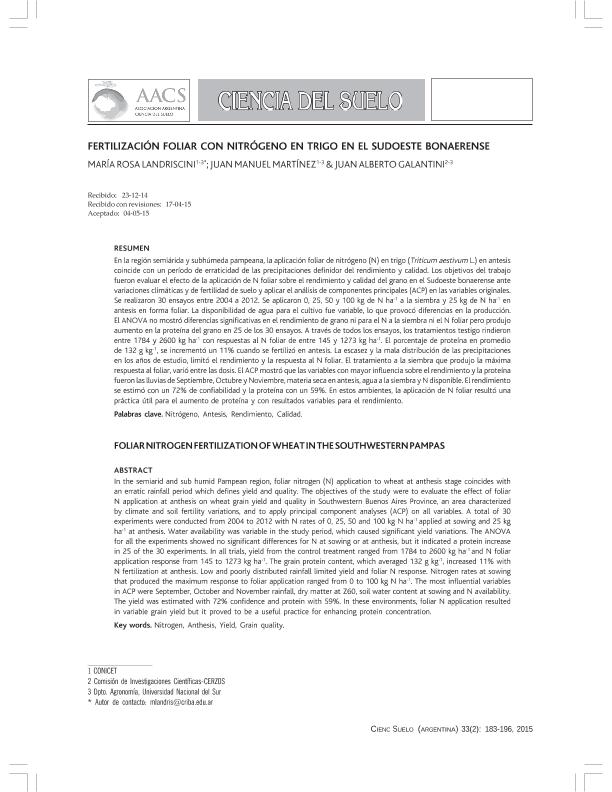
En la región semiárida y subhúmeda pampeana, la aplicación foliar de nitrógeno (N) en trigo (Triticum aestivum L.) en antesis coincide con un período de erraticidad de las precipitaciones definidor del rendimiento y calidad. Los objetivos del trabajo fueron evaluar el efecto de la aplicación de N foliar sobre el rendimiento y calidad del grano en el Sudoeste bonaerense ante variaciones climáticas y de fertilidad de suelo y aplicar el análisis de componentes principales (ACP) en las variables originales. Se realizaron 30 ensayos entre 2004 a 2012. Se aplicaron 0, 25, 50 y 100 kg de N ha-1 a la siembra y 25 kg de N ha-1 en antesis en forma foliar. La disponibilidad de agua para el cultivo fue variable, lo que provocó diferencias en la producción. El ANOVA no mostró diferencias significativas en el rendimiento de grano ni para el N a la siembra ni el N foliar pero produjo aumento en la proteína del grano en 25 de los 30 ensayos. A través de todos los ensayos, los tratamientos testigo rindieron entre 1784 y 2600 kg ha-1 con respuestas al N foliar de entre 145 y 1273 kg ha-1. El porcentaje de proteína en promedio de 132 g kg-1, se incrementó un 11% cuando se fertilizó en antesis. La escasez y la mala distribución de las precipitaciones en los años de estudio, limitó el rendimiento y la respuesta al N foliar. El tratamiento a la siembra que produjo la máxima respuesta al foliar, varió entre las dosis. El ACP mostró que las variables con mayor influencia sobre el rendimiento y la proteína fueron las lluvias de Septiembre, Octubre y Noviembre, materia seca en antesis, agua a la siembra y N disponible. El rendimiento se estimó con un 72% de confiabilidad y la proteína con un 59%. En estos ambientes, la aplicación de N foliar resultó una práctica útil para el aumento de proteína y con resultados variables para el rendimiento. In the semiarid and sub humid Pampean region, foliar nitrogen (N) application to wheat at anthesis stage coincides with an erratic rainfall period which defines yield and quality. The objectives of the study were to evaluate the effect of foliar N application at anthesis on wheat grain yield and quality in Southwestern Buenos Aires Province, an area characterized by climate and soil fertility variations, and to apply principal component analyses (ACP) on all variables. A total of 30 experiments were conducted from 2004 to 2012 with N rates of 0, 25, 50 and 100 kg N ha-1 applied at sowing and 25 kg ha-1 at anthesis. Water availability was variable in the study period, which caused significant yield variations. The ANOVA for all the experiments showed no significant differences for N at sowing or at anthesis, but it indicated a protein increase in 25 of the 30 experiments. In all trials, yield from the control treatment ranged from 1784 to 2600 kg ha-1 and N foliar application response from 145 to 1273 kg ha-1. The grain protein content, which averaged 132 g kg-1, increased 11% with N fertilization at anthesis. Low and poorly distributed rainfall limited yield and foliar N response. Nitrogen rates at sowing that produced the maximum response to foliar application ranged from 0 to 100 kg N ha-1. The most influential variables in ACP were September, October and November rainfall, dry matter at Z60, soil water content at sowing and N availability. The yield was estimated with 72% confidence and protein with 59%. In these environments, foliar N application resulted in variable grain yield but it proved to be a useful practice for enhancing protein concentration.
Fertilizacion foliar con nitrógeno en trigo en el sudoeste bonaerense
Título:
Foliar nitrogen fertilization of wheat in the southwestern pampas

Fecha de publicación:
12/2015
Editorial:
Asociación Argentina de la Ciencia del Suelo
Revista:
Ciencia del Suelo
ISSN:
0326-3169
e-ISSN:
1850-2067
Idioma:
Español
Tipo de recurso:
Artículo publicado
Clasificación temática:
Resumen
Palabras clave:
Nitrógeno
,
Antesis
,
Rendimiento
,
Calidad
Archivos asociados

Tamaño:
666.6Kb
Formato:
PDF
Licencia
 Excepto donde se diga explícitamente, este item se publica bajo la siguiente descripción:
Creative Commons Attribution-NonCommercial-ShareAlike 2.5 Unported (CC BY-NC-SA 2.5)
Excepto donde se diga explícitamente, este item se publica bajo la siguiente descripción:
Creative Commons Attribution-NonCommercial-ShareAlike 2.5 Unported (CC BY-NC-SA 2.5)
Identificadores
Colecciones
Articulos(CERZOS)
Articulos de CENTRO REC.NAT.RENOVABLES DE ZONA SEMIARIDA(I)
Articulos de CENTRO REC.NAT.RENOVABLES DE ZONA SEMIARIDA(I)
Citación
Landriscini, Maria Rosa; Martinez, Juan Manuel; Galantini, Juan Alberto; Fertilizacion foliar con nitrógeno en trigo en el sudoeste bonaerense; Asociación Argentina de la Ciencia del Suelo; Ciencia del Suelo; 33; 2; 12-2015; 183-296
Compartir

