Artículo
Methyl 3-methyl-2H-azirine-2-carboxylate photochemistry studied by matrix-isolation FTIR and DFT calculations
Kaczor, Agnieszka; Gomez Zavaglia, Andrea ; Cardoso, Ana Laura; Pinho E Melo, Teresa M. V. D.; Fausto, Rui
; Cardoso, Ana Laura; Pinho E Melo, Teresa M. V. D.; Fausto, Rui
Fecha de publicación:
08/2006
Editorial:
American Chemical Society
Revista:
Journal of Physical Chemistry A
ISSN:
1089-5639
Idioma:
Inglés
Tipo de recurso:
Artículo publicado
Clasificación temática:
Resumen
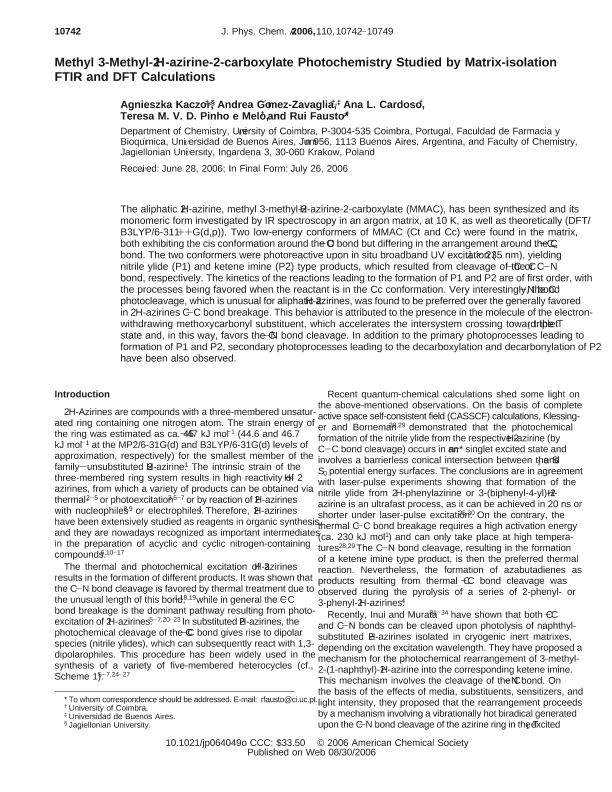
The aliphatic 2H-azirine, methyl 3-methyl-2H-azirine-2-carboxylate (MMAC), has been synthesized and its monomeric form investigated by IR spectroscopy in an argon matrix, at 10 K, as well as theoretically (DFT/B3LYP/6-311++G(d,p)). Two low-energy conformers of MMAC (Ct and Cc) were found in the matrix, both exhibiting the cis conformation around the C-O bond but differing in the arrangement around the C-C(alpha) bond. The two conformers were photoreactive upon in situ broadband UV excitation (lambda > 235 nm), yielding nitrile ylide (P1) and ketene imine (P2) type products, which resulted from cleavage of the C-C or C-N bond, respectively. The kinetics of the reactions leading to the formation of P1 and P2 are of first order, with the processes being favored when the reactant is in the Cc conformation. Very interestingly, the C-N bond photocleavage, which is unusual for aliphatic 2H-azirines, was found to be preferred over the generally favored in 2H-azirines C-C bond breakage. This behavior is attributed to the presence in the molecule of the electron-withdrawing methoxycarbonyl substituent, which accelerates the intersystem crossing toward the T(1) triplet state and, in this way, favors the C-N bond cleavage. In addition to the primary photoprocesses leading to formation of P1 and P2, secondary photoprocesses leading to the decarboxylation and decarbonylation of P2 have been also observed.
Palabras clave:
FTIR
,
photochemistry
,
matrix isolation
Archivos asociados

Tamaño:
195.6Kb
Formato:
PDF
Licencia
 Excepto donde se diga explícitamente, este item se publica bajo la siguiente descripción:
Creative Commons Attribution-NonCommercial-ShareAlike 2.5 Unported (CC BY-NC-SA 2.5)
Excepto donde se diga explícitamente, este item se publica bajo la siguiente descripción:
Creative Commons Attribution-NonCommercial-ShareAlike 2.5 Unported (CC BY-NC-SA 2.5)
Identificadores
Colecciones
Articulos(CIDCA)
Articulos de CENTRO DE INV EN CRIOTECNOLOGIA DE ALIMENTOS (I)
Articulos de CENTRO DE INV EN CRIOTECNOLOGIA DE ALIMENTOS (I)
Citación
Kaczor, Agnieszka; Gomez Zavaglia, Andrea; Cardoso, Ana Laura; Pinho E Melo, Teresa M. V. D.; Fausto, Rui; Methyl 3-methyl-2H-azirine-2-carboxylate photochemistry studied by matrix-isolation FTIR and DFT calculations; American Chemical Society; Journal of Physical Chemistry A; 110; 37; 8-2006; 10742-10749
Compartir


Altmétricas