Artículo
Novel role of VMP1 as modifier of the pancreatic tumor cell response to chemotherapeutic drugs
Gilabert, Mariana; Vaccaro, Maria Ines ; Fernandez Zapico, Martín E.; Calvo, Ezequiel L.; Turrini, Olivier; Secq, Véronique; Garcia, Stéphanie; Moutardier, Vincent; Lomberk, Gwen; Dusetti, Nelson; Urrutia, Raul; Iovanna, Juan L.
; Fernandez Zapico, Martín E.; Calvo, Ezequiel L.; Turrini, Olivier; Secq, Véronique; Garcia, Stéphanie; Moutardier, Vincent; Lomberk, Gwen; Dusetti, Nelson; Urrutia, Raul; Iovanna, Juan L.
Fecha de publicación:
09/2013
Editorial:
Wiley
Revista:
Journal of Cell Physiology
ISSN:
1097-4652
Idioma:
Inglés
Tipo de recurso:
Artículo publicado
Clasificación temática:
Resumen
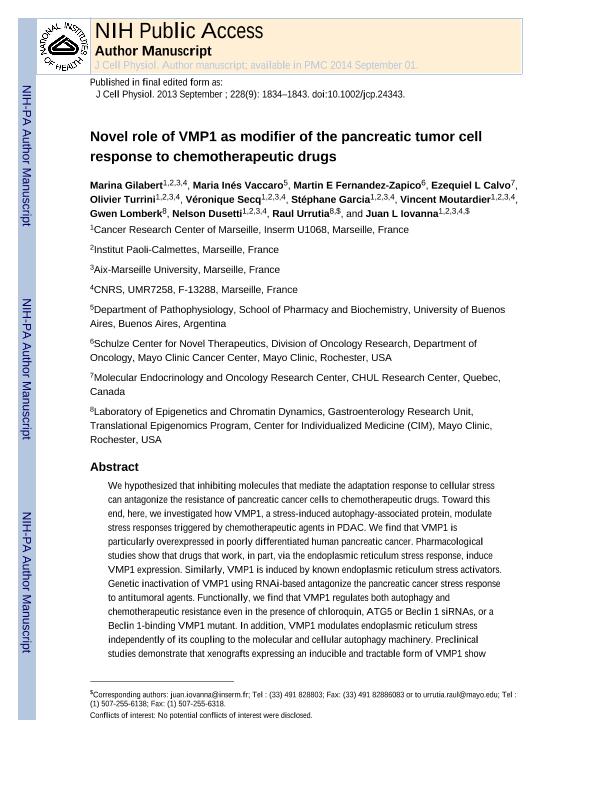
We hypothesized that inhibiting molecules that mediate the adaptation response to cellular stress can antagonize the resistance of pancreatic cancer cells to chemotherapeutic drugs. Toward this end, here, we investigated how VMP1, a stress-induced autophagy-associated protein, modulate stress responses triggered by chemotherapeutic agents in PDAC. We find that VMP1 is particularly over-expressed in poorly differentiated human pancreatic cancer. Pharmacological studies show that drugs that work, in part, via the endoplasmic reticulum stress response, induce VMP1 expression. Similarly, VMP1 is induced by known endoplasmic reticulum stress activators. Genetic inactivation of VMP1 using RNAi-based antagonize the pancreatic cancer stress response to antitumoral agents. Functionally, we find that VMP1 regulates both autophagy and chemotherapeutic resistance even in the presence of chloroquin, ATG5 or Beclin 1 siRNAs, or a Beclin 1-binding VMP1 mutant. In addition, VMP1 modulates endoplasmic reticulum stress independently of its coupling to the molecular and cellular autophagy machinery. Preclinical studies demonstrate that xenografts expressing an inducible and tractable form of VMP1 show increased resistance to the gemcitabine treatment. These results underscore a novel role for VMP1 as a potential therapeutic target for combinatorial therapies aimed at sensitizing pancreatic cancer cells to chemotherapeutic agents as well as provide novel molecular mechanisms to better understand this phenomenon.
Palabras clave:
Vmp1
,
Pancreatic Cancer
,
Autophagy
Archivos asociados

Tamaño:
838.4Kb
Formato:
PDF
Licencia
 Excepto donde se diga explícitamente, este item se publica bajo la siguiente descripción:
Creative Commons Attribution-NonCommercial-ShareAlike 2.5 Unported (CC BY-NC-SA 2.5)
Excepto donde se diga explícitamente, este item se publica bajo la siguiente descripción:
Creative Commons Attribution-NonCommercial-ShareAlike 2.5 Unported (CC BY-NC-SA 2.5)
Identificadores
Colecciones
Articulos(IBIMOL)
Articulos de INSTITUTO DE BIOQUIMICA Y MEDICINA MOLECULAR
Articulos de INSTITUTO DE BIOQUIMICA Y MEDICINA MOLECULAR
Citación
Gilabert, Mariana; Vaccaro, Maria Ines; Fernandez Zapico, Martín E.; Calvo, Ezequiel L.; Turrini, Olivier; et al.; Novel role of VMP1 as modifier of the pancreatic tumor cell response to chemotherapeutic drugs; Wiley; Journal of Cell Physiology; 228; 9; 9-2013; 1834-1843
Compartir


Altmétricas