Artículo
SAR analysis of new dual targeting fluoroquinolones. Implications of the benzenesulfonyl group
Nieto, Marcelo J.; Pierini, Adriana Beatriz ; Singh, Nidhi; McCurdy, Christopher R.; Manzo, Ruben Hilario
; Mazzierie, María
; Singh, Nidhi; McCurdy, Christopher R.; Manzo, Ruben Hilario
; Mazzierie, María
; Singh, Nidhi; McCurdy, Christopher R.; Manzo, Ruben Hilario
; Mazzierie, María
Fecha de publicación:
05/2012
Editorial:
Bentham Science Publishers
Revista:
Medicinal Chemistry
ISSN:
1573-4064
e-ISSN:
1875-6638
Idioma:
Inglés
Tipo de recurso:
Artículo publicado
Clasificación temática:
Resumen
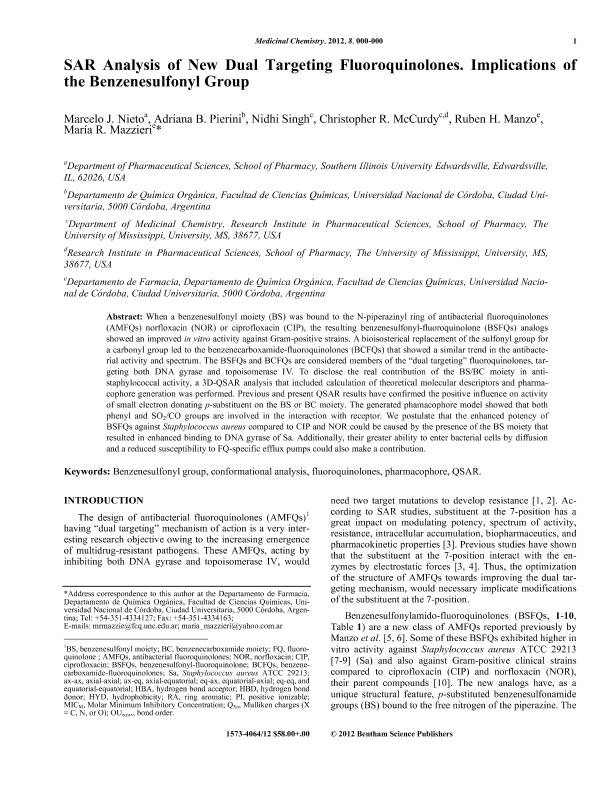
When a benzenesulfonyl moiety (BS) was bound to the N-piperazinyl ring of antibacterial fluoroquinolones (AMFQs) norfloxacin (NOR) or ciprofloxacin (CIP), the resulting benzenesulfonyl-fluoroquinolone (BSFQs) analogs showed an improved in vitro activity against Gram-positive strains. A bioisosterical replacement of the sulfonyl group for a carbonyl group led to the benzenecarboxamide-fluoroquinolones (BCFQs) that showed a similar trend in the antibacterial activity and spectrum. The BSFQs and BCFQs are considered members of the "dual targeting" fluoroquinolones, targeting both DNA gyrase and topoisomerase IV. To disclose the real contribution of the BS/BC moiety in antistaphylococcal activity, a 3D-QSAR analysis that included calculation of theoretical molecular descriptors and pharmacophore generation was performed. Previous and present QSAR results have confirmed the positive influence on activity of small electron donating p-substituent on the BS or BC moiety. The generated phamacophore model showed that both phenyl and SO2/CO groups are involved in the interaction with receptor. We postulate that the enhanced potency of BSFQs against Staphylococcus aureus compared to CIP and NOR could be caused by the presence of the BS moiety that resulted in enhanced binding to DNA gyrase of Sa. Additionally, their greater ability to enter bacterial cells by diffusion and a reduced susceptibility to FQ-specific efflux pumps could also make a contribution.
Archivos asociados

Tamaño:
1.452Mb
Formato:
PDF
Licencia
 Excepto donde se diga explícitamente, este item se publica bajo la siguiente descripción:
Creative Commons Attribution-NonCommercial-ShareAlike 2.5 Unported (CC BY-NC-SA 2.5)
Excepto donde se diga explícitamente, este item se publica bajo la siguiente descripción:
Creative Commons Attribution-NonCommercial-ShareAlike 2.5 Unported (CC BY-NC-SA 2.5)
Identificadores
Colecciones
Articulos(INFIQC)
Articulos de INST.DE INVESTIGACIONES EN FISICO- QUIMICA DE CORDOBA
Articulos de INST.DE INVESTIGACIONES EN FISICO- QUIMICA DE CORDOBA
Articulos(UNITEFA)
Articulos de UNIDAD DE INVESTIGACION Y DESARROLLO EN TECNOLOGIA FARMACEUTICA
Articulos de UNIDAD DE INVESTIGACION Y DESARROLLO EN TECNOLOGIA FARMACEUTICA
Citación
Nieto, Marcelo J.; Pierini, Adriana Beatriz; Singh, Nidhi; McCurdy, Christopher R.; Manzo, Ruben Hilario; et al.; SAR analysis of new dual targeting fluoroquinolones. Implications of the benzenesulfonyl group; Bentham Science Publishers; Medicinal Chemistry; 8; 3; 5-2012; 349-360
Compartir


Altmétricas