Artículo
Development of preconcentration strategies for the simultaneous ultratrace determination of As, Cd and Pb in foods by ICP-OES: knotted-reactor vs. dispersive liquid–liquid microextraction
Martínez Rubio, David; Grindlay, Guillermo; Llaver, Mauricio ; Wuilloud, Rodolfo German
; Mora, Juan
; Wuilloud, Rodolfo German
; Mora, Juan
; Wuilloud, Rodolfo German
; Mora, Juan
Fecha de publicación:
03/2020
Editorial:
Royal Society of Chemistry
Revista:
Journal of Analytical Atomic Spectrometry
ISSN:
0267-9477
Idioma:
Inglés
Tipo de recurso:
Artículo publicado
Clasificación temática:
Resumen
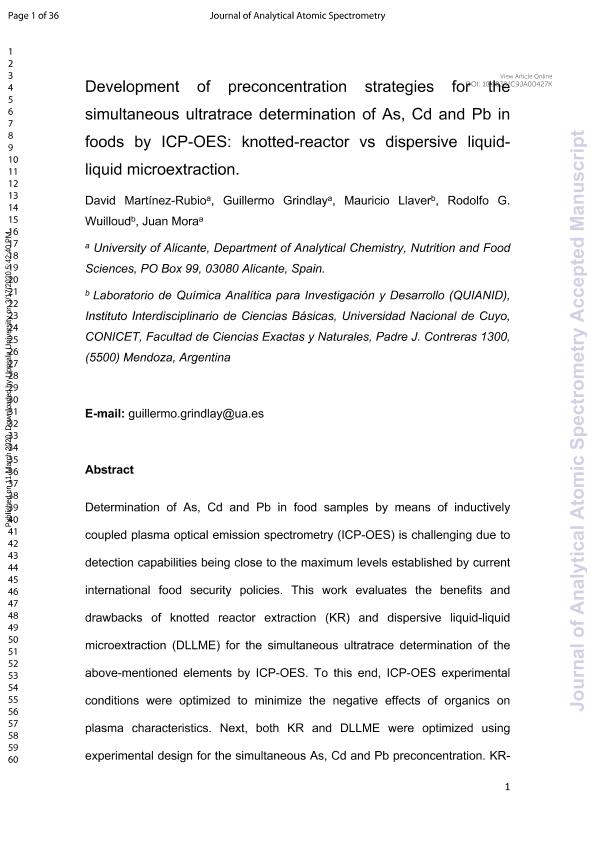
Determination of As, Cd and Pb in food samples by means of inductively coupled plasma optical emission spectrometry (ICP-OES) is challenging due to detection limits being close to the maximum levels established by current international food security policies. This work evaluates the benefits and drawbacks of knotted reactor extraction (KR) and dispersive liquid–liquid microextraction (DLLME) for the simultaneous ultratrace determination of the above-mentioned elements by ICP-OES. To this end, ICP-OES experimental conditions were optimized to minimize the negative effects of organics on plasma characteristics. Next, both KR and DLLME were optimized using the experimental design for the simultaneous As, Cd and Pb preconcentration. KR- and DLLME-ICP-OES methods were compared and applied to the analysis of different food samples, representative of the commodities regulated by the EU policy. Results in this work show that both KR and DLLME allow successful toxic element analysis in foods according to current EU policies. Nevertheless, DLLME is a more attractive approach than KR. First, DLLME allows the simultaneous determination of As, Cd and Pb, while KR is just limited to the last two elements, since As-complexes are not efficiently retained within the system. When compared to conventional ICP-OES analysis (i.e., no preconcentration), DLLME improves limits of detection (LOD) on average by 40-fold for As, Cd and Pb, whereas KR improves it by just 10-fold. For both methodologies, LOD improvement is derived from the preconcentration procedure as well as the beneficial effect of organics on aerosol generation and transport to the plasma compared to aqueous samples. Finally, DLLME affords higher sample throughput and consumption index than KR.
Archivos asociados

Tamaño:
778.4Kb
Formato:
PDF
Licencia
 Excepto donde se diga explícitamente, este item se publica bajo la siguiente descripción:
Creative Commons Attribution-NonCommercial-ShareAlike 2.5 Unported (CC BY-NC-SA 2.5)
Excepto donde se diga explícitamente, este item se publica bajo la siguiente descripción:
Creative Commons Attribution-NonCommercial-ShareAlike 2.5 Unported (CC BY-NC-SA 2.5)
Identificadores
Colecciones
Articulos(ICB)
Articulos de INSTITUTO INTERDISCIPLINARIO DE CIENCIAS BASICAS
Articulos de INSTITUTO INTERDISCIPLINARIO DE CIENCIAS BASICAS
Citación
Martínez Rubio, David; Grindlay, Guillermo; Llaver, Mauricio; Wuilloud, Rodolfo German; Mora, Juan; Development of preconcentration strategies for the simultaneous ultratrace determination of As, Cd and Pb in foods by ICP-OES: knotted-reactor vs. dispersive liquid–liquid microextraction; Royal Society of Chemistry; Journal of Analytical Atomic Spectrometry; 35; 5; 3-2020; 933-942
Compartir


Altmétricas